
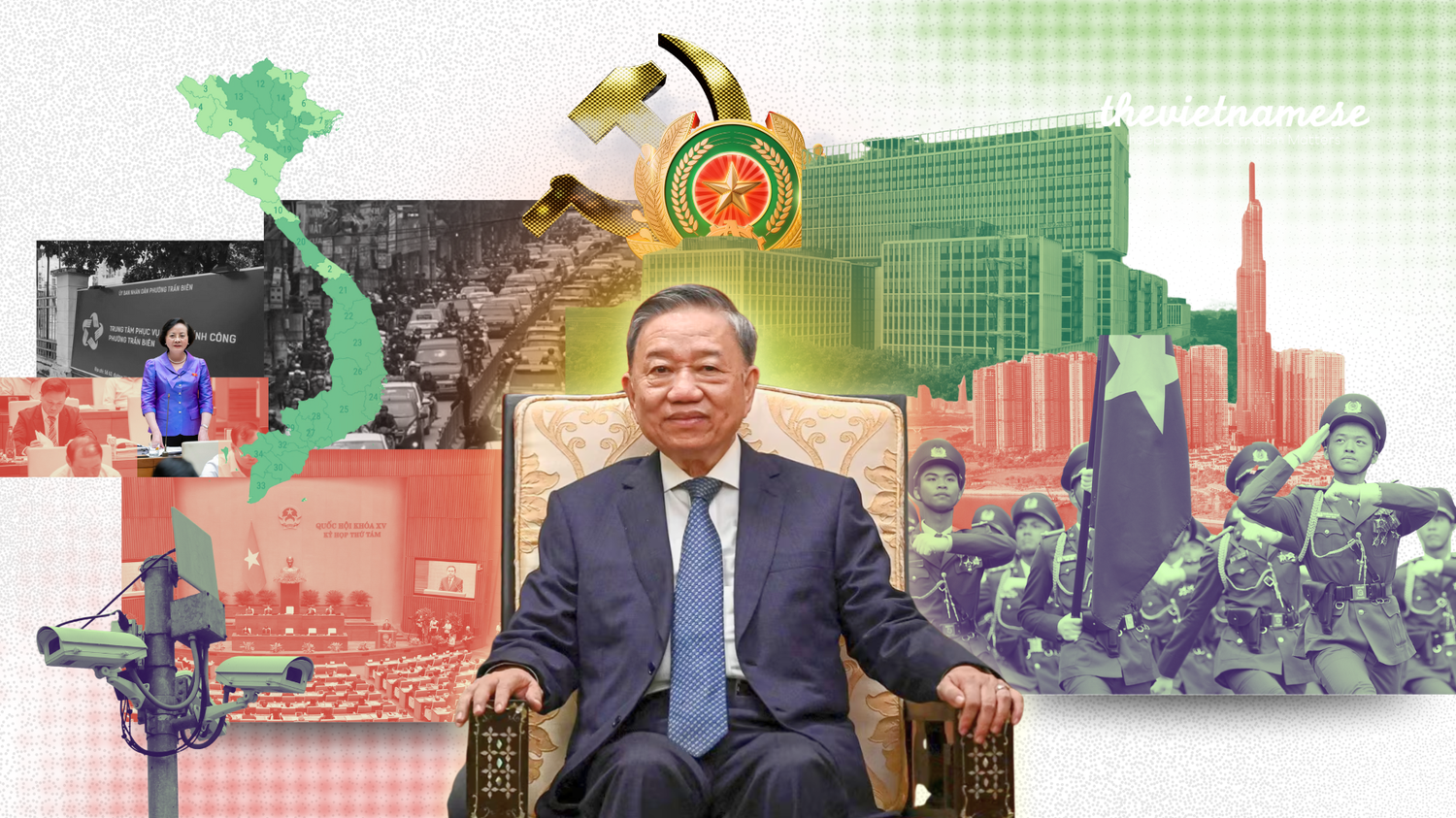
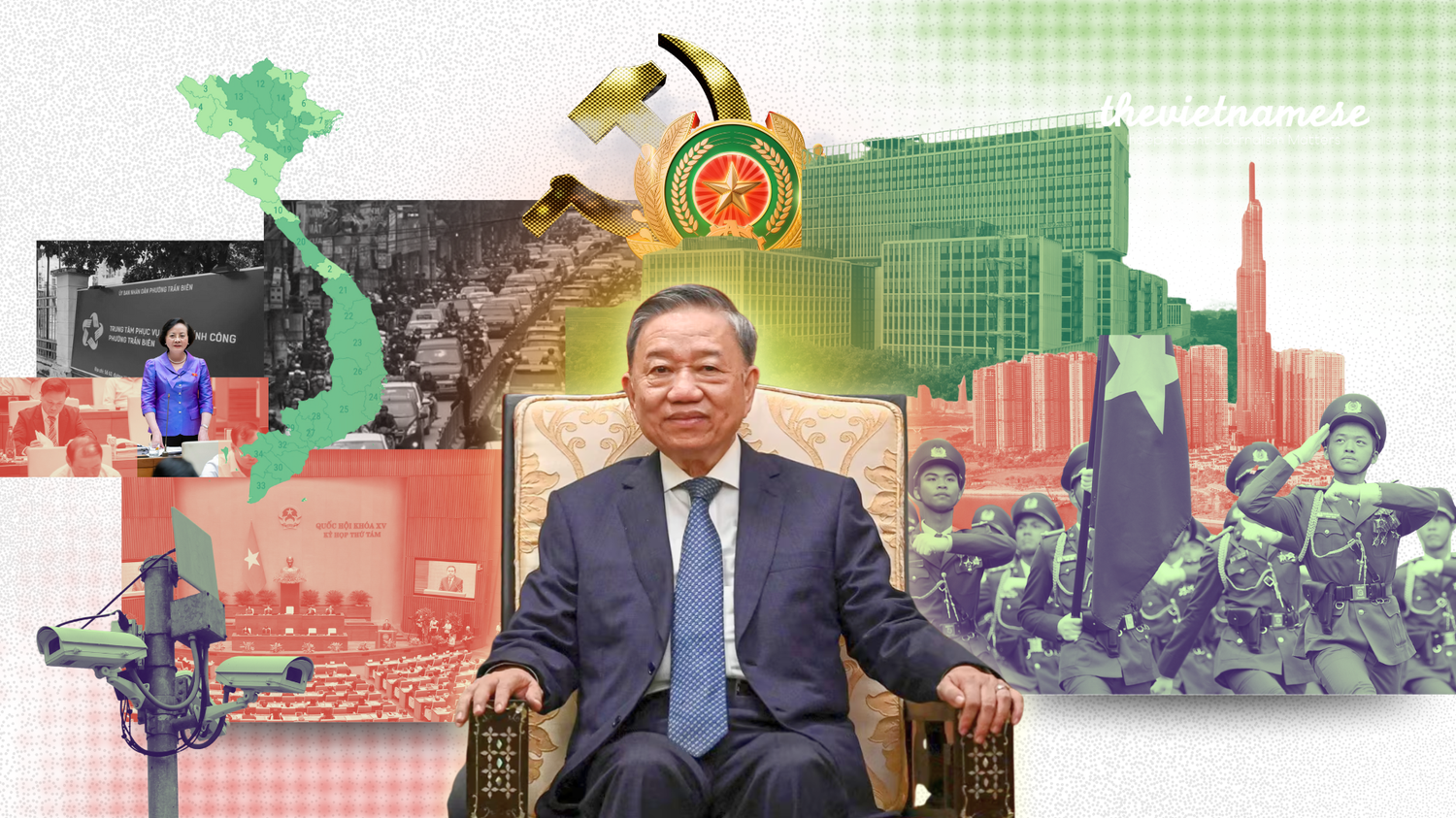
In contrast to the turbulence of 2024—defined by the death of former General Secretary Nguyễn Phú Trọng and unprecedented upheavals at the leadership level—Việt Nam’s politics in 2025 appeared significantly calmer.
However, this tranquility is misleading. While less chaotic than its predecessor, 2025 was far from quiet. If 2024 was a year of shocks, 2025 was the year of resetting order.
This period marked General Secretary Tô Lâm’s first full year in command, allowing him time to firmly establish his leadership style and dictate his tenure’s priorities. A review of the political landscape reveals four distinct shifts, all converging on a single trend: the increasing centralization of power.
Streamlining the System
Early in 2025, General Secretary Tô Lâm made it clear: streamlining the state apparatus could not be delayed until the 14th Party Congress in 2026. [1] Acting on this directive, the Vietnamese political system underwent a rapid and dramatic transformation in the first quarter of the year. [2]
At the central level, the number of Party organs, National Assembly bodies, and government ministries was significantly reduced. At the local level, departments were merged and intermediate administrative layers were excised, leading to a sharp decrease in leadership positions.
Crucially, this bureaucratic contraction doubled as a political purge. The dissolution of agencies forced a wide-scale personnel screening; officials were reshuffled, sidelined, or removed entirely.
While General Secretary Tô Lâm cited government efficiency as the primary motivation [3], the reforms served a deeper strategic purpose. After the turmoil of 2024, the system needed to stabilize.
As noted by the ISEAS–Yusof Ishak Institute, while the 2024–2025 reforms were framed as efficiency measures, their primary function was to tighten organizational discipline, minimize political risk, and rearrange power structures ahead of the 14th Party Congress. [4]
Limiting Local Power
The most visible change of 2025 for the general public was the radical redrawing of the map. Through a series of aggressive mergers, the number of provinces and centrally governed cities was slashed from 63 to 34, while district-level units saw similar consolidations.
This triggered a total restructuring of local governance—from Party committees to security forces. The immediate result was the elimination of numerous provincial-level leadership roles.
While touted as the largest administrative restructuring in decades, the move is fundamentally about power dynamics. Each merged province represents the erasure of a distinct local power base. Consequently, the pool of local leaders capable of building independent influence and challenging central authority has been significantly reduced.
As analysis from ISEAS notes, this consolidation is a strategic effort to curb localism and enhance central coordination ahead of the next political cycle. [5] By reducing the number of administrative units, the central government has effectively streamlined its control. With fewer local fiefdoms to manage, power naturally gravitates upward to the center.
A Dominant Pillar of the System
General Secretary Tô Lâm’s background as the former Minister of Public Security (MPS) makes any shift in that institution politically significant. In 2025, the trend was undeniable: the MPS was expanding its reach into the very machinery of governance.
The MPS has increasingly absorbed functions previously held by civilian ministries. Areas such as population data, digital identity, cybersecurity, and key aspects of economic administration now bear the Ministry’s distinct imprint. Simultaneously, officials with public security backgrounds have been systematically elevated to key leadership roles across the political spectrum. [6]
Structurally, the MPS has tightened its vertical chain of command. The most striking move was the abolition of district-level police, removing an entire intermediate tier of administration.
As noted by ISEAS, this aligns with the broader strategy of centralization. [7] By cutting out the district level, directives flow unimpeded from provincial commanders to the grassroots. While this ensures speed and unity, it comes with a structural risk: the elimination of intermediate checks concentrates immense power—and responsibility—at the very top.
As the MPS expands its control over society, the power to wield it is increasingly withdrawn to the center.
The Constitutional Amendment
While the administrative mergers grabbed headlines, a far more significant development occurred quietly in the background: the constitutional amendment.
Historically a years-long ordeal of debates and consultations, the 2025 revision was finished in record time. From the Politburo’s initial directive to the National Assembly’s unanimous stamp of approval, the entire process took a mere 43 days. [8] Public debate was non-existent; the revision was executed neatly, orderly, and with clinical precision.
Though few in number, the amendments were targeted at the state’s core structure. The most critical change was the constitutional formalization of the two-tier government model (province and commune), which provided the legal basis for abolishing district-level administration.
Furthermore, the revision explicitly codified the role of the Fatherland Front and other socio-political organizations under Party leadership, removing any ambiguity about their subordination to central oversight.
This amendment was the keystone of 2025. It retroactively legalized the streamlined apparatus, the provincial mergers, and the personnel purges. By embedding these shifts into the supreme law, the regime ensured that the transformation of power was a permanent constitutional reality.
Conclusion
In retrospect, the defining political movements of 2025 converged towards centralization.
The strategy was executed on four fronts. Streamlining the apparatus created a leaner system capable of rigorous personnel filtering. The merger of provinces dismantled local power bases, effectively reducing fragmentation. The Ministry of Public Security solidified its position as the central engine of governance, driving stability through control. Finally, the constitutional amendment served as the formal “seal,” permanently locking these structural shifts into place.
This alignment reflects a deliberate prioritization of stability through the concentration of power, setting the stage for the 14th Party Congress. 2025 was not a year of chaos; it was a year of calculated reorganization—executed quietly, firmly, and with absolute intent.
Thúc Kháng wrote this article in Vietnamese and published it in Luật Khoa Magazine on Dec. 23, 2025. Đàm Vĩnh Hằng translated it into English for The Vietnamese Magazine.
References:
- VnExpress. (2025, February 14). Tổng Bí thư giải thích nguyên nhân tinh gọn bộ máy trước Đại hội Đảng 14. vnexpress.net. https://vnexpress.net/tong-bi-thu-giai-thich-nguyen-nhan-tinh-gon-bo-may-truoc-dai-hoi-dang-14-4849055.html
- Đức Nhân, Bình An. (2025, June 25). Toàn cảnh: Diện mạo mới của chính quyền sau tinh gọn. Luật Khoa tạp chí. https://luatkhoa.com/2025/03/toan-canh-dien-mao-moi-cua-chinh-quyen-sau-tinh-gon/
- VnExpress. (2025, February 14). Tổng Bí thư giải thích nguyên nhân tinh gọn bộ máy trước Đại hội Đảng 14. vnexpress.net. https://vnexpress.net/tong-bi-thu-giai-thich-nguyen-nhan-tinh-gon-bo-may-truoc-dai-hoi-dang-14-4849055.html
- Giang, N. K. (2025). Vietnam’s Bureaucratic Reforms: Opportunities and Challenges in “The Era of National Rise” [Journal-article]. No. 14. https://www.iseas.edu.sg/wp-content/uploads/2025/01/ISEAS_Perspective_2025_14.pdf
- See [4]
- Lan, D. (2025, March 25). Tô Lâm xây dựng hệ thống “Công an – Tài phiệt trị” theo mô hình Nga? Tiếng Việt. https://www.rfa.org/vietnamese/thoi-su/2025/03/24/to-lam-cong-an-tai-phiet-viet-nam/
- See [4]
- Hoàng Mai. (2025, October 16). Việt Nam’s path to prosperity: Is “streamlining the apparatus” enough? The Vietnamese Magazine. https://www.thevietnamese.org/2025/10/viet-nams-path-to-prosperity-is-streamlining-the-apparatus-enough/