
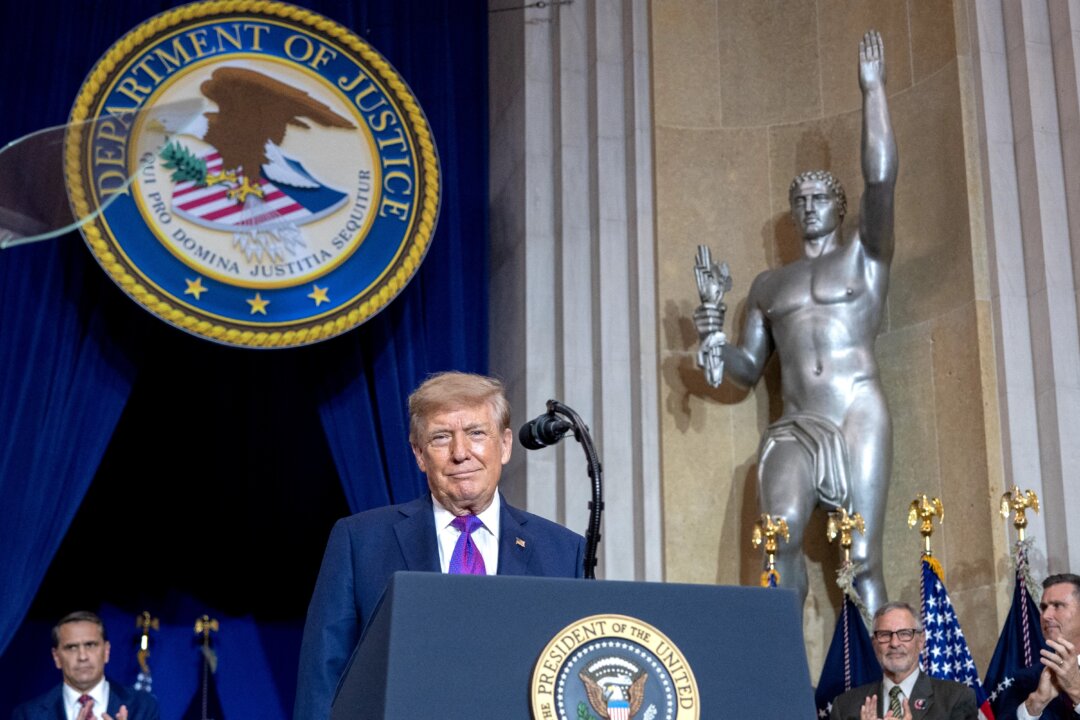
President Donald Trump on Monday urged Congress to approve legislation that would broaden the use of capital punishment, covering both the killers of law-enforcement officers and illegal immigrants who commit murder.
He delivered the request in remarks at the Department of Justice, where he also criticized California Gov. Gavin Newsom’s proposal to convert every pending death sentence in the state to life without parole.
“Finally, at my request, Congressman Brandon Gill has just introduced a new bill to strengthen the death penalty in America,” Trump said. “The Just Punishment for Murder Act will codify many aspects of today’s directive, along with my Executive Order on capital punishment for killers of law enforcement, and it will expand the policy to ensure that illegal alien murderers are likewise sentenced to death. I am calling on Congress to send me that bill without delay.”
Rep. Brandon Gill (R-Texas) introduced H.R. 11132 on Nov. 20. In a post on Monday on X, Gill wrote: “If you murder a law enforcement officer, you should face the death penalty. If you’re an illegal alien who murders an American, you should face the death penalty. I introduced the Just Punishment for Murder Act with President Trump’s full support, and he’s ready to sign it.”
The legislation would put into law key parts of a memorandum Trump signed Monday and of Executive Order 14164, issued on his first day back in office in January 2025. That order told the attorney general to pursue the death penalty in federal capital cases involving the murder of a law-enforcement officer or murder committed by an illegal immigrant present in the country.
Trump signed the memorandum at the Justice Department event. It directs Attorney General Todd Blanche to seek the death penalty in additional categories of federal murder cases: the first-degree murder of a minor; murder committed during rape, sexual abuse, sexual exploitation of a child, or sex trafficking; and murder committed during kidnapping or human trafficking. Trump said the order also directs the attorney general to expedite the execution of federal death sentences.
Trump used the same appearance to attack Newsom’s plan. On Nov. 5, the governor said he would commute every remaining death sentence in California to life imprisonment without the possibility of parole—the largest single act of clemency in the state’s history. The 548 inmates consist of 529 men and 19 women. Newsom’s term ends in January 2027.
“After nearly 30 years in public office, I have come to understand the limits of what government can justly accomplish,” Newsom wrote in an open letter. “I take this action because I firmly believe that state-sanctioned killing is incompatible with California’s values, undermines the foundations of our legal system, and diminishes each of us.”
The California Constitution bars a governor from commuting the sentence of anyone convicted of more than one felony unless the state Supreme Court recommends the commutation and at least four justices agree. Newsom informed the court that 382 of the inmates have multiple felony convictions and asked for a response before year’s end.
District attorneys from nearly 30 California counties—including Los Angeles, San Diego, Riverside, and Sacramento—together with victims’ advocacy groups asked the California Supreme Court in a petition dated Nov. 15 to block the plan. They contend Newsom did not give individual notice to local prosecutors, preventing families from being contacted and offering their views.
Trump called Newsom’s decision “one of the most shocking acts of injustice our country has ever seen.” Newsom responded in a video statement, accusing the president of “pay-to-play” pardons.
“Donald Trump doesn’t oppose mercy; he sells it,” Newsom said.
The January 2025 Executive Order also directed the attorney general to pursue the death penalty for all crimes “of a severity demanding its use,” to ensure that states with capital punishment have enough drugs to carry out lethal injections, and to evaluate the places of imprisonment and conditions of confinement for the 37 federal death-row inmates whose sentences President Joe Biden commuted in December 2024.
California last carried out an execution in 2006. Voters turned down ballot measures to abolish the death penalty in 2012 and again in 2016. Newsom imposed a moratorium on executions in March 2019, soon after he took office.
Trump has continued to push for wider application of the death penalty. In October, he told first responders he had directed the Justice Department to seek capital punishment for those who kill police officers or firefighters.
“We’re bringing the death penalty back for anybody that kills a police officer, by the way, or anybody in law enforcement,” he said at the time at a White House Rose Garden luncheon.
A Gallup poll published this month showed 49 percent of U.S. adults support the death penalty—the first time it has gone below 50 percent since 1971.
Trump said the bill would codify many aspects of the memorandum and the January 2025 order. Its text had not been published on Congress.gov as of Nov. 24, but its official title says it would provide sound capital sentencing procedures, avoid unjustified delays in executing capital sentences, and give finality to state capital judgments subject to U.S. Supreme Court review.
We had a problem loading this article. Please enable javascript or use a different browser. If the issue persists, please visit our help center.