
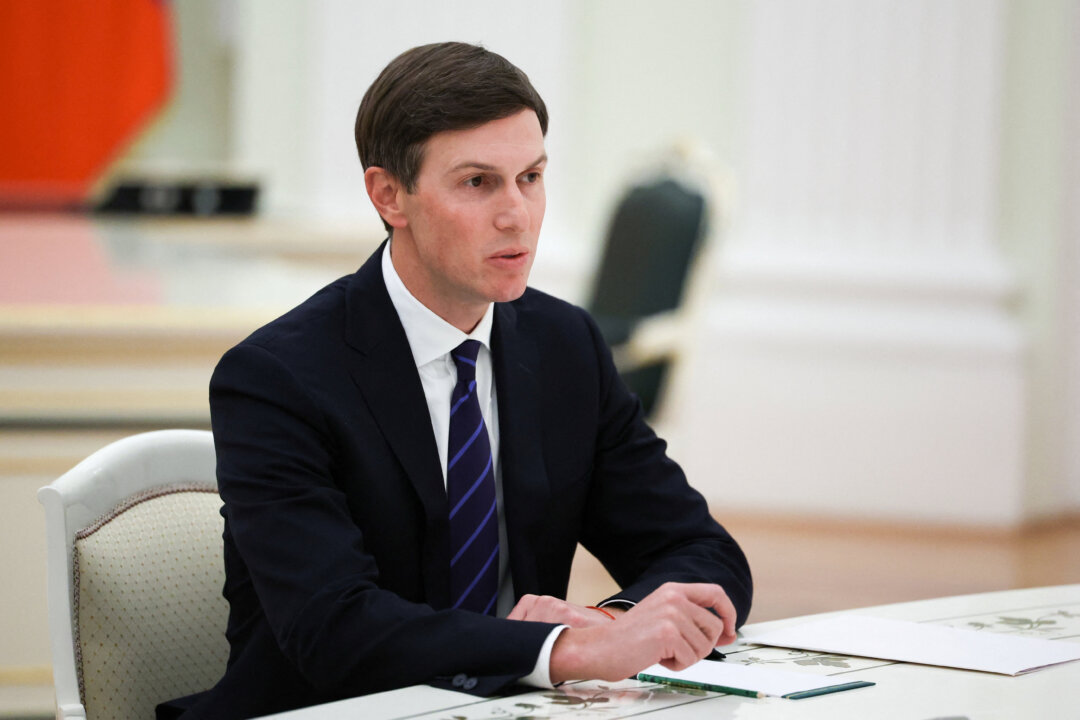
President Donald Trump would be prepared to consider NATO-style security guarantees for Ukraine under certain conditions, U.S. envoy Jared Kushner said on Sunday.
The president’s son-in-law said in a Nov. 22 post on X that a “credible Article 5-like guarantee, backed by deterrence and deconfliction arrangements, could dramatically reduce the risk of another war,” adding that Ukrainian President Volodymyr Zelenskyy “is right that these guarantees must be specific, credible, and clearly documented.”
NATO’s Article 5 states that an armed attack against one or more member states “shall be considered an attack against them all,” and obliges other alliance members to take “such action as it deems necessary, including the use of armed force, to restore and maintain the security of the North Atlantic area.”
Kushner added that Trump would have to approve any such guarantee and subject it to the appropriate constitutional and congressional processes, saying the president “would take such a step only if he believed it clearly served America’s national interests and the broader security arrangements made it highly unlikely that the guarantee would ever be invoked.”
He said the United States is seeking a future in which “Ukraine is secure, Europe is stronger, Russia has confidence that NATO is not seeking confrontation, and NATO and its partners have confidence that Russia will respect the sovereignty and security of its neighbors,” adding that achieving this requires “clear statements of intent, supported by credible, verifiable commitments.”
Kushner further stated that he and U.S. special envoy Steve Witkoff would work to find a common understanding on security architecture with Russia, Ukraine, and Europe over the coming weeks.
Kushner made the post in response to a Nov. 21 post on X by Zelenskyy, in which the Ukrainian leader once again pushed for full NATO membership for Ukraine.
“The Allies understand that the clearest security guarantee for Ukraine is NATO membership,” Zelenskyy said. “And the clearest way to strengthen NATO is to bring Ukraine in. This works for both sides: Ukraine and NATO.”
Russia considers Ukrainian NATO membership a red line in negotiations to end the war. Doing so would dramatically increase the length of border shared by the alliance and Russia, bring NATO military infrastructure closer to Moscow, and potentially limit Russia’s access to the Black Sea. Russia has also continually objected to the eastward expansion of NATO, which was created as a collective defense against the Soviet Union, much of which is now Russia, before it collapsed.
Zelenskyy added that it was not clear what “Article 5-like security guarantees” meant, saying “there are a lot of questions about this ‘like.’ The answers should not just be words – this has to be on paper.” He added that he wanted to be sure any guarantees last beyond the end of Trump’s term in office.
Kushner also floated the idea of NATO-style guarantees at a meeting of the Coalition of the Willing in Berlin on Nov. 19, telling reporters that a “big development” was that he thought the United States had “gotten the Russians comfortable with that concept where any security guarantee for Ukraine would be based on Article 5.”
This notion, however, was rebuffed by Russian Deputy Foreign Minister Sergei Ryabkov in comments to Russian outlet Interfax on Nov. 20.
“I want to say that even finding a formula for quasi-NATO membership for Kyiv and searching for some kind of ‘creative solution’ in this area is unacceptable to us,” he said.
He went on to say that Moscow’s condition that Ukraine not be allowed to join NATO is “irrevocable” and urged Kyiv to recognize this.
“When this happens, I believe the issue of security guarantees can be discussed one way or another,” Ryabkov said. “And without prejudging any decisions in this area, I emphasize that we are not closing ourselves off from dialogue, but from dialogue on Ukraine’s accession to NATO. Once again, this is a completely unacceptable option.”
We had a problem loading this article. Please enable javascript or use a different browser. If the issue persists, please visit our help center.