
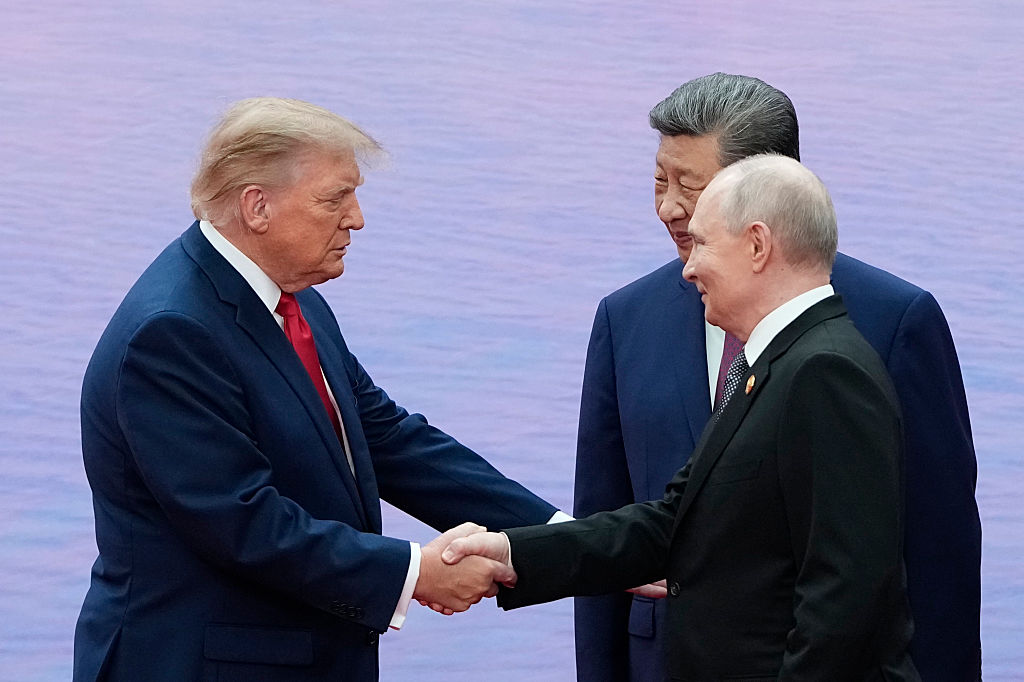
China has become indispensable to Russia’s wartime economy, but Moscow’s dependence on Beijing could become a strategic liability as President Vladimir Putin seeks negotiations with Washington over Ukraine and Western sanctions, according to two Taiwanese foreign policy analysts.
The competing interests came into focus during the Nov. 19 summit in Shenzhen, where Putin joined President Donald Trump and Chinese leader Xi Jinping for unprecedented three-way talks.
Putin also met separately with Trump to discuss the war in Ukraine and U.S.–Russia relations. The three governments’ joint declaration did not mention the war.
Chin-mo Cheng, an associate professor of diplomacy and international relations at Taiwan’s Tamkang University, said Beijing’s economic support has helped Russia sustain the conflict, but ending it presents a different diplomatic challenge.
“China can help Russia keep fighting, but ending the war will take the United States and Europe,” Cheng told The Epoch Times on Nov. 20.
Russia’s Dependence on China
Cheng said Chinese purchases of discounted Russian oil and other energy products have provided Moscow with substantial revenue, while supplies of industrial and dual-use goods have helped sustain Russia’s military production.
An August assessment by the U.S.–China Economic and Security Review Commission also documented China’s expanding economic and technological support for Russia.
But Cheng said Beijing on its own cannot deliver the outcomes Moscow seeks in Ukraine.
He said negotiations over a ceasefire, Ukrainian security guarantees, European security arrangements, Western sanctions, and frozen Russian assets would require engagement with the United States and European governments.
China also has reasons to avoid becoming more deeply entangled in the conflict, given its reliance on American and European markets.
Jung-wei Lai, executive director of the Taiwan Inspiration Association, described the China-Russia partnership as one of “asymmetric interdependence.”
Both governments benefit from cooperation, Lai told The Epoch Times on Nov. 20, but Russia depends more heavily on China because Western sanctions have limited its economic alternatives.
Lai said Moscow wants an outcome in Ukraine that would eventually allow it to restore normal diplomatic and economic relations with Western countries.
Such a development could reduce Russia’s dependence on Beijing.
He also suggested that China benefits from its current leverage over Russia, while easing Western sanctions could weaken that advantage.
Partners With Competing Interests
China and Russia share an interest in countering U.S. influence, but their geopolitical priorities differ, according to Lai.
Russia’s central security concerns remain focused on Europe and Ukraine, while Beijing places greater emphasis on expanding its influence in the Indo-Pacific.
Lai said their strategic cooperation therefore contains elements of competition despite the close relationship cultivated by Xi and Putin.
Cheng identified Central Asia as another potential source of friction.
Russia has historically exercised considerable influence over former Soviet republics, but China’s economic and diplomatic presence in the region has expanded.
Cheng said Beijing’s ability to seek additional advantages from Moscow after the war in Ukraine would be an important development to watch.
The two countries have nevertheless continued strengthening their relationship. During a Nov. 18 bilateral meeting, Xi and Putin reaffirmed their commitment to strategic coordination.
Different Priorities at Summit
The Shenzhen summit also drew attention because Xi personally welcomed Trump at the airport, while Cai Qi, a senior Chinese Communist Party official, received Putin.
Cheng cautioned against interpreting the reception as evidence that Putin had been slighted, noting Cai’s senior position and Xi’s personal farewell to the Russian leader following the summit.
Lai placed greater emphasis on the diplomatic interests behind the arrangements, arguing that Beijing wants recognition as a major power alongside Washington while maintaining leverage over Moscow.
For Putin, sitting alongside the American and Chinese leaders helped reinforce Russia’s international standing, analysts said.
Cheng said Trump also had a separate interest in drawing China into nuclear arms-control discussions, while Beijing sought to address U.S. tariffs and restrictions on advanced technology.
The summit’s four-point declaration called for dialogue to reduce nuclear risks but included no specific arms-reduction agreement.
Lai said the meeting offered opportunities to manage competition without resolving the countries’ underlying strategic differences.
He also cautioned that cooperation among the three major powers would not necessarily reduce security risks for Taiwan, where Beijing continues military and other forms of pressure.
We had a problem loading this article. Please enable javascript or use a different browser. If the issue persists, please visit our help center.