
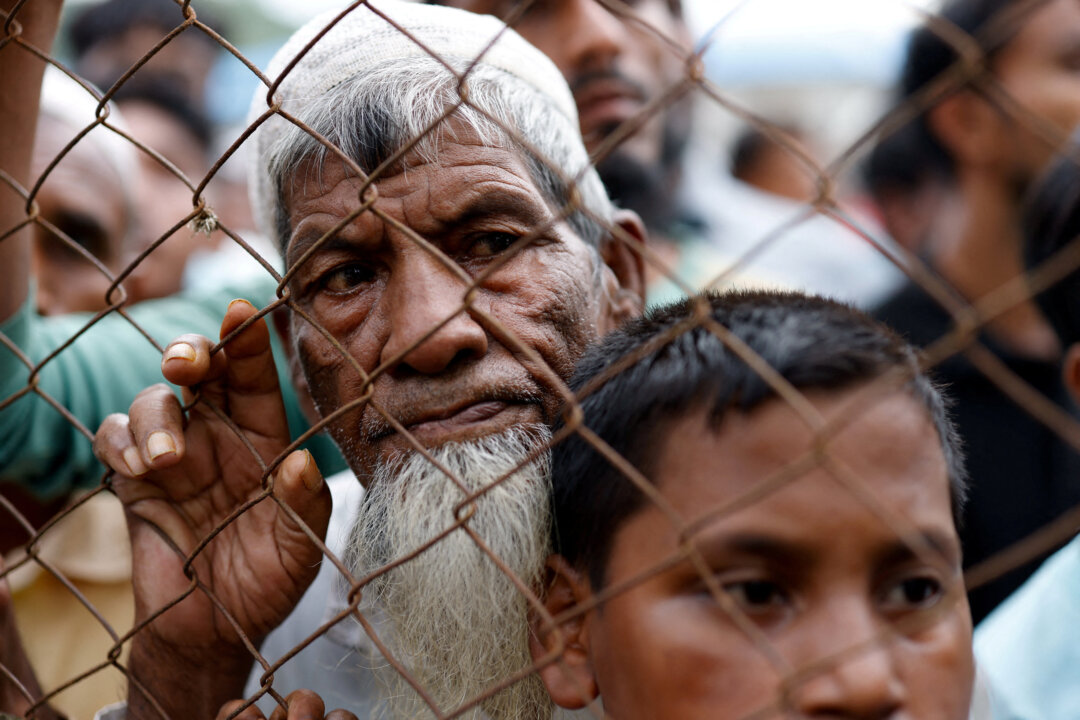
The United Nations’ highest court, the International Court of Justice (ICJ), ruled on Thursday that Burma—also known as Myanmar—had committed genocide against the Rohingya Muslim minority in 2017.
The decision is the first time the ICJ has held a state responsible for genocide, and is only the fourth time since the Holocaust that an international court has accepted that the legal threshold for genocide has been reached.
“The court finds that Myanmar’s security forces killed thousands of Rohingya civilians, perpetrated widespread acts of sexual violence as well as acts of extreme violence against children and attacked fleeing Rohingya,” presiding Judge Yuji Iwasawa said as he read out the decision.
The case against Burma—a majority Buddhist country—was brought seven years ago by Gambia, a predominantly Muslim nation in West Africa.
The Burmese government has previously denied genocide toward the Rohingya, and on Friday presidential spokeswoman Khine Khine Soe called the ruling “unfair.”
“Not all 15 judges agreed with the decision,” Khine told reporters in the capital, Naypyitaw. “So it was not a decision made unanimously. I would say that it was unfair.”
The 191-page ruling was published on Thursday, and stated that the court voted by nine to six that Myanmar “has committed genocide against the Rohingya group in northern Rakhine State.” Among those who voted against was China’s Xue Hanqin.
Xue alone voted against the court’s determination that “the Republic of the Union of Myanmar must cease any ongoing violation of its obligations under Article V of the Convention on the Prevention and Punishment of the Crime of Genocide by enacting legislation giving full effect to its obligations under the Convention.”
The ICJ is a separate body from the International Criminal Court (ICC), which prosecutes individuals for war crimes, crimes against humanity, and genocide. The Trump administration has imposed sanctions against the ICC, which it describes as a “rogue court,” but not the ICJ, which is also based in The Hague, Netherlands.
In a statement, the ICJ said Burma violated its obligation to “prevent the commission of genocide by individuals acting alongside its security forces, but the ICJ ruled that Burma did not “directly and publicly incite the commission of genocide by private persons against the Rohingya group” in northern Rakhine state.
The ICJ ordered Burma to allow the “safe, voluntary and dignified return to their place of residence and reunification of families for the Rohingya” who had been displaced within Burma or abroad, and “to compensate the Rohingya group and its members for the damage caused.”
Navi Pillay, a South African-born jurist who won the Nobel Peace Prize last month, sat as an ad hoc judge on the ICJ panel, and voted in favor of all 13 determinations in the genocide ruling.
The ICJ investigated reports that messages which were posted on Facebook by the non-Rohingya population, including on official Facebook military networks, often “used the derogatory slur ‘kalar’, portraying the Rohingya as dark-skinned foreigners.”
It said a speech in 2017 by Senior Gen. Min Aung Hlaing—who is now the Burmese President—in which he referred to the “Bengali problem” and referred to the Rohingya as threatening to “swallow up” other races, was widely disseminated on Facebook pages. Facebook had around 14 million users in Burma at the time.
In November 2018, Facebook published a commissioned report on its role in Burma.
“The report concludes that, prior to this year, we weren’t doing enough to help prevent our platform from being used to foment division and incite offline violence,” Facebook said. “We agree that we can and should do more.”
In August 2020, Facebook said it was providing data it had preserved since 2018 to the U.N.’s Independent Investigative Mechanism for Myanmar (IIMM), the body that supplied evidence to the ICJ.
The Epoch Times reached out to Meta for comment on the ICJ ruling, but did not receive a response by publication time.
Around 700,000 Muslim Rohingya fled across the border into Bangladesh in 2017, joining others who had previously moved there. There are now around 1.2 million Rohingya living in refugee camps in Cox’s Bazar district in southeastern Bangladesh, Reuters reported.
A crowd of more than 1,000 people cheered as the verdict was relayed live from The Hague on a TV screen in the refugee camp on Thursday.
On Friday, United Nations General Assembly President Khalilur Rahman, who is also the Bangladeshi Foreign Minister, visited a refugee camp near the Myanmar border.
“This verdict is finalized,” Rahman said. “There is no scope for appeal.”
“The International Court of Justice has clarified that the Rohingya will repatriate to their own land,” Rahman said. “This decision is compulsory. Therefore, all parties should work to make it happen.”
The ICJ has no enforcement powers and usually relies on diplomatic pressure.

The ICJ ruling stated that Burma said its forces, the Tatmadaw, had been resisting the Arakan Rohingya Salvation Army (ARSA).
In its ruling, the ICJ said the ARSA were, by August 2017, capable of mounting “approximately 30 co-ordinated violent attacks and mobilizing several thousand Rohingya villagers to participate.” An expert for the Gambia, Michael Newton, said they represented a “serious” insurgency.
The Associated Press and Reuters contributed to this report.
We had a problem loading this article. Please enable javascript or use a different browser. If the issue persists, please visit our help center.