
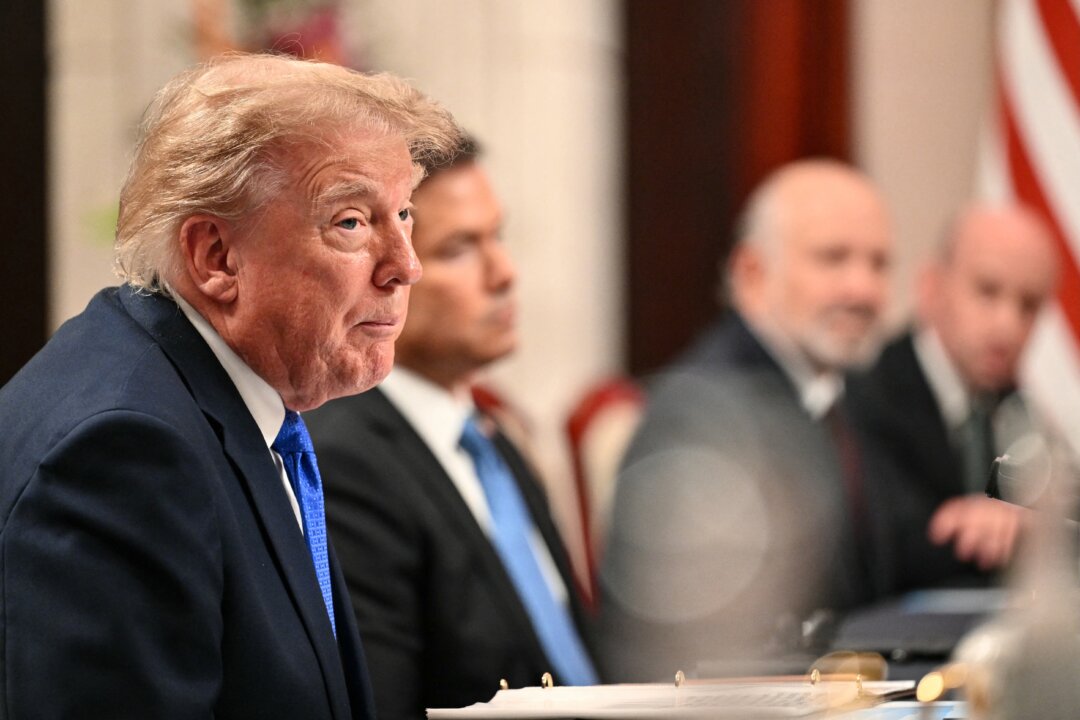
An agreement with China and Russia on limiting nuclear weapons will be hard to achieve, President Donald Trump said Thursday after a trilateral summit with Chinese leader Xi Jinping and Russian President Vladimir Putin.
“I love the concept of it but in terms of pure negotiation, it’s a very hard thing for me as a president to do,” Trump told Reuters over the phone while on Air Force One flying back to Washington from the summit in China.
He noted that Xi agrees on the idea of limiting nuclear weapons, “but at the same time it’s very hard for somebody to say ‘We have 4,000 nuclear weapons, we’ll give up half.’ It’s hard to do.” Trump added that he would continue to pursue such a deal “because it should be done, but it’s hard to do psychologically.”
The leaders’ meeting in Shenzhen concluded around 5:50 p.m. local time. Trump departed about an hour later.
The gathering represented the world’s first-ever sit-down among the heads of the three largest nuclear powers. They issued a four-point peace declaration stating that a nuclear war cannot be won and must never be fought, while pledging dialogue on reducing nuclear risks and preventing the spread of nuclear weapons.
Denuclearization ranked high on Trump’s agenda ahead of the meeting. China, which holds significantly fewer nuclear weapons than the United States or Russia, has been growing its arsenal and has resisted such discussions with Washington and Moscow for years. The push follows February’s expiration of the New Strategic Arms Reduction Treaty (START), the last treaty that capped deployed U.S. and Russian strategic nuclear arms.
U.S. officials want China included in any replacement as Beijing expands toward a projected 1,000 nuclear warheads by the end of the decade, according to the Pentagon’s 2025 assessment.
The trilateral session lasted nearly 90 minutes behind closed doors after the media left the room. Trump also held separate meetings with Xi and Putin earlier that day.
“The three of us have a great deal to discuss, and we’ve already discussed a lot,” Trump said in opening remarks before the closed-door trilateral meeting.
He added that as leaders of three of the world’s largest countries, they shared a special responsibility to keep an open and respectful dialogue on issues affecting the entire planet.
Putin thanked Xi, who hosted the session, for organizing the first meeting in this format. The three countries shared responsibility for maintaining international peace and security, and for strengthening the system of international law built around the United Nations, Putin said.
U.S. officials had flagged nuclear arms as a priority.
“If you’re going to have true arms control, it has to be triparty. It has to be the U.S., Russia, but also China,” U.S. Secretary of State Marco Rubio told reporters in July after meeting China’s top diplomat in Manila. Beijing’s diplomats have long contended that the United States bears the main responsibility for denuclearization given China’s smaller arsenal.
On Oct. 15, Trump told Newsmax that he was discussing denuclearization with the leaders of China and Russia but acknowledged Beijing’s reluctance.
He warned that China could catch up within the next five years. Data from the Federation of American Scientists show Russia leads in total nuclear weapons inventory with 5,420 warheads, while the United States has 5,042, and China has 620.
The New START expired on Feb. 5 after 15 years, leaving no legally binding limits on the world’s two largest nuclear arsenals for the first time in decades.
Putin had offered a one-year extension last year. Trump initially called the idea good but later pushed for a new pact altogether.
We had a problem loading this article. Please enable javascript or use a different browser. If the issue persists, please visit our help center.