
Beijing responded to new U.S. restrictions on artificial intelligence chips by saying it would take countermeasures if the United States imposes more.
Analysts said the latest U.S. restrictions dealt a severe blow to China’s artificial intelligence ambitions, and an AI Cold War is underway.
Following the U.S. Commerce Department’s Bureau of Industry and Security (BIS) announcement of new regulations on advanced AI chips on Nov. 16, which aimed to prevent circumvention of existing U.S. export restrictions through third countries, the Chinese regime’s Ministry of Commerce expressed dissatisfaction and opposition to further restrictions.
The Chinese ministry stated that if the United States “persists in its course of action,” China will take countermeasures.
Chinese AI companies’ stocks plummeted after the new U.S. restrictions were issued.
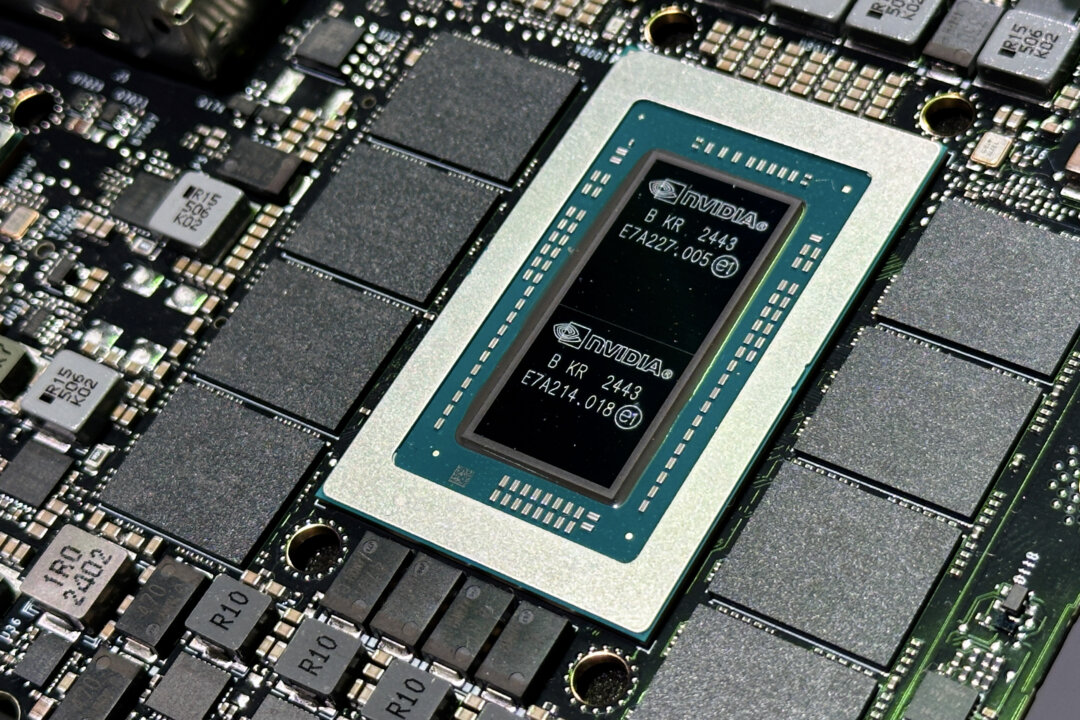
The CCP’s immediate threat of countermeasures shows that recent allegations that companies have circumvented U.S. export controls to ship advanced Nvidia chips to China will negatively affect the Chinese regime’s AI ambitions, according to analysts who spoke with The Epoch Times.
Tang Jingyuan, a U.S.-based China analyst and current affairs commentator, told The Epoch Times that the AI chip allegations have had a profound impact on the United States, compelling it to take decisive measures to sever the Chinese regime’s access to U.S. AI technology.
“This has dealt a devastating, cliff-edge blow to the Chinese AI industry,” said Tang. “In particular, the Chinese regime’s practice of renting computing power in Southeast Asian nations to train its AI models has now been effectively cut off under the new regulations.”
The Chinese Ministry of Commerce’s threat shows that it is currently gripped by a profound sense of panic, Tang said.
By saying that if U.S. “persists in its course of action,” the Chinese Ministry of Commerce likely refers not just to the regulation announced by the U.S. government on Nov. 16, but to a broader range of potential U.S. measures aimed at the Chinese regime, Tang said.
“This includes various bills currently being drafted in Congress, as well as targeted executive orders issued by the U.S. Department of Commerce and the Department of the Treasury,” he said. “The CCP will face an ‘AI winter’ in the very near future.”
In addition to purchasing chips directly, Chinese enterprises also rent computing power through data centers in third countries, and the U.S. government is currently attempting to close off the indirect channels for acquiring technology, Sun Kuo-hsiang, a professor of international affairs and business at Nanhua University in Taiwan, told The Epoch Times.
“What Beijing is truly concerned about is that Washington is constructing a more comprehensive global system to block China’s access to U.S. AI technology,” Sun said. “As for the Chinese Ministry of Commerce’s rhetoric, it’s likely a form of diplomatic pressure—a negotiating tactic—employed ahead of the meeting between Trump and Xi at the [Asia-Pacific Economic Cooperation summit].”
According to Wang He, a U.S.-based China analyst and current affairs commentator, the Chinese Communist Party (CCP) knows that conflict has already been ignited and that it must respond; therefore, it was positioning itself accordingly ahead of the Trump-Xi meeting at the Asia-Pacific Economic Cooperation (APEC) summit.
“The CCP needs advanced Nvidia chips to develop cutting-edge research projects; they require this computing power. So this move by the U.S. government deals a significant blow to them,” he told The Epoch Times.
“The CCP’s countermeasures are extremely limited—consisting primarily of restrictions on rare earths and critical minerals—as they have little else of any real impact at their disposal,” Wang said.
The most effective strategy for the United States is not a blanket cutoff of all technology trade with China, but rather the establishment of a precise, enforceable regulatory framework—backed by allies—that targets high-risk, advanced computing capabilities with military or intelligence applications, Sun said.
“Meanwhile, the United States should accelerate the diversification of supply chains for critical minerals, thereby reducing China’s ability to retaliate by exploiting economic dependencies,” he said.
The U.S. side has its own possible countermeasures, Tang said. “The CCP relies on the United States and not just for chips. It is also entirely dependent on the United States in areas such as aircraft engines and many other sectors. I believe the United States still holds cards—additional leverage—that it can use to contend with the CCP.”

Xi said in a speech at APEC that the Chinese regime is against trade protectionism and barriers.
The meeting between Trump and Xi at APEC might ease the dispute over chip exports, but the likelihood of truly resolving the structural conflict between the two nations remains extremely low, Sun said.
“The reason lies in the fact that the United States views advanced chips and AI computing power as core national security assets essential for maintaining its military, intelligence, and technological superiority. Meanwhile, China regards breaking through technological blockades as a vital strategic objective for achieving technological self-reliance and national development. The interests of the two sides are fundamentally in conflict,” Sun explained.
When it comes to U.S.–China relations, the most critical issue right now is the AI chips, Tang said. “The U.S. and China are operating within an atmosphere akin to a Cold War—much like the Cold War between the United States and the Soviet Union back in the day,” he added, likening the AI chips of today to the nuclear weapons of the Cold War period.
After the United States imposes restrictions, the CCP can still obtain equivalent computing power domestically, but it will have to pay more. It will take more than five to 10 years for domestic chips to reach the level of those from Nvidia and Taiwan Semiconductor Manufacturing Company, and they may not succeed, Su Tzu-yun, researcher and director of Division of Defense Strategy and Resources at Taiwan’s Institute for National Defense and Security Research, told The Epoch Times.
In the long run, the U.S.-China competition will lead to the formation of two systems in the global AI industry chain, which amounts to a digital Cold War, Su said.
“The United States leads a set of digital AI in the free world, and AI in the communist world led by China has a different development direction. The free world may be more advanced.”
Luo Ya and Reuters contributed to this report.
We had a problem loading this article. Please enable javascript or use a different browser. If the issue persists, please visit our help center.