
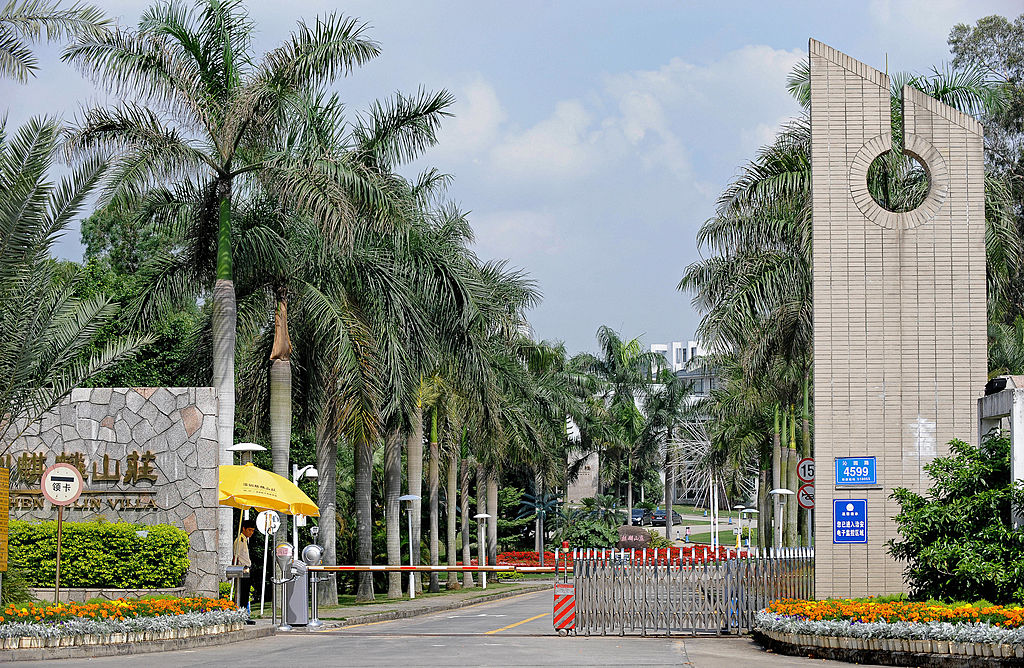
The planned Nov. 19 meeting of President Donald Trump, Chinese leader Xi Jinping, and Russian President Vladimir Putin at Shenzhen’s Kylin Villa is drawing attention not only because it would mark the first face-to-face summit among the three leaders, but also because of the unusual venue chosen by Beijing.
Unlike the main venues for the 2026 Asia-Pacific Economic Cooperation (APEC) meetings, Kylin Villa is a secluded government reception complex known for hosting senior Chinese Communist Party (CCP) officials and foreign dignitaries. Its restricted access and extensive security arrangements make it suitable for sensitive diplomatic discussions.
The meeting would also mark the third Trump–Xi encounter this year. However, analysts who spoke to The Epoch Times are skeptical that the three countries will reach substantive agreements, given their competing strategic interests.
A Retreat for CCP Elites
Kylin Villa, located in Shenzhen’s Nanshan District, covers approximately 380,000 square meters (94 acres). The complex features European-style villas and conference facilities surrounded by hills and water.
The regime constructed Kylin Villa and Wuzhou Guest House in 1996. Kylin Villa was primarily intended to host senior CCP officials, while Wuzhou Guest House focused on large international conferences.
Sometimes described as Shenzhen’s equivalent of Beijing’s Diaoyutai State Guesthouse, Kylin Villa serves as an important reception facility. Although parts of the property operate commercially, its primary function is official hospitality.
The complex has hosted numerous senior CCP figures. Xi Jinping’s father, Xi Zhongxun, who helped establish the Shenzhen Special Economic Zone, spent about 12 years in Shenzhen during his later life. According to “The Biography of Xi Zhongxun” published by CCP-owned Central Literature Publishing House, he visited Kylin Villa and Shenzhen’s Fairy Lake Botanical Garden to rest and take walks after being diagnosed with cancer.
Former Chinese leader Deng Xiaoping’s wife, Zhuo Lin, also lived at the complex, according to Zhengzhijian, a political news column affiliated with the CCP’s propaganda media Beijing Youth Daily.
Security Surrounding the Summit
Security around Kylin Villa has been particularly stringent ahead of the meeting. On Nov. 16 and 17, police were stationed along roads leading to the complex, with unauthorized entry and photography prohibited.
During the summit, police are expected to be positioned around the compound at intervals of about 100 meters, while plainclothes officers conduct frequent patrols. Nearby tourist attractions have been closed, and public bus services in the area are suspended from Nov. 16 through Nov. 20.
U.S.-based China affairs commentator Li Linyi told The Epoch Times that the venue reflects the CCP’s governing model, in which Party authority takes precedence over everything else.
“Even an international summit must be held inside a completely controlled Party-state facility, rather than a more open public venue or an internationally standardized conference center,” Li said, adding that the arrangement highlights the regime’s fear of transparency and contact with ordinary citizens.
What to Expect
Trump is expected to attend APEC leaders’ activities in the morning before meeting Xi at Kylin Villa around 12:45 p.m., according to the itinerary posted by the White House press pool. Putin is expected to join them at approximately 2:30 p.m. for a three-way meeting lasting about an hour. Trump is then expected to return to the United States.
Only designated media outlets will be permitted to cover the meetings.
Shen Ming-shih, a research fellow at Taiwan’s Institute for National Defense and Security Research, told The Epoch Times that Trump might make proposals in front of cameras without prior coordination.
Beijing, Shen said, would seek to use its position as host to control the meeting’s duration and the information released afterward. The three governments may issue separate statements rather than a joint statement.
“Without a joint statement, there is naturally no consensus,” Shen said.
The leaders could discuss the war in Ukraine, developments involving Iran, nuclear arms reductions, and AI.
U.S.-based Chinese author and political commentator Chen Pokong told The Epoch Times that the meeting was unlikely to achieve anything substantive and could ultimately amount to little more than a symbolic gathering.
Shen likewise said the three countries’ differences over core security interests would make binding agreements difficult. He suggested the meeting might instead serve domestic political and geopolitical purposes, allowing each leader to gauge the others’ positions and strategic intentions.
The summit’s significance, therefore, may lie less in any diplomatic breakthrough than in the opportunity for the three leaders to assess one another’s priorities and limits.
Tang Bing contributed to this report.
We had a problem loading this article. Please enable javascript or use a different browser. If the issue persists, please visit our help center.