
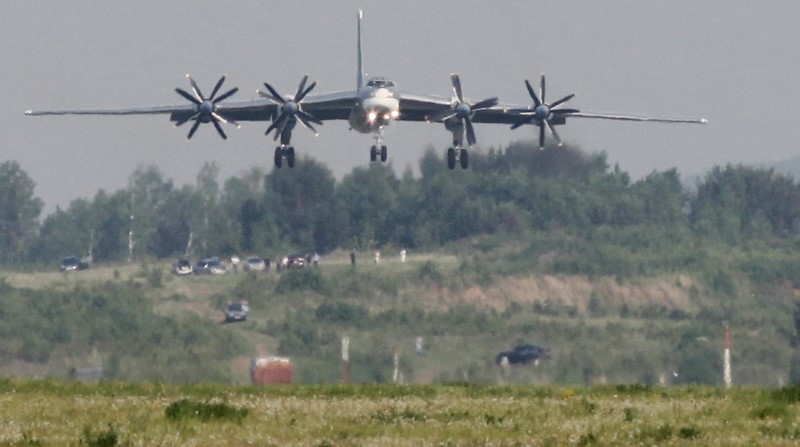
Russian military aircraft carried out extensive flights over East Asia before two strategic bombers arrived in Vietnam on Nov. 17, triggering air-defense responses from Japan, South Korea, and Taiwan.
An analysis of satellite imagery and aircraft movements by aviation-tracking group AviVector identified five Russian Tu-95MS strategic bombers operating from Ukrainka Air Base in Russia’s Far East. Three conducted an approximately 11-hour training flight over the Sea of Japan, while two others continued south to Vietnam.
The three bombers conducting the training flight were supported by three Il-78M aerial-refueling aircraft. An A-50U military radar aircraft operating from Vladivostok also flew over the Sea of Japan, according to AviVector.
Japan scrambled fighter jets after two aircraft believed to be Russian separately entered its territorial airspace near Okinoshima Island, off the coast of Kyushu in southwestern Japan, early on Nov. 17, according to the Japanese Defense Ministry.
The aircraft remained in Japanese airspace for approximately three minutes each before continuing through the Tsushima Strait and later flying between Japan’s Yonaguni Island and Taiwan, the ministry said.
Taiwan’s Defense Ministry said two Russian military aircraft entered its air defense identification zone from the northeast, flew east of the island, and exited south of Taitung. South Korea also deployed fighter jets in response to Russian aircraft entering its identification zone. The aircraft did not violate South Korean territorial airspace.
An air defense identification zone extends beyond a country’s sovereign airspace and is used to monitor approaching aircraft. Taiwan did not report an airspace violation.
Japan lodged a strong diplomatic protest with Moscow. Japanese Defense Minister Shinjiro Koizumi called the incursions a serious violation of Japan’s sovereignty and said the aircraft’s intentions were unclear.
Taiwan’s deputy chief of the General Staff, Gen. Huang Chih-wei, condemned the flights on Nov. 18, saying they threatened regional stability and were detrimental to peace across the Taiwan Strait.
China–Russia Military Cooperation
The Russian flights came a day before Chinese leader Xi Jinping and Russian President Vladimir Putin met in Shenzhen on Nov. 18, ahead of scheduled three-way talks with President Donald Trump the following day.
During their bilateral meeting, Xi called for using existing channels between the two countries’ governments, legislatures, militaries, and political parties to carry out agreements reached by their leaders, according to China’s Foreign Ministry.
Putin called for closer strategic coordination with Beijing, describing the partnership as working “back to back.”
Earlier, at the Asia-Pacific Economic Cooperation CEO Summit, Putin expressed expectations of significant benefits from the planned meeting with Trump and Xi.
China and Russia have conducted repeated joint long-range bomber patrols near Japan.
In December 2025, Japan’s Defense Ministry documented two Russian Tu-95 bombers joining two Chinese H-6 bombers over the East China Sea before flying together toward the Pacific.
No Chinese aircraft have been publicly identified as participating in the latest Russian operation, and neither Beijing nor Moscow has publicly linked the flights to the Xi–Putin meeting or the upcoming summit with Trump.
Russian Aircraft Deployment Extends to Southeast Asia
The two Tu-95MS bombers that AviVector tracked to Vietnam were identified as RF-94202 and RF-94188. Both were documented at Da Nang International Airport on Nov. 17.
Satellite imagery dated Nov. 17 also captured two accompanying transport aircraft. AviVector identified them as Il-76MD military transports. One was identified as a modernized Il-76MD-90A.
The Tu-95MS is a long-range strategic bomber capable of carrying cruise missiles, including nuclear-armed weapons.
AviVector’s flight-path reconstruction links the southbound bombers with the route past Japan and Taiwan. Neither Japan nor Taiwan publicly identified the aircraft in their air-defense incidents by type.
Vietnam has longstanding military ties with Moscow, which has supplied much of its military equipment. Hanoi also maintains relations with Washington and Beijing, despite maritime disputes with China in the South China Sea.
On Nov. 18, Vietnamese leader To Lam met Putin in Shenzhen, where the two discussed expanding bilateral cooperation.
According to Vietnam’s government, Putin described the country as a trusted and priority partner in Russia’s Asia-Pacific policy.
The Russian deployment has also revived questions about Vietnam’s willingness to accommodate Moscow’s long-range military aviation. In 2015, Washington urged Hanoi to prevent Russia from using access to Cam Ranh Bay for activities that could increase regional tensions.
Vietnam’s official account of the latest Putin meeting did not mention the bombers at Da Nang. Neither Hanoi nor Moscow has publicly explained the mission or disclosed whether the aircraft’s visit is part of a broader arrangement for Russian military access.
We had a problem loading this article. Please enable javascript or use a different browser. If the issue persists, please visit our help center.