
China’s increasingly frequent military exercises around Taiwan could allow Beijing time to prepare for an attack without detection by the United States and its allies, according to a new security report released by Institute for Indo-Pacific Security (IIPS) researchers.
The warning comes after the Secretary-General of Taiwan’s National Security Council Joseph Wu reported that communist China deployed more than 100 naval and coast guard vessels across the western Pacific in late October and early November. Analysts differ on whether the geographically widespread operations were part of a single coordinated military exercise.
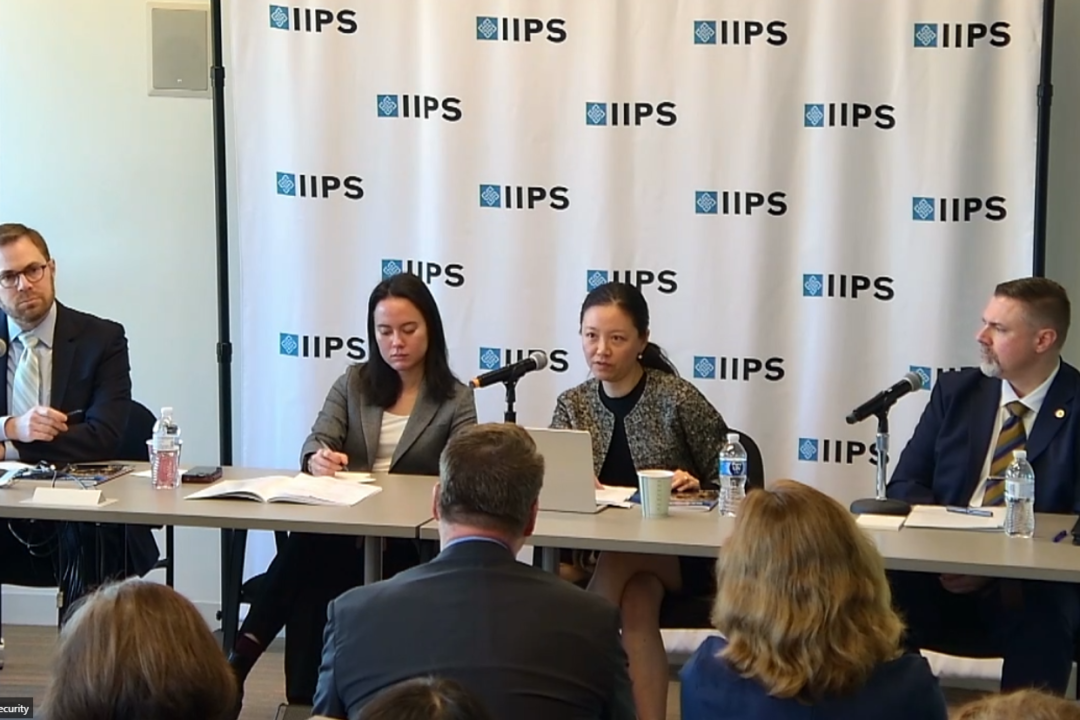
Bonny Lin, director of the China Power Project at the Center for Strategic and International Studies (CSIS), questioned that interpretation during an IIPS panel in Arlington, Virginia, on Nov. 17 announcing the new report.
Lin said the Chinese deployments included substantial naval activity involving three regional military commands in the Philippine Sea. But she suggested that some operations elsewhere in the region had different purposes. For example, Chinese military activity in the South China Sea appeared connected to a Philippine operation to deliver fuel to fishermen near Scarborough Shoal. The purpose of some Chinese military flights around Taiwan in early November remains unclear, she said.
Lin said she had not seen sufficient evidence to conclude that all the vessels were participating in one coordinated exercise. Chinese official messaging suggested separate activities, she said.
Her assessment differs from the IIPS report and a Nov. 13 analysis by the Institute for the Study of War, which assessed that China was very likely conducting a major unannounced exercise simulating Taiwan’s isolation.
Lin said CSIS was preparing its own assessment of the deployments, with publication expected as early as Nov. 23.
Warning Signs Beyond Military Movements
The 118-page IIPS report called Indications and Warning for a Taiwan Contingency, examines China’s behavior ahead of past military confrontations to identify potential advance warning indicators of an attack.
The researchers identified six primary warning indicators and nine supporting indicators, including Chinese actions beyond the military. They said the unusual stockpiling of food, explicit warnings about actions that could trigger Chinese military retaliation, the appointment of new military commanders, or large movements of troops and supplies could warrant closer attention.
The study also identified warning indicators for three potential military operations by the Chinese Communist Party (CCP) against Taiwan: large-scale missile and air strikes, a blockade restricting the island’s trade, and an amphibious invasion.
China’s preparations for these military actions could include placing missile units on higher alert, assembling vessels capable of stopping commercial shipping, or mobilizing civilian ships to transport troops and equipment.
The researchers argue that Beijing may be deliberately blurring the distinction between its military pressure and preparations for war, a strategy they call “denial through convergence.”
The Challenge of Recognizing an Attack
Johnathan Proctor, member of the U.S. Joint Staff Directorate for Intelligence, said intelligence analysts face a fundamental problem: the earliest warnings provide the greatest opportunity to respond but also carry the most uncertainty.
“Certainty is your adversary,” he said, describing the difficulty of issuing early warnings before any evidence becomes conclusive.
An unusual Chinese military deployment could be an exercise, an attempt to intimidate Taiwan, or preparations for an attack. Waiting for more definitive evidence could leave Washington with insufficient time to act.
Asked during the panel what specific changes might distinguish an exercise from preparations for an actual attack, Annie Kowalewski, an IIPS senior fellow and co-author of the report, emphasized that the ultimate decision to use force rests with the CCP’s political leadership.
She described it as “fundamentally a political decision, not a military decision.”
Kowalewski said analysts should consider Xi Jinping’s political calculations, China’s international relationships, People’s Liberation Army (PLA) readiness and morale, and even weather and sea conditions around Taiwan.
Political Math
The discussion also addressed whether Xi’s repeated removal of senior PLA officers could affect the military’s ability to conduct an operation.
Lin said CSIS was beginning a two-year study of military purges and their effect on combat readiness. She cautioned that historical evidence has yet to establish whether such purges necessarily strengthen or weaken a military.
Lin raised another challenge in facing the CCP dictatorship: the concentration of decision-making power under Xi.
She said CCP officials communicating with Washington might repeatedly deliver forceful warnings without knowing what Xi has actually decided.
Such uncertainty, already seen within the CCP’s political system, could make it harder for U.S. intelligence agencies to determine whether Beijing is moving toward military action.
Kowalewski said the United States could receive enough warning to recognize that Xi is preparing to act against Taiwan, yet still lack time to decide whether to intervene and what level of support to provide.
She argued that Washington needs to consider those political decisions before a crisis rather than wait for intelligence agencies to establish with certainty that an attack is imminent.
We had a problem loading this article. Please enable javascript or use a different browser. If the issue persists, please visit our help center.