
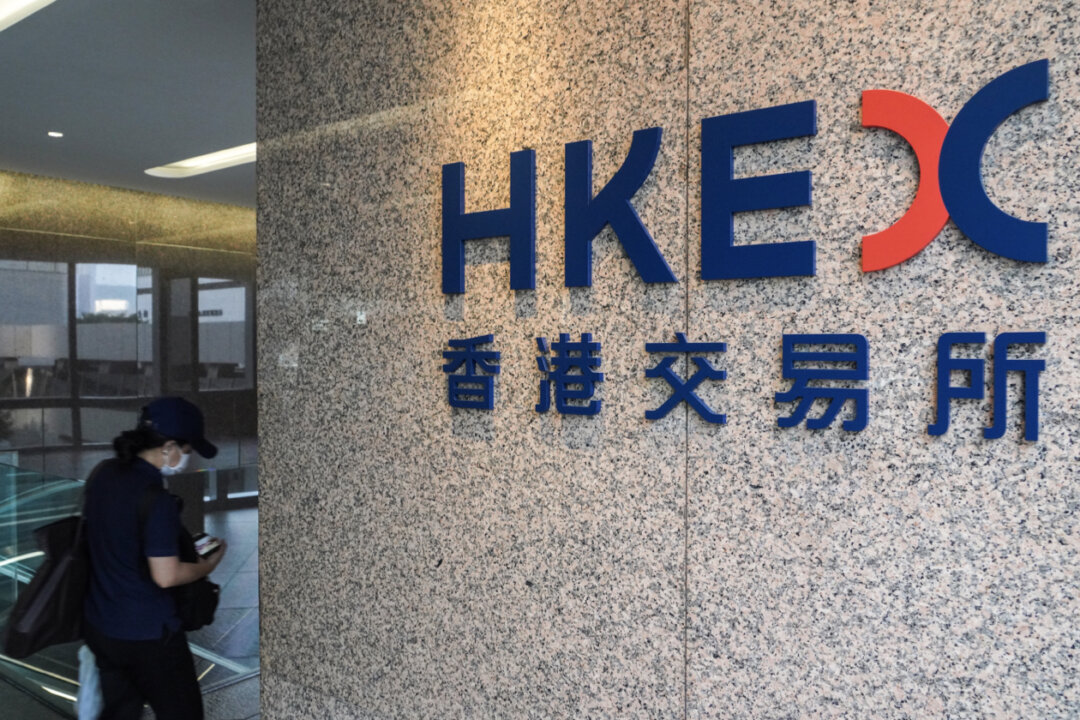
Chinese artificial intelligence stocks (AI) have extended their losses as U.S. lawmakers press for tighter restrictions on Nvidia chip sales to China.
Hong Kong-listed AI developers Z.AI and MiniMax fell 10 percent and 8.2 percent, respectively, on Friday, extending two-day declines of nearly 20 percent and 15 percent. The Hang Seng Tech Index dropped 3.02 percent to 3,813.19.
The sell-off followed Nvidia co-founder Jensen Huang’s resignation as CEO amid congressional scrutiny of the company’s China-related dealings. Nvidia said on Nov. 12 that Chief Financial Officer Colette Kress had become interim CEO.
Concerns have been raised about Chinese technology companies’ access to Nvidia’s advanced processors used to develop AI models.
Rep. John Moolenaar, chairman of the House Select Committee on the Chinese Communist Party, called for tougher semiconductor controls following Huang’s resignation. Sens. Jim Banks (R-Ind.) and Elizabeth Warren (D-Mass.) separately urged passage of legislation to strengthen congressional oversight of advanced AI chip exports.
No new Commerce Department restrictions arising from this week’s developments have been announced. Under a January rule, exports of Nvidia H200 and certain comparable advanced processors to China remain subject to case-by-case license review under specified conditions.
Chinese AI Infrastructure Still Uses Nvidia
Although Beijing has encouraged Chinese firms to adopt domestically produced processors, company disclosures and procurement records document continued demand for Nvidia hardware.
Alibaba, one of China’s largest AI and cloud-computing providers, identified U.S. controls on advanced Nvidia chips in its annual regulatory filing. The company also warned of potential restrictions on Chinese businesses obtaining advanced American computing power through overseas cloud providers.
DeepSeek, a Chinese AI developer, documented training its V3 model using 2,048 Nvidia H800 processors in a technical paper released in late 2024.
More recent Chinese records identify additional Nvidia-based computing projects.
In an April 2026 investment proposal, the Jilin provincial government described a planned 2.26 billion yuan ($339 million) computing center in Songyuan that would use Nvidia H100 processors for advanced AI model training alongside domestically produced chips.
The proposal allocated 60 percent of its planned computing capacity to H100 systems and the remainder to domestic processors. It did not establish that the equipment had been purchased or installed.
A February 2025 announcement by Chinese state-owned machinery group Sinomach identified Nvidia H100 and H200 processors in the design of a planned 3-billion-yuan ($450-million) computing center in Xi’an.
Chinese university procurement documents also identify more recent demand. Northwestern Polytechnical University, a Chinese institution with ties to military research that’s on a U.S. export blacklist, purchased two Nvidia H200 processors in October 2026. The procurement notice did not establish whether the chips had been delivered.
Other disclosures establish actual commercial activity. Shanghai-listed Damingcheng reported in June that an H800-based computing cluster had provided services during 2025 through a business arrangement involving Shanghai Unicom.
The company disclosed that the original service agreements ended in January 2026, with subsequent rights and obligations transferred to another company. It did not report that the computing cluster had been shut down.
Domestic Alternatives Expand
Chinese technology companies are also advancing their use of domestic AI processors, particularly for inference—the process of running an already-trained model to answer questions or perform tasks.
Z.AI, one of the companies hit by Friday’s sell-off, reported in August that it had deployed more than 100,000 domestic chips for large-scale inference. The company said its computing cost per unit of generated AI output had fallen 80 percent since the beginning of 2026.
Huawei has also announced additional Ascend AI processors and computing systems intended to compete with foreign technology, although some remain on its product roadmap.
Alibaba, however, warned in its annual filing that U.S. export restrictions could disrupt its access to computing chips, cloud services, and other technologies critical to its AI business. The company said it and its technology partners might be unable to develop or obtain equivalent alternatives in time or on commercially acceptable terms.
We had a problem loading this article. Please enable javascript or use a different browser. If the issue persists, please visit our help center.