
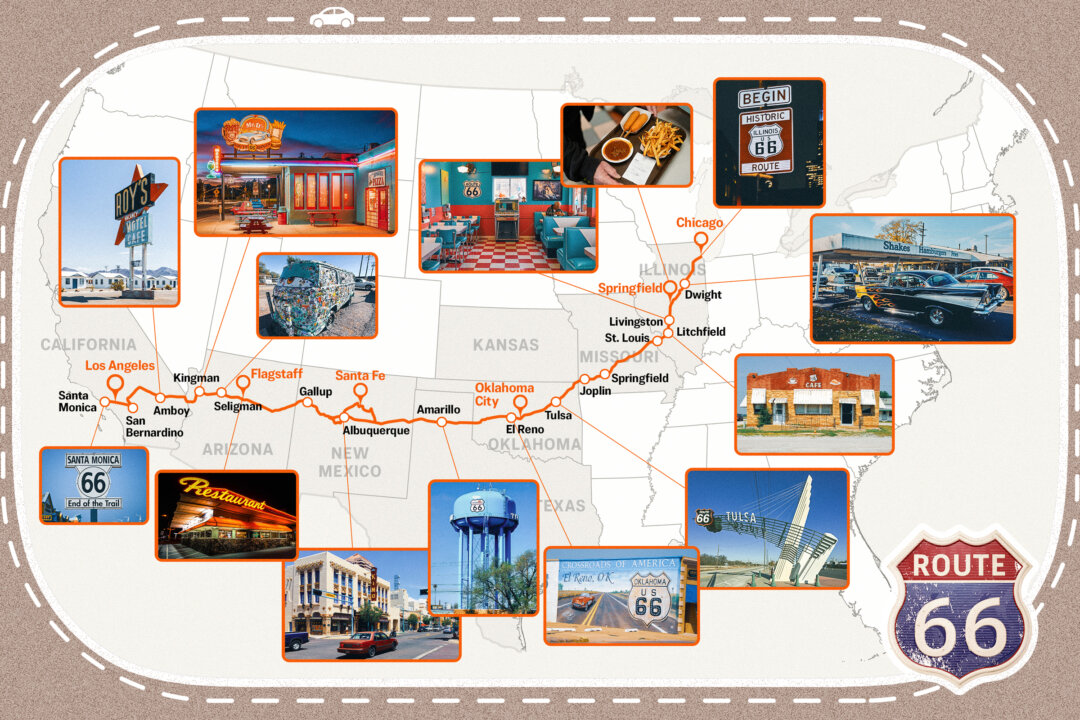
They called it the Main Street of America.
The route rose up from Chicago, City of the Big Shoulders, and rolled south across the Illinois prairie. Crossing the Mississippi at St. Louis, the Gateway to the West, the road cut a diagonal path into the Ozark Mountains, slicing a corner off of Kansas.
From there it rumbled over endless miles of Oklahoma cotton fields, Texas ranches, the high country of New Mexico, and the Arizona desert, entering at last the Golden State, land of America’s hopes and dreams.
For six decades, this most famous of highways carried the produce of America’s factories westward, troops and war materiel eastward, and dreamers, adventurers, speculators, and vacationers in both directions.
Famed in literature, popular music, film, and television, the road came to symbolize America—the seemingly limitless horizon of its land and the inexhaustible energy of its people.
Route 66 was more than a highway. It was, as John Steinbeck put it, the mother road.
Route 66 came to symbolize America—the seemingly limitless horizon of its land and the inexhaustible energy of its people.
Even now, decades after its decommissioning as a U.S. highway, the road retains a mythic place in American culture.
That all began 100 years ago, when a Washington bureaucrat assigned a number to the newest federal roadway, naming it Route 66.
The Way West
Route 66 followed a path much older than itself. The original route mirrored trails taken by the first migrants traveling west from the Mississippi.
Much of Route 66 ran along Beale’s Road, a military route commissioned in 1857 that led west from Fort Smith, Arkansas.

With the advent of the automobile, early 20th-century business leaders promoted the idea of a coast-to-coast automobile route.
When it opened on Nov. 11, 1926, Route 66 became the first all-weather automobile road from the Midwest to the West Coast.
The Lincoln Highway, running from New York City to San Francisco, was a decade older. But it faced winter closures and was practical only for the wealthy.
Route 66 shaved 200 miles off the drive from Chicago to Los Angeles, blazing a trail to the west for ordinary Americans.
‘The Road of Flight’
200K
MIGRANTS
traveled along Route 66 from the Southern Plains states to California.
Most roads in America were unpaved in 1926, as was most of the original Route 66.
The Works Progress Administration, a Depression-era program that put unemployed men to work on the road across its eight states, completed paving the route in 1938.
The Great Depression also cemented Route 66’s place in American culture. When severe drought and high winds caused dust storms that devastated farmland, some 200,000 people migrated along Route 66 from the Southern Plains states to California.
Steinbeck wrote of that migration in “The Grapes of Wrath.”

“Highway 66 is the main migrant road, … the path of a people in flight, refugees from dust and shrinking land,” Steinbeck wrote.
“They come into 66 from the tributary side roads, from the wagon tracks and the rutted country roads. 66 is the mother road, the road of flight.”
America Comes of Age
As America came of age in the prosperous post-World War II era, Route 66 carried another kind of migrant: Americans seeking opportunity rather than fleeing disaster.
Millions of Americans lit out for the Southwest after the war, adding more than 39 million people to its cities by 1980. That growth alone was about 1.4 times the population of the entire region in 1940.
A contemporary quote widely attributed to architect Frank Lloyd Wright called Route 66 “a giant chute down which everything loose in this country is sliding into Southern California.”
New car production boomed after the war, hitting 6.7 million by 1950. Within 10 years, 78 percent of American households owned at least one car. Many owned two, even three.

And Americans were eager to travel.
Disneyland, the Grand Canyon, the Painted Desert, the Petrified Forest, the Black Mountains, Chicago, St. Louis, Los Angeles, Lake Mead, the Pacific Ocean, and countless other attractions were on or near Route 66.
“People who had never taken a vacation in their life now had the opportunity to travel west, not in pursuit of a job to ease their desperation, but for the sheer enjoyment of it,” historian Michael Cassity wrote.
These travelers preferred overnight accommodations directly along the route to city hotels. Roadside cabins sprang up along the route, followed by motels with colorful neon signs advertising “Free TV” and “AC in Every Room.” Many had swimming pools and adjoining restaurants.
The boom reshaped the route as it was widened, modernized, and occasionally rerouted. The road also reshaped entire towns, bringing increased traffic and economic growth.

Legend Status
Route 66 both shaped and was shaped by mid-century pop culture, becoming a symbol for a youthful, mobile, and adventurous nation.
The diners and drive-ins that sprang up along the road created new foods and the lingo to describe them: soft ice cream, chili pie, trucker special, and burger basket.
Steak ’n Shake opened its first restaurant on Route 66 in Normal, Illinois, in 1934.
The bumper sticker appears to have originated at Route 66 attraction Meramec Caverns in Missouri, where “bumper sign boys” tied placards advertising the caverns to visitors’ cars.
Artists reflected Route 66’s carefree vibe in their work.

Nat King Cole’s 1946 hit song urged young people, “Get your kicks on Route 66.” The Rolling Stones covered the song on their 1964 debut album.
The television show “Route 66” followed two young men as they roamed the country in a Corvette convertible, searching for adventure. The hit show ran for four seasons, cementing the image of the American highway as a place of freedom in the minds of a new generation.
The 1969 film “Easy Rider” offered a darker take: a cross-country trip by two bikers that epitomized America’s counterculture.


And Just Like That
Route 66 grew with the country for six decades, then vanished seemingly overnight.
As early as 1941, highway administrators had proposed a federal interstate highway system comprising 40,000 miles of new, modern road. Congress approved the plan in 1944 but didn’t fund it.
The country returned to the idea in the 1950s. Over the following decades, the interstate highways that Americans now take for granted emerged, reshaping cities, towns, and traffic patterns nationwide.
Route 66 grew with the country for six decades, then vanished seemingly overnight.
Eventually, those new roads would replace every mile of Route 66.
Some interstate segments were built on top of the existing road. Others were routed well away from the towns that thrived on Route 66 traffic.

The economic impact was immediate and devastating.
“They talked about it like turning the light switch off,” Jerry McClanahan, author of EZ 66 Guide for Travelers, told The Epoch Times.
“One day the motels were full, the gas stations were bustling, the restaurants were serving people, then, bam! There it went,” McClanahan said.
Seligman, Arizona, is perhaps the best-known example. In a documentary, lifelong resident Angel Delgadillo recalled the precise moment when I-40 bypassed the town. It was Sept. 22, 1978, at about 2 p.m.
One day the motels were full, the gas stations were bustling, the restaurants were serving people, then, bam! There it went.
Jerry McClanahan, author, “EZ 66 Guide for Travelers”
“The world stopped,” Delgadillo said. “The world just forgot about us.”
Seligman later inspired the 2006 Pixar animated film “Cars.”
By 1985, interstates had replaced all of Route 66, and it was decommissioned as a federal highway.
Some communities, such as Glenrio, Texas, became ghost towns. Others remained as shadows of their former selves, with boarded-up motels, abandoned service stations, and old stretches of highway left to crumble.
Rebirth
Route 66 today carries federal historic highway markers, thanks to Delgadillo and others who refused to accept the loss of their culture and livelihood.
Delgadillo, nicknamed “the angel of Route 66,” founded the Historic Route 66 Association from his barbershop. He successfully lobbied Arizona to declare 159 miles of the old route, including the road through Seligman, a historic landmark.
An army of small business owners and Route 66 enthusiasts have preserved historic structures and documented the route’s history.
Delgadillo, now 99, believed people would return to the road if invited, his daughter, Mirna Delgadillo, told The Epoch Times.
“He realized people were searching for America of yesterday, and Route 66 is America of yesterday,” she said.
Route 66 preservation organizations sprang up across the eight-state route. An army of small business owners and Route 66 enthusiasts have preserved historic structures along the route and documented its history.
As the route celebrates its centennial, tourism is stronger than ever, said Myrna Delgadillo, who operates a gift shop in her father’s former barber shop.
“I can’t tell you how many folks I have spoken to who are traveling from Chicago to L.A. or L.A. to Chicago,” she said. “I’ve not heard that in the 30 years I’ve been working here.”

McClanahan, who operates McJerry’s Route 66 Gallery in Chandler, Oklahoma, said the route still appeals to the human need for adventure.
“We have a tradition of travel and wanderlust, westward expansion in America,” McClanahan said. “Route 66 has come to symbolize all of that.”
The route generated an estimated $132 million in economic activity and created about 5,600 jobs, according to a 2011 study by Rutgers University.
Tour companies arrange guided travel by motor coach, van, and motorcycle from Chicago to Los Angeles or vice versa.
It’s impossible to determine the total number of travelers because parts of the old road are used as interstate highways and others as local streets.


Yet up to 20 percent of the tourists are from overseas, according to the Rutgers report.
“The Europeans have a fascination with the American West,” Jim Ross of Arcadia, Oklahoma, told The Epoch Times.
“A big part of that is the freedom of the open road. A lot of European countries are relatively small compared to the United States, so it seems like this endless wonderland.”
Ross has documented the route in several books, including a pictorial history, “Route 66: The First 100 Years,” coauthored with his wife, Shellee Graham.

The Road Ahead
The future of Route 66 is bright, said Rhys Martin, president of the Oklahoma Route 66 Association and a board member at the national Route 66 Road Ahead Partnership.
“It’s not a dead highway,” Martin told The Epoch Times. “There are new business owners, young people restoring old motels, third- or fourth-generation families operating diners or quirky roadside attractions.”
We have a tradition of travel and wanderlust, westward expansion. … Route 66 has come to symbolize all of that.
Jerry McClanahan, author of “EZ 66 Guide for Travelers”
Martin waxed philosophical about the highway’s enduring appeal.
“Nostalgia is definitely a part of it,” he said. “But it’s also anemoia, which is like nostalgia for a time you never got to experience.”
Yet Martin said the Route 66 experience is about the present, not the past.

Driving the two-lane blacktop through America’s small towns forces travelers to slow down and experience the moment. The journey itself becomes the destination, he said.
“This road is more important than just pavement.”
McClanahan agrees.
Allan Stein contributed to this report.
We had a problem loading this article. Please enable javascript or use a different browser. If the issue persists, please visit our help center.