
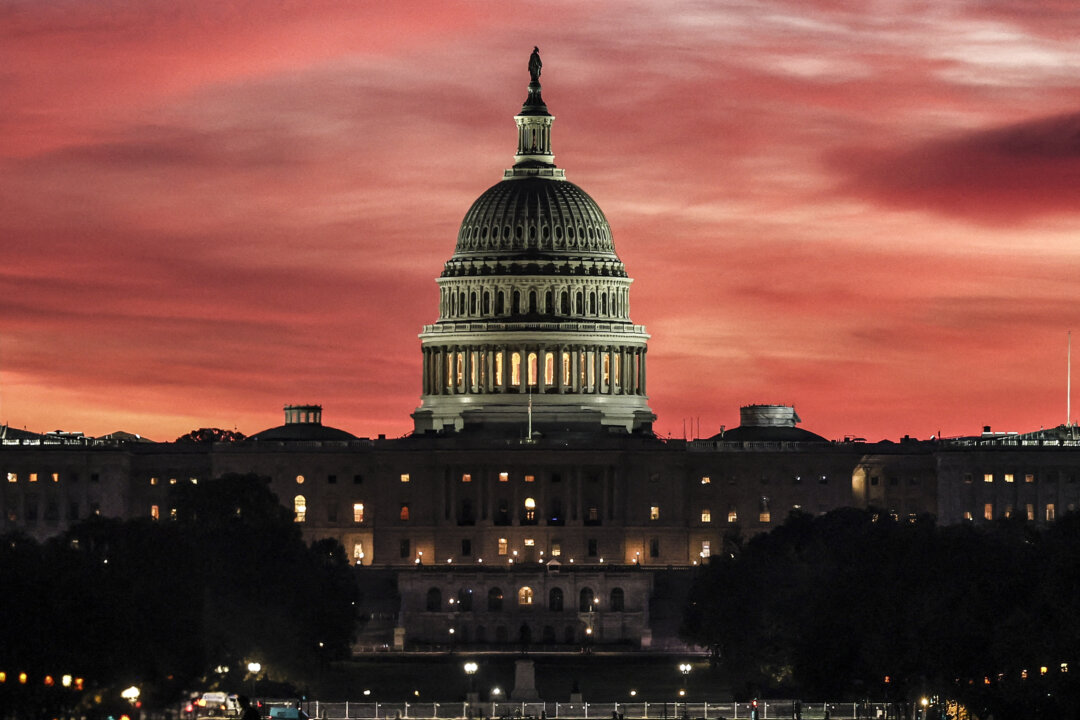
Congress returns today for its first session since September and its first since the Democrats’ sweeping victory in the 2026 midterm elections.
It will likely be a somber session for Republicans, who have lost at least 44 House seats to Democrats and seven Senate seats.
Based on current results from The Associated Press, Democrats have won 254 seats and lead in enough races to expand that majority to 261 seats. Republicans could ultimately control as few as 174 seats.
That sets Democrats up for the largest majority for any party since 1991 when they take their seats in January.
Congress has much to do this week and in the coming weeks before Republicans hand over their majority in both chambers on Jan. 3, 2027, including government funding, the National Defense Authorization Act (NDAA), and energy permitting reform.
Congress will also consider two pieces of legislation introduced by Rep. Thomas Massie (R-Ky.), including a discharge petition on a stricter version of the bill to release files related to sex offender Jeffrey Epstein, and a measure to impeach Secretary of War Pete Hegseth.
Here’s what’s on the congressional agenda.
House Republican Leadership
After Republicans’ midterm defeat, House Speaker Mike Johnson (R-La.)—who predicted a red wave and likened Republican voter enthusiasm to 2024—announced he wouldn’t seek election as House minority leader, leaving Republicans scrambling to replace the leader of their soon-to-be fractured caucus.
Two top contenders are vying to replace him as Republican leader: Judiciary Committee Chairman Jim Jordan (R-Ohio) and House Majority Leader Steve Scalise (R-La.).

House Majority Whip Tom Emmer (R-Minn.) is running to reprise his role as minority whip, facing a long-shot challenge from Rep. August Pfluger (R-Texas).
Incumbent Republican Conference Chair Lisa McClain (R-Mich.) is running to keep her current role, fielding a challenge from Reps. Erin Houchin (R-Ind.) and Greg Steube (R-Fla.).
The vote will be held on Tuesday.
Government Funding
As they approach the end of the year, lawmakers face a Dec. 11 deadline to fund the federal government and traditionally consider 12 appropriations bills for various government sectors.
Currently, the government is funded under a stopgap measure, with funding set to expire on Dec. 11 of this year.
The House has passed three of the 12 bills, while the Senate has passed none.
This legislation will set funding levels through Sept. 30, 2027, and offers Republicans one of the final opportunities to influence government funding for the year ahead.

The filibuster looms over negotiations on these bills.
Though Democrats remain in the minority until January, Senate procedure could let them block any party-line funding measures until the new Congress sits, potentially setting the stage for a December government shutdown.
At a minimum, Democrats will have much more influence over funding levels than they would have had if Republicans retained the Senate.
National Defense Authorization Act
The NDAA sets congressional policy for how the Pentagon should use government funds and authorizes funding levels for Department of Defense programs.
The House passed a version of the bill in July. Though Senate Republicans reported the bill out of committee, it has stalled in the Senate amid divisions over the legislation’s key provisions.

Senate Democrats blocked the advancement of the critical defense spending package in mid-July, denying it the necessary votes to overcome the 60-vote filibuster threshold. They linked the vote to the Trump administration’s decision to resume the war in Iran.
The $1.15 trillion legislation would authorize almost $1.1 trillion for the Department of War, more than $41.14 billion for the Energy Department to manage the nation’s nuclear arsenal, and $11 billion for other defense-related activities.
Energy Permitting Reform
Lawmakers will also continue work on a bipartisan effort to reform U.S. energy permitting, under an effort led by Sens. Mike Lee (R-Utah), Shelley Moore Capito (R-W. Va.), Martin Heinrich (D-N.M.), and Sheldon Whitehouse (D-R.I.)
Called the Bipartisan American Affordability and Jobs Act of 2026, the bill would make it easier to receive federal permitting for energy projects.

It aims to provide relief to traditional energy sources and mines—a GOP demand—while also expanding the U.S. power grid and providing clean energy infrastructure, a key Democratic goal.
Proponents are seeking to attach the legislation to government funding or the NDAA.
The Epstein Files Transparency Act II
The House is also expected to take up legislation sponsored by Reps. Ro Khanna (D-Calif.) and Massie, the Epstein Files Transparency Act II, that would require the administration to provide Epstein victims, upon request, with unredacted information concerning them or alleged harm they suffered.
Massie has said he’s confident the bill will reach the 218 signatures needed to force a vote once Congress is back in session.

Epstein survivors and lawmakers say the Department of Justice (DOJ), under former Attorney General Pam Bondi and Attorney General Todd Blanche, has suppressed critical information and names in the files since the bill’s original iteration passed. The Trump DOJ has not announced any new prosecutions of alleged Epstein co-conspirators based on evidence in the files.
In response to this inaction, the measure would give state attorneys general direct access to the files, allowing them to prosecute criminal activity at the state level. It also allows survivors to sue the U.S. attorney general for withholding or redacting records concerning them or the harm they suffered.
Hegseth Impeachment
Hegseth has become a target in the wake of the defeat, which Republicans such as Vice President JD Vance and Donald Trump Jr. have attributed to the war in Iran.
Massie introduced eight articles of impeachment against Hegseth before the House left for the October recess, though there wasn’t time then for the measure to receive a vote.

The articles include allegations that Hegseth violated the War Powers Act, that he acted with disregard for civilian life, that his department undertook extrajudicial killings, and that he engaged in the suppression of free speech.
“Secretary Hegseth has acted in a manner contrary to his trust as Secretary of Defense and subversive of constitutional government, to the great prejudice of the cause of law and justice, and to the manifest injury of the people of the United States of America,” Massie said at the time.
The Pentagon did not return a request for comment on the allegations.
We had a problem loading this article. Please enable javascript or use a different browser. If the issue persists, please visit our help center.