
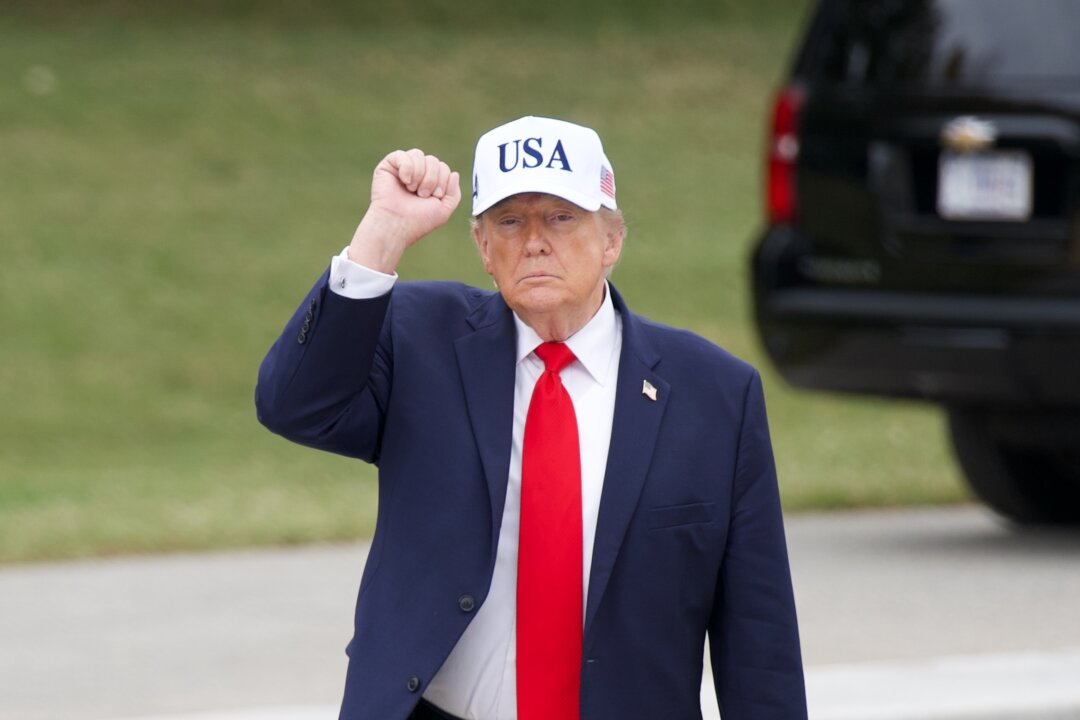
President Donald Trump said his immigration policies “both helped and hurt” Republicans’ performance in the midterm elections, and that his administration’s deportations were “too tough” for many voters while speaking with CBS News’s “60 Minutes.”
The president gave himself an “A plus” for closing the border while acknowledging voters’ disapproval of portions of his deportation policies.
“I get very high marks for getting the bad ones out,” Trump said of his administration’s deportation of criminal illegal immigrants. “But I get hurt because we also took people that had good jobs that created one violation or breaking of the law—that was that they came into the country illegally.”
When asked by a reporter if his administration’s deportation policy “went too tough,” Trump said it might be the case.
“I think it might be too tough, yeah. And a lot of people would say that it’s great, but a lot of people think it’s too tough. I think ultimately, that hurt me,” the president said.
Hispanic support for Republican candidates declined approximately 10 percent in 2026 midterms compared to the 2024 election, according to exit polling. Along the Texas border, where Trump won every district in 2024, Democrats captured the majority during the midterms.
Across the country and in Congress, Americans remain divided on the issue, the president told “60 Minutes” correspondent Ross Douthat in a Nov. 6 interview that aired on Sunday night.
“There’s a group of people, I would say on the pretty far right, that would like everybody taken out,” Trump said, as he acknowledged that some of them work in his administration. “There are a lot of those people.”
“And there’s a group of people that are more modified on that,” Trump said of those who want the murderers, rapists, and drug dealers to be deported, while law-abiding, tax-paying individuals could be offered a deal to stay in the country.
“Then you have a group that’s a very dangerous group—the sanctuary city group—that want[s] to let murderers stay. I don’t understand that group,” the president added.
Bipartisan Opportunities
Trump said he believes that Democrats and Republicans can work together to formulate a solution that allows certain individuals to seek amnesty.
“I think that’s something that’s actually doable,” he told Douthat.
“In other words, get the killers out, get all the rough ones out, get the drug dealers out, but let the people that are here—and in some cases here for 10 and 15 years—work a deal for them.”
Protective Pardons
Trump has often criticized his political opponents for using the justice system to target him, his supporters, and his political agenda.
When Democrats seized control of the House in 2018, they used their power to investigate and impeach the president. Now, with Democrats poised to take control of both houses of Congress in January, Trump told “60 Minutes” he could use blanket pardons to shield against any new charges while downplaying his expectation of any similar attempts next year, citing his administration’s economic and national security achievements.
“I intend to issue tremendous numbers of pardons,” Trump said of his planned response to any politicized charges. “In fact, I say oftentimes, anybody that got within 1,000 miles of the Oval Office, because I don’t want people spending the rest of their lives [in prison].”
President Joe Biden issued 80 pardons during his term, including for his son Hunter Biden, former National Institute of Allergy and Infectious Disease Director Dr. Anthony Fauci, members of the House of Representatives’ January 6 Select Committee, and other high-profile officials.
Trump in his first term issued roughly 144 pardons, including for Michael Flynn, Roger Stone, Paul Manafort, George Papadopoulos, and Alex van der Zwaan related to the Russia investigation, and Charles Kushner and Steve Bannon. In his second term, he has issued far more, including for the roughly 1,500 people charged or convicted in connection with the breach of the U.S. Capitol on Jan. 6, 2021.
Family Investments
As Democrats take control of Congress on Jan. 3, 2027, the president’s businesses and investments could come under scrutiny in Congressional hearings, including cryptocurrency company holdings.
“This is true for every president,” Trump said, noting that crypto is new, but prior presidents were heavily invested in oil and other markets.
Election Results
The president also boiled down the GOP midterm loss to a handful of other issues.
“They didn’t like the war,” Trump said. “They didn’t like the fact that gasoline went up … and there’s a great dislike, incredibly, for Israel.”
Vice President JD Vance posted similar sentiments on X the day after the election.
While acknowledging the war’s impact on the midterms, the president said he would make the same decision if given the opportunity to reconsider.
“I gave absolutely no credence and will not give credence to the election when it comes to Iran. It doesn’t even enter my mind,” Trump had said back in September.
Future strikes on Iran are possible, if needed, Trump told “60 Minutes,” saying that Space Force members are monitoring the action from above to ensure compliance.
“We have telescopic lenses that are unbelievable,” Trump said, referencing Iran’s nuclear facilities already destroyed and those located at Pickaxe Mountain. “I can tell the color of the red dots on your tie, and we watch every one of those sites.”
He also confirmed that talks were underway with Russian President Vladimir Putin. Trump said that U.S. officials were meeting with Putin’s team over the weekend before the trilateral talks with Ukraine scheduled for Nov. 10–11 in Abu Dhabi.
“There’s a very important meeting taking place,” he told Douthat. “ I believe that that war is going to end, and it’s going to end soon.”
An agreement will likely result in a “very different[ly] shaped Ukraine,” the president said.
Super Intelligence
Data centers were another pivotal factor in some midterm races. The president had argued during campaign season that the new developments were vital to national security and would be beneficial to the local economies. But the election results showed that the public remains divided on the speed at which data centers are being proposed and built.
Trump doubled down on his position, telling Douthat, “If we don’t have it, China is going to have it. That would put us at an unbelievable disadvantage,” he said. “It’s all between us and China. There’s nobody else.”
The risks are real but manageable, the president said, emphasizing the need to win the super intelligence race against the communist dictatorship. Some form or regulations are needed, but balancing restrictions and development is of paramount importance.
“I don’t mind guardrails, but I don’t want to put us in a deep second position,” Trump said. “And China has no guardrails.”
We had a problem loading this article. Please enable javascript or use a different browser. If the issue persists, please visit our help center.