
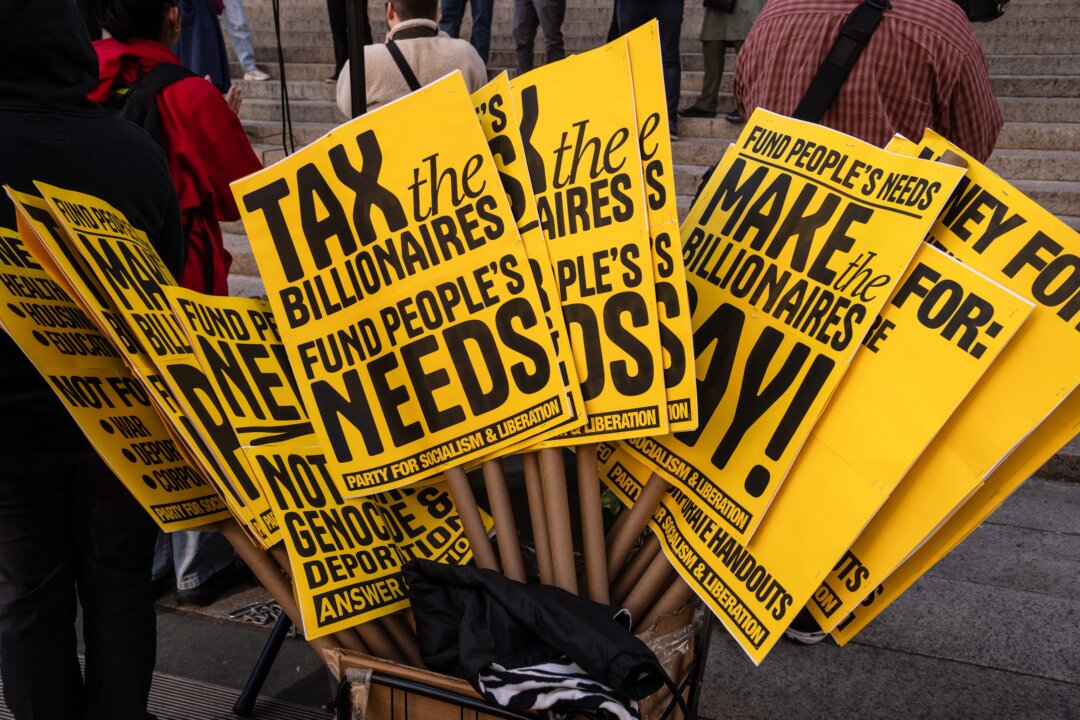
An attempt to impose a wealth tax on California’s billionaires failed at the ballot box as California voters rejected Proposition 40, which sought to charge a one-time 5 percent tax on the assets of residents with a net worth of more than $1 billion by a margin of 55.6 percent against to 44.4 percent in favor.
Simultaneously, voters in the Nov. 3 midterm elections approved Proposition 42, which prohibits the state from imposing new property taxes, 54.3 percent to 45.7 percent.
The vote follows a multimillion-dollar battle between Californians who opposed the wealth tax and Democrats and health unions, which supported it. According to the California Secretary of State, $33 million was spent to persuade voters to support it while more than $130 million was spent in opposition.
The Yes on 40 website stated that “billionaires like Sergey Brin and Peter Thiel are spending tens of millions in non-stop ads attacking Prop 40. They think they can fool us into voting no.”
Dave Regan, president of Service Employees International Union-United Healthcare Workers (SEIU-UHW), which put Proposition 40 on the ballot, said the group plans to resurrect the bill in 2028.
Rep. Ro Khanna (D-Calif.), whose district includes parts of Silicon Valley, likewise pledged to put the measure back on the ballot in 2028. In addition, other states that have introduced wealth tax bills include Illinois, Maryland, Minnesota, Rhode Island, and Washington. Recent Democratic victories across the United States could give additional momentum to those efforts.
California’s billionaire tax would have applied to an estimated 260 residents, according to California Billionaire Wealth Tracker, which monitors the Forbes Real-Time Billionaires list. Proponents claimed it would raise $100 billion over five years, although critics said it would cause rich residents to flee the state, sharply reducing the tax base.
Proceeds of the tax were slated to fill gaps in the state’s healthcare budget following federal funding cuts in the One Big Beautiful Bill Act (OBBBA), passed in 2025.
The Yes on 40 website stated that impact of the OBBBA on the state would be “skyrocketing health insurance premiums, 3.4 million Californians losing health coverage, and clinics, ERs, and hospitals closing their doors. Prop 40 restores this lost funding.”
Proponents said that the wealth tax would fund healthcare, food assistance, and education.
Opponents said that a wealth tax would simply cause wealthy Californians to leave the state.
The California Chamber of Commerce stated that “the effort to impose an unprecedented wealth tax is not only misguided but creates a dangerous precedent that will cause more problems than it would ever solve.”
The Chamber cited research by the California Tax Foundation that estimated the billionaire’s tax would ultimately cut state tax revenue by $3.53 billion to $4.49 billion per year “due to billionaire departures and their economic spillover effects.”
Recent departures of rich Californians include Google co-founders Larry Page and Sergey Brin and renowned Hollywood director Steven Spielberg, just prior to the date when the wealth tax would have taken effect.
Mark Zuckerberg, founder of Meta, was also contemplating leaving California because of a “potential significant, multibillion-dollar tax payment” he would owe if a wealth tax were to be imposed, according to an Oct. 21 company filing.
We had a problem loading this article. Please enable javascript or use a different browser. If the issue persists, please visit our help center.