
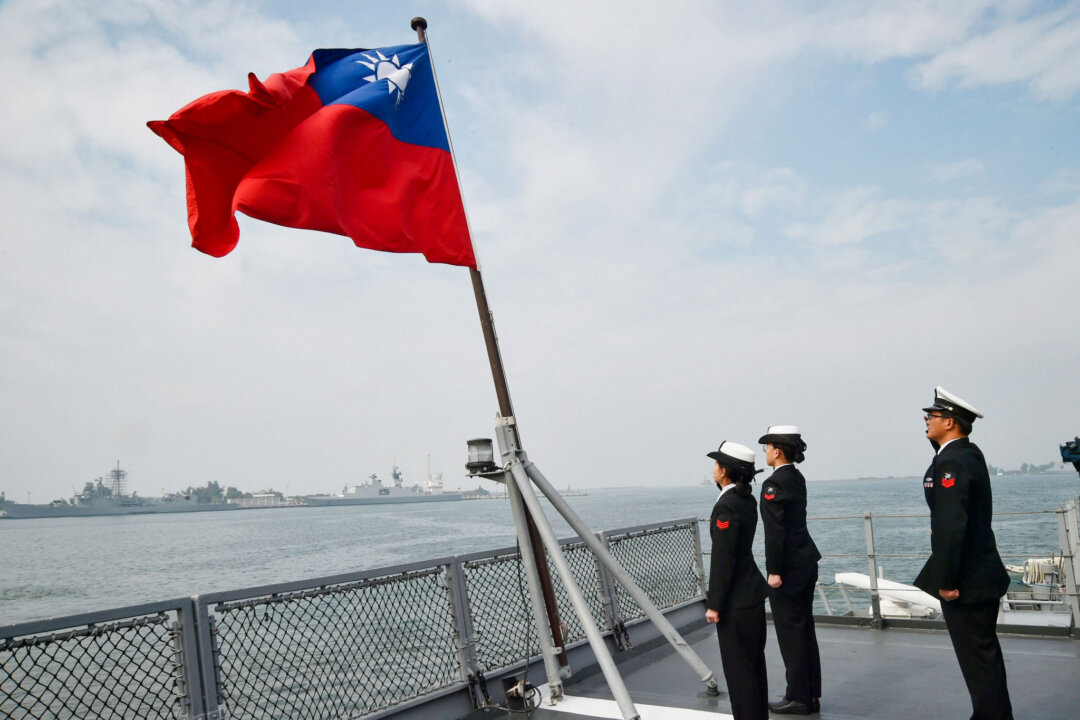
TAIPEI, Taiwan—China has dispatched more than 100 navy and other vessels across the western Pacific, according to a senior Taiwanese official.
On Nov. 3, Joseph Wu, secretary-general of Taiwan’s National Security Council, posted a map on X showing the locations of Chinese naval and coast guard vessels, including the aircraft carrier Liaoning, across the East China Sea, South China Sea, and waters near Japan, Taiwan, and the Philippines.
Beyond China’s maritime activities, Wu also pointed to the “high number of air sorties” conducted by Chinese military aircraft near Taiwan recently.
On Nov. 3, Taiwan’s Ministry of National Defense reported detecting 49 Chinese military aircraft around the island in the preceding 24 hours, including 31 sorties that entered Taiwan’s air defense identification zone (ADIZ).
An ADIZ is an area extending beyond a country’s national airspace, where approaching foreign aircraft may be required to identify themselves and provide their location.
The Chinese regime “is such a big bully,” Wu wrote in remarks accompanying the map, before adding that Taiwan “is staying vigilant.”
“We won’t provoke, but we won’t bow to any pressure,” he added.
Wu has published several similar maps in recent months, including one in late October.
Beijing, which claims Taiwan as part of its territory, has pursued a sustained campaign of military intimidation, economic coercion, and political pressure aimed at shaping public opinion on the island.
Wu’s warnings come as Taiwan gears up for local elections on Nov. 28, with the mayoral races in Taipei, New Taipei City, Taoyuan, Taichung, Tainan and Kaohsiung among the key contests.
Taiwan’s National Security Bureau warned in a report last month that the Chinese regime was stepping up disinformation campaigns and cyberattacks aimed at interfering in the upcoming elections.
Coast Guard Patrols
China has increased its presence off Taiwan’s eastern coast since June, establishing regular coast guard patrols in the area.
On Oct. 31, Jiang Lue, a spokesperson for the China Coast Guard, said that its patrol flotilla led by a vessel named “Hushi” had been conducting routine law enforcement patrols in waters off eastern Taiwan, having increased management and control of the relevant waters since October.
In response, Taiwan’s Coast Guard Administration issued a statement rejecting China’s claims, citing international law, saying Taiwan has sovereign rights and jurisdiction over its exclusive economic zone off its eastern coast and that China has no jurisdiction over any of the island’s maritime areas.
“China’s politically motivated claims referring to Taiwan as ‘China’s Taiwan Island’ and describing its activities as ‘law enforcement patrols’ are false narratives,” the statement reads.
“Its attempts to harass vessels navigating at sea through radio communications constitute an act of overreach in violation of international law and undermine regional peace and stability.”
On Nov. 2, Kuan Bi-ling, head of Taiwan’s Ocean Affairs Council, which oversees the Coast Guard Administration, said at a local sea-drone forum that the ocean is vital to Taiwan’s security and economic well-being.
“Taiwan also sits on one of the most important shipping routes in the global supply chain. Therefore, protecting these waters concerns not only the daily lives of Taiwan’s people but also global economic development,” Kuan said.
She warned of Chinese “gray-zone harassment” and said the Coast Guard needed more equipment and intelligence capabilities to detect and respond to threats more effectively.
“We maintain that Taiwan’s ocean must be surveyed by ourselves, and that we must master our own information,” she added.
Potential Timeline
The Chinese regime has not ruled out the use of force to seize Taiwan and is rapidly advancing its military capabilities to force unification if necessary.
Army Gen. Ronald Clark, commander of U.S. Army Pacific, told a forum in Hawaii on Oct. 27 that his command was preparing for a possible Chinese assault on Taiwan, with April 2, 2027, set as the target date for military readiness.
Clark said Army forces were prepositioning “equipment, materiel, and personnel on a rotational basis” in areas across the “first and second island chain[s] on the west side of the international date line.”
Taiwan sits at the heart of the first island chain, which stretches from the southern Japanese island of Kyushu, through the Philippines, to the Malay Peninsula. The second island chain extends from Japan through Guam to Micronesia. These island chains represent buffer zones to aid defense against Chinese aggression and help secure shipping routes.
Despite these preparations, Clark emphasized that the United States does not view April 2 next year as the actual date that a conflict will break out across the Taiwan Strait.
“We‘ll continue to modernize, we’ll continue to posture ourselves for the business of deterring war well beyond [2027],” Clark added.
Reuters contributed to this report.
We had a problem loading this article. Please enable javascript or use a different browser. If the issue persists, please visit our help center.