
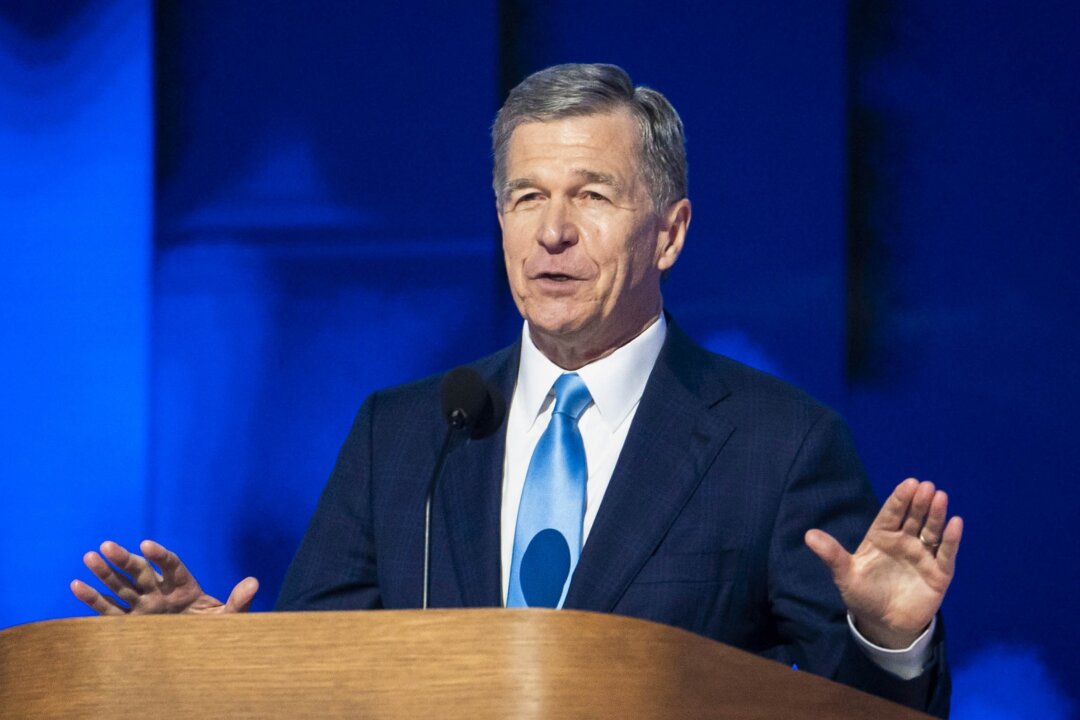
Former Gov. Roy Cooper, a Democrat, won the Senate race in North Carolina on Nov. 3, flipping the seat from the Republican Party.
He defeated former Republican National Committee Chairman Michael Whatley. Cooper will succeed Sen. Thom Tillis (R-N.C.), who decided not to run for reelection after breaking with President Donald Trump on the 2025 GOP spend-and-tax legislation, known as the One Big Beautiful Bill Act.
Cooper, who served as governor of the Tar Heel State between 2017 and 2025, led in the polls before the election by 10.8 percentage points in the RealClearPolitics average.
Cooper’s polling advantage caused Republicans to divert money for Whatley toward competitive races. The Senate Leadership Fund, which supports Republicans for Senate, canceled $18 million it had planned to spend in North Carolina in October, according to AdImpact, after having spent about $32 million overall.
Whatley was endorsed by President Donald Trump before he entered the race. The president said in July 2025 that Whatley “would make an unbelievable senator.”
With his win, Cooper continued his streak of never losing an election. In addition to winning his gubernatorial races in 2016 and 2020, Cooper won his races for attorney general and served as North Carolina’s top prosecutor between 2001 and 2017.
The last time Democrats won a Senate contest in North Carolina was 2008. Trump won the state in his presidential campaigns in 2016, 2020, and 2024.
Cooper mainly ran on affordability. This included reducing the cost of food and groceries in numerous ways, such as reversing Trump’s tariffs.
His platform also consisted of making healthcare affordable, including reinstating Affordable Care Act tax credits and reversing Medicaid cuts. The tax credits expired at the end of last year as most Republicans were against extending them, while Democrats called for the credits to continue.
Republicans made cuts to Medicaid as part of the One Big Beautiful Bill Act, saying they were targeting waste, fraud, and abuse in the program. Democrats criticized the cuts as benefiting the wealthy and corporations.
Cooper also ran on lowering energy and utility costs. He called for data centers to incur costs from using power as opposed to passing them onto consumers. He also encouraged large tech companies to have their own energy sources in order to reduce consumer utility costs.
Whatley ran on enacting Trump’s agenda in the Senate. His platform also included making North Carolina safe, combating illegal immigration, and delivering hurricane relief.
During the campaign, Whatley blamed Cooper for affordability issues.
“When it comes to our economy, and we talk about affordability, we talk about high prices, we talk about the ditch that Roy Cooper and Joe Biden put America in with the economy,” he said in September.
Cooper blamed Trump for the state of the economy and tied Whatley to the president.
“You have a situation where [Whatley] is cheering on the war in Iran, and his oil stock goes up, and people are paying more at the pump,” Cooper said.
“That’s money out of people’s pockets and into his,” he continued. “When utility rates go up, money out of people’s pockets and into his, and he’s not going to change when he gets to United States Senate.”
The Associated Press contributed to this report.
We had a problem loading this article. Please enable javascript or use a different browser. If the issue persists, please visit our help center.