
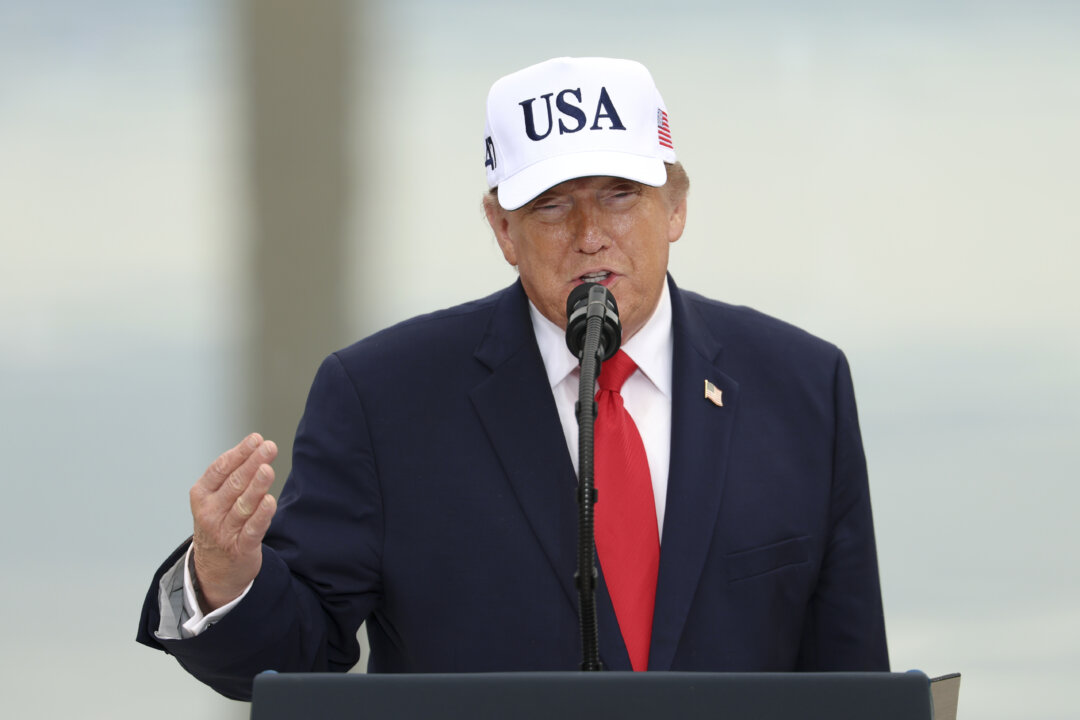
President Donald Trump gave a one-word answer Nov. 2 when asked by a reporter if he was considering renewing strikes against Iran after the midterms.
“No.”
The president made the statement to a White House correspondent as he left the Lincoln Reflecting Pool following his final campaign speech before midterm election polls open Tuesday.
Trump also hinted Monday that the United States could reach a settlement with Iran as talks continue in Qatar.
“Iran wants a settlement, as soon as possible. It could happen!” Trump posted on social media Monday.
The president confirmed Nov. 1 that he “had a very good talk” with Israeli Prime Minister Benjamin Netanyahu to discuss the Iran conflict, which has entered its ninth month.
The suggestion for a diplomatic resolution has signaled possible progress for an agreement among the countries as the threat of renewed strikes looms.
Trump said Oct. 23 that he may launch a “little” version of Operation Epic Fury against Iran unless they agree to a deal, referencing the U.S. military operation that started the conflict in late February.
Vice President JD Vance also suggested Monday that there was reason to believe that the United States and Iran could still come to an agreement.
“We’ve had a number of good conversations with the Iranians,” Vance told reporters. “I actually just spoke with the president of the United States about an hour ago about this. Look, the president and I both feel pretty good about the prospects for potentially coming to a negotiated settlement. We’re going to keep on working at it.”
The United States and Iran continued indirect diplomatic discussions in Qatar over the weekend. Trump said they still needed to address one or two Iranian nuclear sites.
Iran’s Foreign Minister Abbas Araghchi told the Islamic Republic News Agency on Nov. 2 that meetings in Qatar and Pakistan were ongoing. Iran had presented its conditions and proposals, and “now everything depends on how much political rationality prevails on the American side and whether there is a will to take the wise path of diplomacy or, as in previous instances, to drag the situation toward aggression and military operations,” he said.
The Iranian Foreign Ministry spokesperson urged Arab states to stop enabling attacks on Iran from their territories.
U.S. Secretary of State Marco Rubio told reporters on Oct. 31 that Trump would prefer to solve the conflict in Iran diplomatically.
“What President Trump has expressed is that if the United States needed to do something militarily on Iran, we would have the ability to do it,” Rubio said. “We have everything we need to be successful, but we would prefer to do it peacefully.”
Rubio said Washington would not allow Iran to acquire nuclear weapons, saying Tehran remained a source of instability across the Middle East through its support of regional armed groups.
Mohammad Bagher Ghalibaf, speaker of the Iranian Parliament and one of the country’s top negotiators, said Oct. 29 that Iran’s conditions have been “repeatedly and clearly stated to the mediators.”
“The carrot-and-stick approach has no effect on Iran,” Ghalibaf posted on X. “Progress can only be achieved once Iran’s seven conditions have been agreed upon.”

Iran’s conditions include an end to all hostilities and military operations, including in Lebanon, a release of Iranian funds and financial assets, lifting of the U.S. naval blockade, an end to what it said was interference in internal affairs, a stop to attacks in Iran, compensation for war-related damages, and lifting of oil sanctions and bans.
Iranian Parliament member and former Foreign Minister Manouchehr Mottaki told IRINN TV on Nov. 1 that a renewed conflict could mean Iranian missiles reach European countries that had allowed U.S. military jets to launch strikes against Iran from their bases.
Officials confirmed that the United States launched a defensive strike on Iran’s Qeshm Island in the Strait of Hormuz on Monday. The island functions as a major underground missile fortress for Iran.
Five blasts were heard across the island, and residents said they spotted two aircraft in the skies, the IRNA news service reported.
A White House official said the United States is in a “very strong position” with control of the Strait of Hormuz and with the Iranian economy collapsing.
“The Commander in Chief has all options available at any time,” the U.S. official told The Epoch Times. “President Trump holds all the cards and will do whatever is best for the United States.”
Ryan Morgan contributed to this report.
We had a problem loading this article. Please enable javascript or use a different browser. If the issue persists, please visit our help center.