
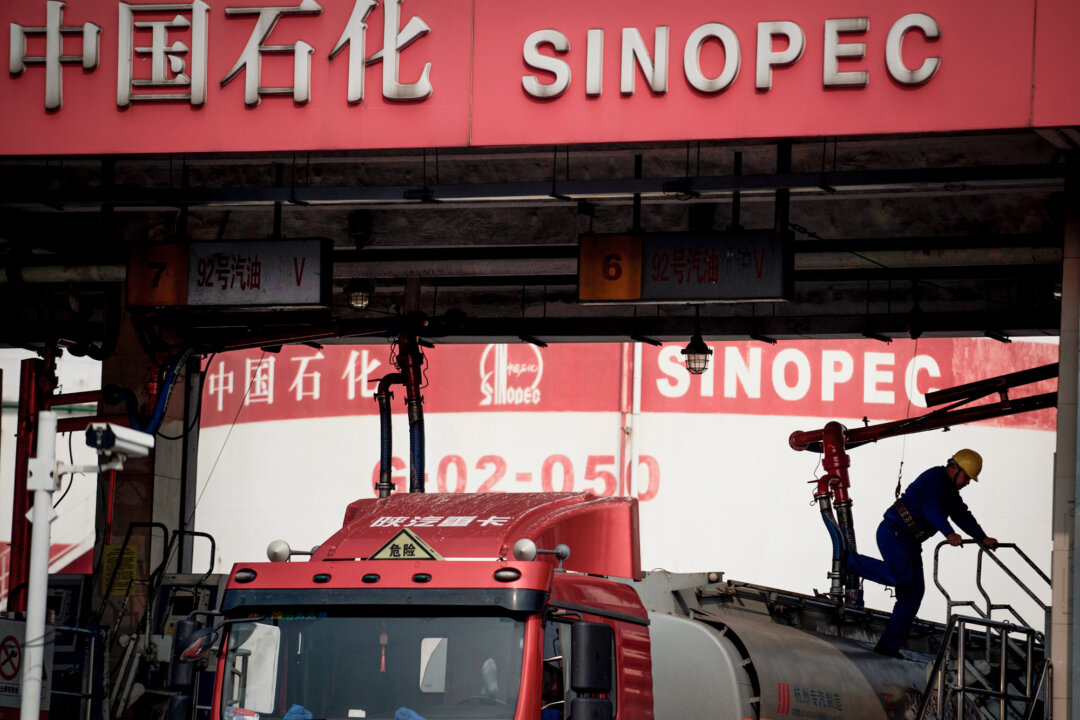
Enormous expansion in China’s chemical manufacturing is squeezing foreign producers out of its domestic market and intensifying competition overseas, according to a new report, as American chemical companies struggle with global oversupply and low prices.
China accounts for more than 45 percent of the world’s production capacity for basic chemicals and plastic resins, the Rhodium Group said in a report released on Nov. 2. Its chemical output has grown 18-fold over the past 25 years.
The buildup has created more production capacity than Chinese customers can absorb. As demand weakened, prices fell, inventories accumulated, and producers faced shrinking profits.
Foreign chemical manufacturers are being squeezed in two ways. They are losing sales in China as Chinese companies replace imported products, while facing increasing competition from Chinese exports in other countries.
Rhodium found that the decline in China’s chemical imports has so far hurt foreign producers more than its growing exports.
American Manufacturers Face Global Oversupply
The pressure on American chemical manufacturers has already led to plant closure decisions.
Houston-based Westlake Corporation announced in December 2025 that it would shut down four chemical production units in Louisiana and Mississippi, affecting approximately 295 employees.
The closures involved chemicals used to make plastics and other industrial products, including polyvinyl chloride (PVC), commonly used in pipes and construction materials.
In a filing with the Securities and Exchange Commission, Westlake said global overcapacity and increased low-priced Asian exports had depressed prices for some of its chemical products.
The company said three of its North American production units were no longer globally cost-competitive when serving export markets because of high manufacturing and transportation costs. It also decided to exit styrene production because of an unfavorable export outlook.
Westlake estimated approximately $415 million in charges related to the closures and was expecting the changes to improve annual operating earnings.
Beijing Seeks More Growth Despite Excess Capacity
China’s chemical industry expanded rapidly over the past two decades as Beijing promoted domestic manufacturing and sought to reduce dependence on imported industrial materials.
But the collapse of China’s property market beginning in 2021 weakened demand for chemicals used in construction, just as investments in new production facilities accelerated, Rhodium said.
Despite acknowledging weak demand and intense competition, Beijing continues to pursue growth in the sector.
A September 2025 industrial plan issued by seven Chinese regime agencies targets average annual growth of more than 5 percent in the value added by the petrochemical and chemical industries during 2025 and 2026.
The plan calls for curbing some new production capacity while upgrading existing facilities, developing more advanced chemical products, and expanding into international markets.
Rhodium said those measures could make Chinese producers more efficient without substantially reducing the amount of surplus capacity.
The firm expects Chinese manufacturers to compete increasingly in specialized chemicals, a market where foreign companies have traditionally enjoyed higher profit margins.
US Trade Investigation Underway
American chemical producers are also seeking protection through U.S. trade laws.
On Oct. 20, the Commerce Department opened investigations into whether certain chemical compounds imported from China were being sold at unfairly low prices or benefiting from government subsidies.
The investigations followed petitions from New Jersey-based Evonik Corporation and Texas-based Huntsman International.
The compounds, known as amines, are used in various industrial processes and products. The investigations concern specific chemical imports, not China’s entire chemical industry.
Commerce reported alleged dumping margins of 244.94 percent to 352.32 percent. The figures represent claims under investigation, not established violations.
The U.S. International Trade Commission is scheduled to vote on Nov. 12 on whether there is a reasonable indication that the imports are harming or threatening American manufacturers. An affirmative decision would allow the investigations to proceed.
Rhodium warned that tariffs targeting individual Chinese chemical products would not fully address the pressure on foreign manufacturers. Chinese chemicals can also reach overseas markets as ingredients in finished goods, while foreign producers continue losing sales within China itself.
We had a problem loading this article. Please enable javascript or use a different browser. If the issue persists, please visit our help center.