
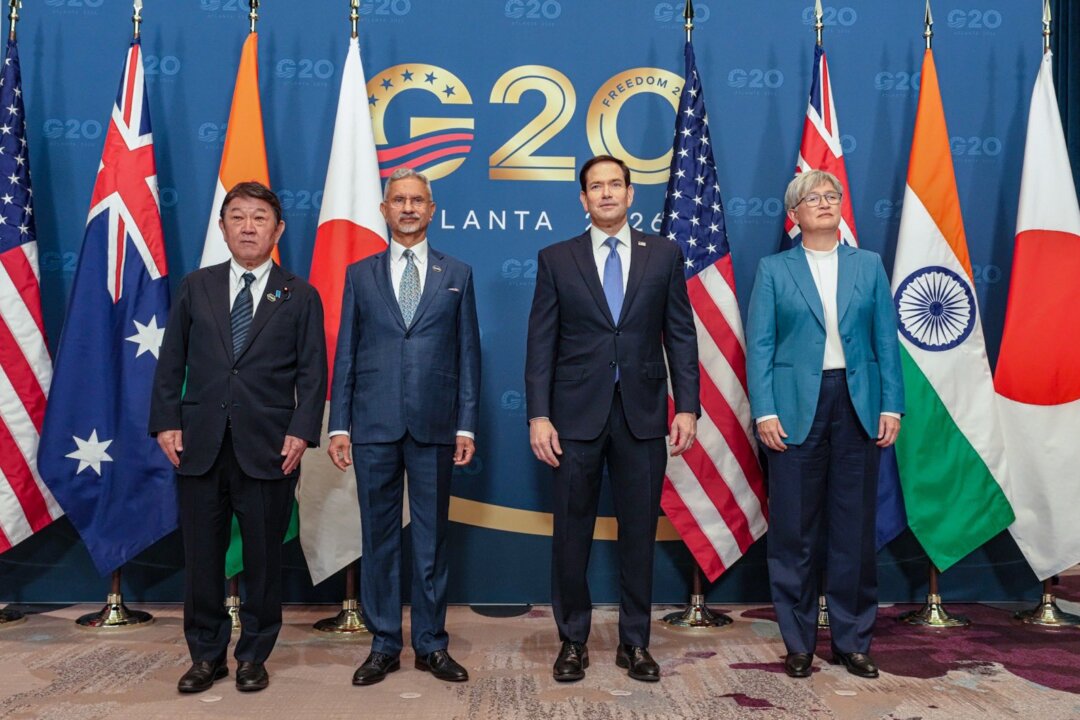
The United States, Japan, Australia, and India announced new measures on Oct. 31 to secure critical minerals and advanced computer chips, moving ahead with specific supply-chain projects as the world’s major economies discussed how to reduce dependence on concentrated sources of essential materials.
The four countries, known collectively as the Quad, met in Atlanta on the sidelines of a Group of 20 (G20) foreign ministers’ meeting, where supply-chain security was a major topic.
The Quad announced a $10 million U.S. commitment to support critical-mineral recycling in India and Southeast Asia, along with a new effort to identify potential disruptions in semiconductor production.
In a joint statement, the ministers also expressed grave concern over economic coercion, arbitrary export restrictions, and government policies that disrupt global supply chains.
The statement did not name China, but when asked whether the criticism was directed at Beijing, Secretary of State Marco Rubio pointed to the repeated conduct of one country.
“Now, those activities or behaviors are coming repetitively from one country; that’s going to be obvious to everybody,” Rubio told reporters.
He said the Quad was not an anti-China coalition but a partnership concerned about particular actions rather than opposition to any country.
China’s Dominance in Critical Minerals
China dominates the production of numerous minerals essential to electronics, defense equipment, and advanced technologies.
According to a U.S. Geological Survey report published in June, China was the world’s leading producer of 39 mineral commodities in 2023, accounting for 98 percent of global production of refined gallium, a material used in specialized semiconductors.
Beijing has imposed export controls on several critical minerals, including gallium, germanium, graphite, and rare earths.
The USGS warned that Chinese restrictions on minerals for which the country holds a majority share of global production could cause considerable supply-chain disruptions.
Japan also raised the issue at the G20 meeting. Foreign Minister Toshimitsu Motegi said arbitrary export restrictions threatened stable supplies of critical minerals, while excessive subsidies and other non-market practices made global supply chains more vulnerable.
The Quad had already criticized such restrictions in May, when it established a framework to coordinate investment in critical-mineral mining, processing, and recycling.
The Atlanta meeting added specific funding and projects to that earlier agreement.
New Recycling and Technology Projects
The United States committed $10 million to support facilities recovering critical minerals from electronic waste and industrial scrap in India and Southeast Asia. The Quad also plans to simplify cross-border shipments of recyclable materials.
For advanced chips, the four countries announced an initiative to identify supply-chain weaknesses before disruptions occur. They also intend to provide more than $85 million in technical and financial assistance to expand access to trusted artificial intelligence technologies across the Indo-Pacific.
The ministers announced their first Quad Business Leaders’ Forum to encourage commercial partnerships. Export-credit agencies, which help finance international trade and investment, are scheduled to meet in Tokyo on Nov. 18 to pursue further cooperation.
After the meeting, Rubio wrote on X that the Quad was making progress in turning shared priorities into benefits for the Indo-Pacific through stronger supply chains, new technologies, maritime cooperation, and critical minerals.
G20 Seeks Broader Supply-Chain Cooperation
The Quad announcements followed two days of G20 discussions on energy security, supply chains, and geopolitical tensions.
A G20 chair’s statement called for greater transparency, investment, and cooperation with businesses to expand critical-mineral processing, refining, and recycling. Unlike the Quad announcement, the statement did not specify new jointly funded mineral-recycling projects.
Rubio acknowledged that the G20 countries recognized the supply-chain problem but had not agreed on collective solutions.
“We all agree there’s a problem, but obviously there’s work to be done to find agreement on—collectively on solutions,” he told reporters.
We had a problem loading this article. Please enable javascript or use a different browser. If the issue persists, please visit our help center.