
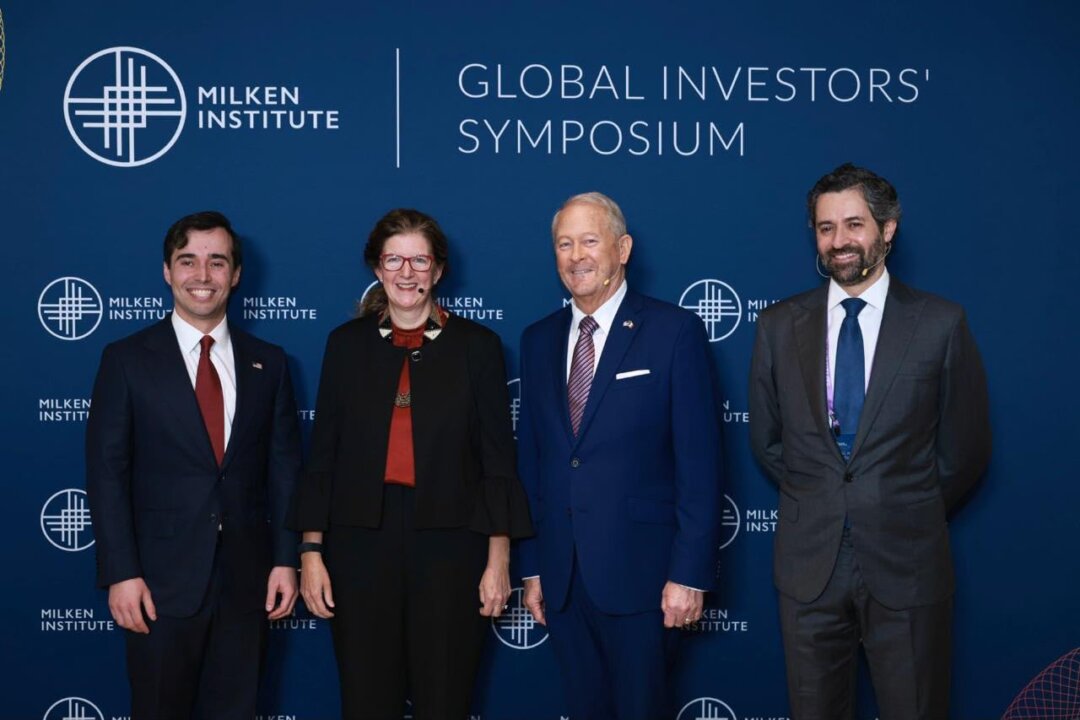
U.S. Ambassador to Mexico Ronald Johnson accused Beijing of welcoming instability along America’s southern border and using business incentives to foster economic dependence and disorder in Mexico.
“If Mexico is chaotic, unsecure on the U.S. southern border, China would be happy with that,” Johnson said on Oct. 28 at the Milken Institute’s Global Investors’ Symposium, where senior American officials linked Mexico’s economic development to security and the future of North American trade.
He further alleged that Beijing was willing to provide incentives to businesses even at a financial loss to “create a dependency and create that chaos.”
Ricardo Pita Macedo, the State Department’s deputy assistant secretary for North America, delivered a separate warning at the symposium about Chinese involvement in sensitive industries.
“Chinese companies cannot be trusted with critical infrastructure, emerging technologies, or natural resources,” he said.
Pita Macedo said that the United States and Mexico must consider not only how much they trade but also which companies they can trust to build critical infrastructure.
Mexico Tightens Investment Reviews
Pita Macedo welcomed Mexican measures to protect domestic industries and North American supply chains, citing tariffs on more than 1,000 products from countries without trade agreements, anti-dumping investigations, and a proposed national-security review of foreign investment.
He also said future ports, power grids, and communications networks should be built by companies that follow established rules.
A day before the symposium, Mexico’s Congress gave final approval to legislation expanding government scrutiny of foreign acquisitions in sensitive industries and sent the measure to President Claudia Sheinbaum for the next constitutional steps.
Under the reform, foreign investors seeking more than 49 percent ownership of a Mexican company operating in sectors such as energy, mining, artificial intelligence, cybersecurity, or critical infrastructure would face additional review if the company’s assets exceed a threshold set by regulators.
The National Foreign Investment Commission would be able to approve transactions, impose conditions to address security risks, or block acquisitions. Defense and public security officials would participate in the reviews.
The legislation does not single out China.
US Promotes Energy, Technology, and Financing
Beyond investment safeguards, Pita Macedo promoted greater American participation in Mexico’s energy and manufacturing industries.
He said U.S. power and natural gas companies were prepared to help Mexico expand reliable electricity supplies and modernize its power grid. He also identified the U.S. International Development Finance Corporation and Export-Import Bank (EXIM) as potential financing partners.
At a subsequent panel, Sarah Whitten, chief commercial officer of EXIM, outlined four financing priorities: American equipment exports, energy, critical minerals, and advanced technologies.
Whitten said the bank had established a financing program for overseas mining projects supplying critical minerals to the United States, either directly or through allied countries.
She also described efforts to finance American technology abroad, emphasizing trusted suppliers and coordination with other federal agencies.
Those efforts already have a foothold in Mexico. In September 2025, EXIM approved nearly $185 million in financing for Mexican freight operator Grupo México Transportes to purchase modernized locomotives from U.S.-based Wabtec. The bank said the transaction would support 600 American manufacturing jobs.
Johnson separately questioned the intentions of Chinese businesses seeking access to Mexican resources near the United States, saying that the United States, Mexico, and Canada could develop their own resources into manufactured products for global markets.
Mexico Seeks Continued China Cooperation
Mexican Foreign Minister Roberto Velasco Álvarez offered the country’s perspective during a later discussion at the same symposium.
Velasco Álvarez said Mexico wanted to diversify its international relationships without replacing its most important trade partnership—with the United States and Canada.
He also said Mexico intended to maintain political dialogue and cooperation with Beijing. Velasco Álvarez had visited China several weeks earlier, and President Claudia Sheinbaum planned to travel there for November’s Asia-Pacific Economic Cooperation summit.
“We have a history of good political relations with China,” Velasco Álvarez said, adding that Mexico wanted to maintain cooperation while pursuing its own manufacturing and investment priorities.
Velasco Álvarez also expressed cautious optimism about negotiations with Washington over tariffs and other trade barriers, while declining to predict when an agreement might be reached. He said the two governments were separately discussing the review of the United States-Mexico-Canada Agreement, including rules governing where products must be made to qualify for trade benefits.
China’s Embassy in Mexico rejected the American officials’ remarks on Oct. 30, denying that Beijing wanted instability in Mexico and accusing Washington of disparaging Chinese businesses to promote American commercial interests.
We had a problem loading this article. Please enable javascript or use a different browser. If the issue persists, please visit our help center.