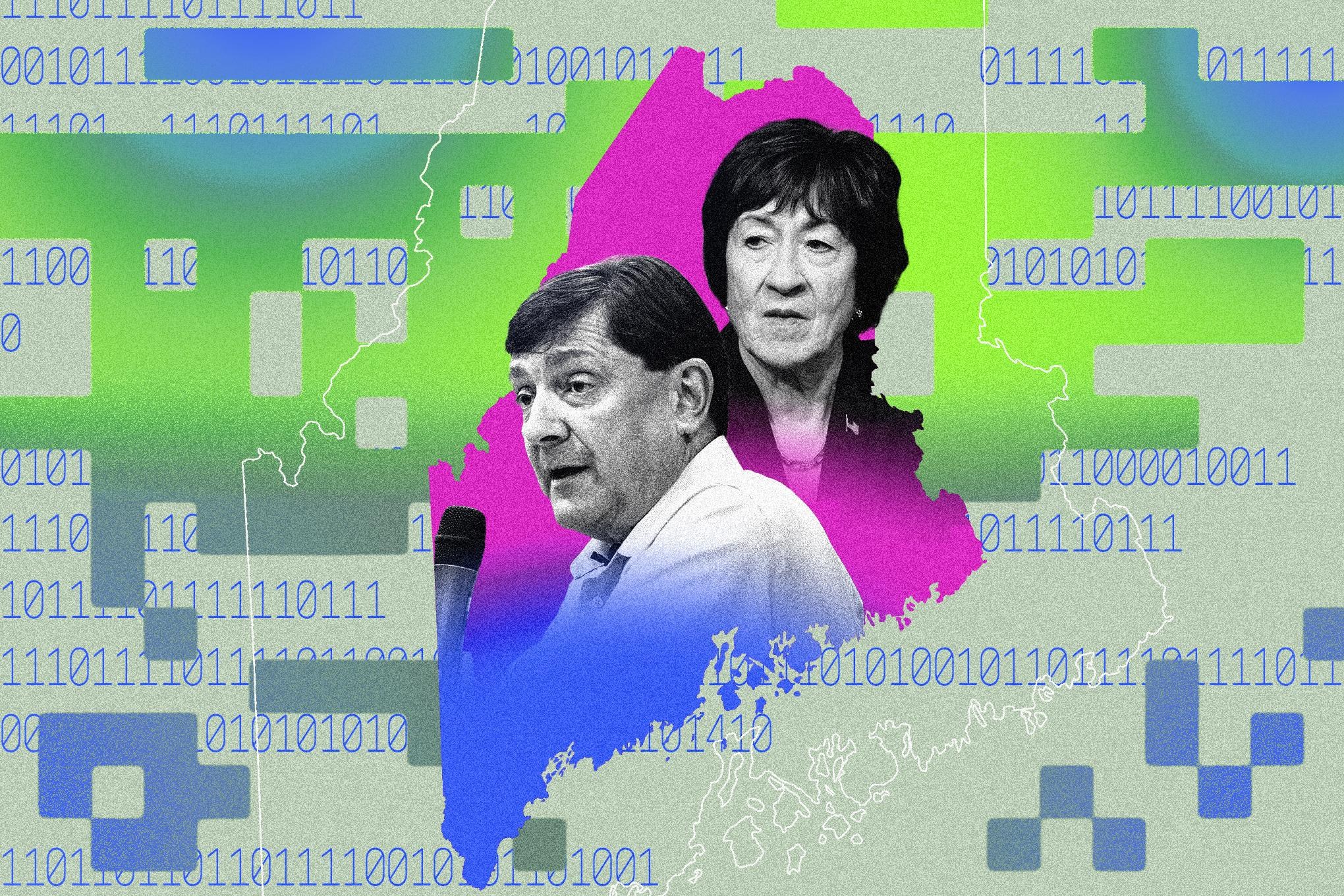
As tech billionaires pour record millions into Maine’s high-stakes Senate race, rural voters push back against the resource strain, rising utility costs, and phantom jobs of the AI data center boom.Oct 30, 2026, 11:00 AM UTC Image: Cath Virginia / The Verge, Getty ImagesAs tech billionaires pour record millions into Maine’s high-stakes Senate race, rural voters push back against the resource strain, rising utility costs, and phantom jobs of the AI data center boom.Oct 30, 2026, 11:00 AM UTCMaine Sen. Susan Collins, a Republican, was midway through defending her record during the final debate of the midterms when an audience member cut her short.“I’m terrified,” a man shouted. “AI data centers are destroying our climate. They are poisoning our water.” Collins brushed off the outburst, tying the man to her Democratic challenger, Troy Jackson. But the fear echoing through the auditorium wasn’t so easily dismissed. Just days before voters head to the polls, the rapid expansion of resource-hungry data centers has exploded into one of Maine’s most volatile campaign issues.Maine drew national headlines in April when the state Legislature passed what would have been the nation’s first statewide moratorium on large data centers — had Gov. Janet Mills not vetoed the bill 10 days later. But the fight hasn’t slowed down, with towns across the state adopting temporary moratoriums or putting the question of data center expansion to voters this November. In a September poll of Mainers by UMass Lowell and YouGov, 76 percent of respondents said they oppose building a data center in their community, with 58 percent strongly opposed.Maine’s hotly contested Senate race is set to be the most expensive Senate race per capita that the US has ever seen, with Democrats spending a projected $81 million and Republicans $114 million. Much of that campaign cash has come from the very industry Mainers and rural voters across the country have been fighting for more than a year. The outcome of the race will help determine which party controls the Senate and help shape federal data center and AI policy, impacting data center construction not just for Maine residents, but for the entire country.Cheap land, rich waterMaine and other rural states are becoming prime targets for new data centers. While cities run short on land and power, Maine has abundant cheap land, vacant industrial mills and buildings, and ample access to water, thanks to its numerous rivers and waterways. Recognizing the high stakes, major tech companies and private equity firms tied to data centers and AI have invested millions in the midterms to win over skeptical locals.The issue has sparked fierce local debate, leading towns and cities across the state to enact temporary bans this summer.Molly White, the researcher, writer, and software engineer behind Tech Influence Watch, says that voters are paying a lot of attention to the issue because they connect data centers to rising costs for utilities. As White points out, many Mainers are also already feeling the pinch due to record-high heating oil costs this fall, and “they’re now looking at an election where the question is, is this candidate going to invite a data center to move in next door, and then my electricity prices go up, or the knock-on effects are going to hurt me even more when I’m already in very dire straits?” she said.White launched her site in 2024 to track crypto spending in political races, but has since expanded it to monitor AI and Big Tech investments. White says the playbook that AI and data center backers are using in the midterms is very similar to the one the cryptocurrency industry used in 2024.“There’s a lot going on in this election,” White says, “but I do think it has been a big issue in Maine and across the country, where you’ll go to a political event, you’ll see people asking questions of candidates, and AI keeps coming up. Certainly there’s a lot of questions about the economy, the war, all these different things, but AI is the new one.”Data center developers and their political allies often sell rural Maine communities on long-term job creation — a promise economists say rarely materializes. In reality, economic research indicates that most data centers create virtually no net employment once construction is complete.Historically, Maine’s industry has centered around lumber and timber, shipbuilding, commercial fishing, textiles, and pulp and paper manufacturing. The timber industry contributed around $8.3 billion to Maine’s economy in 2024, but Donald Trump’s tariffs and rising operating costs have hit it hard, resulting in mill closures and layoffs.Mark Brewer, who chairs the political science department at the University of Maine, says Maine’s history complicates the debate. These former mill towns jump at the chance to rebuild their local tax bases and infrastructure, but past boom-and-bust cycles make residents cautious.“Maine has a long history of extractive industries providing jobs,” Brewer says, which allowed Mainers to tolerate these industries despite the state’s environmental focus. With data centers thus far, he says, “the jobs part of it’s not there. It’s one thing to put up with a paper mill that’s employing three shifts of 1,000 workers, right? Data centers aren’t doing that.”For many rural Mainers, the question is not only whether a data center will bring jobs back, but whether to trust the companies promising them or the government helping make the deal, said Nicholas Jacobs, the director of the Public Policy Lab at Colby College in Maine. These residents say they’re concerned about the opaque ownership of these data centers, limited long-term employment, and the risk of wealth being extracted from rural communities.Tech millions fuel Collins’ reelection war chestTech and AI interests see an ally in Susan Collins, the 73-year-old Republican chair of the Senate Appropriations Committee. Like most congressional Republicans, she has largely supported data centers and AI, though she has said she believes data centers should be evaluated on an individual basis. Collins has even used her position as head of the Appropriations Committee to secure $6.2 million in federal funding for a high-performance computing hub data center in central Maine, which is designed to bolster localized AI and biotech research. Her stance has brought in a tremendous amount of campaign donations from Big Tech, AI, and data center donors for her reelection bid.Collins’ individual donors include Alex Karp, the cofounder and CEO of Palantir; Marc Andreessen and Ben Horowitz of VC firm Andreessen Horowitz, which heavily backs data centers; and others from Google, Meta, and Microsoft. According to White’s donation tracker, Collins has received $325,644 from AI and crypto donors. Nearly 100 billionaires have donated to Collins’ reelection bid in some form or another.Super PACs like the Republican Senate Leadership Fund dumped nearly $42 million into ads across Maine. Elon Musk gave $158 million to the Senate Leadership Fund this summer, and has spent around $450 million of his own money to support Republicans in the midterms. Musk’s America PAC has spent around $2.1 million in Maine. Pine Tree Results PAC, to which Collins and her husband have personal ties, put $29.1 million into the race to support her. Stephen Schwarzman from Blackstone has donated $2 million this year to Pine Tree Results.A recent FEC report flagged by the Maine Newsroom shows that Musk’s corporate SpaceX PAC gave $55,000 to Collins’ Victory Committee in August and another $50,000 to the Pine Tree Results PAC.The campaign and PAC money appears to flow in support of just one candidate, too. Collins’ opponent Troy Jackson only recently filed his FEC paperwork, which shows no obvious data center, AI, or Big Tech ties, though it does show at least four billionaire donors. However, Jackson’s stance is similar to Collins’, and he focuses largely on putting guardrails in place for AI and data center development. He has said he wants to ensure union jobs for the buildout and maintenance of data centers in the state.Collins’ ties to data centers don’t stop with her donors. Her family has actual stakes in the AI boom. Earlier this month, Forbes ranked Collins’ household fifth in the Senate for AI- and data center-linked investments, with an estimated $300,000 to $800,000 held in her husband Thomas Daffron’s name.Daffron is a former lobbyist and was paid consulting fees in 2025 by the lobbying firm of Scott Reed. Reed chairs Pine Tree Results, the super PAC with close ties to Collins. And according to American Journal News and The New York Times, Reed’s firm lobbied for a developer that has built data centers in Maine. Collins’ financial disclosure shows that she and her husband hold assets worth anywhere from $4 million to $10 million.Jackson, who started as a logger before he was elected to the state Senate, has most recently earned money from consulting, and he and his wife hold assets worth anywhere from $147,000 to $430,000. He doesn’t have any reported financial ties to data centers, AI, or Big Tech interests.Outside money and extractive boom-and-bust fears fuel backlashBillionaire influence tends to spark partisan backlash, White notes, adding that Mainers resent wealthy outsiders trying to buy their votes. Jacobs agrees, noting that many Maine voters harbor a deep, long-standing skepticism toward anyone from “away” looking to exploit local resources.“Rural wealth exists, but it is extracted out of the community, and that’s the game of rural living,” Jacobs says. “You harvest your timber; you send it away. You harvest your crops; you send them away. It’s extractive, but there’s a fine line between an extractive economy and an exploitive economy. And so I do think that there is a history and maybe even a culture of wariness towards that form of exploitation.”Brewer says he is skeptical that the huge amount of campaign spending will sway rural voters’ views about data centers. If anything, voters may punish Collins for her ties to Elon Musk and other unpopular tech billionaires.Much of the campaign spending from the super PACS with a vested interest in data centers and AI has flooded the airwaves and mailboxes with hostile attack ads, Jacobs and Brewer note. With broadcast television inventory completely sold out, campaigns have shifted money into radio, social media, and direct mail. The sheer volume has pushed voters past their breaking point, Brewer says, calling the contest “the most negative race” he has tracked in 25 years of observing Maine politics.According to a recent Maine Monitor report, as of mid-October, $54 million has been spent or committed for negative attack ads, and nearly all of it is coming from outside PACs financed by Big Tech and data center supporters, not the candidates’ campaigns. While no ads have focused specifically on Collins’ support for data centers and AI, some have targeted her ties to Big Tech, billionaires, and data centers through her husband. The National Republican Senatorial Committee tried to tie Troy Jackson to Senate Democrats’ opposition to the Husted legislation in September in a press release.“That is where the overwhelming amount of money is going,” Jacobs says about the attack ads. “It’s ads, and then paying consultants to write the ads, polling, paying the consultants to do the polls, right? The worst case is that it tarnishes the image of democracy in voters’ minds, and I think that is the most significant consequence beyond any quid pro quo relationship.”As Jacobs notes, many Maine voters, especially independents, are conflicted about data center investment in the state. They are deeply attached to their community and wary of outsiders changing it, while also worried their children won’t be able to afford to stay or find good jobs without the influx of tech money.“I think many people throughout Maine worry about the future and whether or not their children will be able to afford to live there,” he says. “Whether there will be jobs. Both of these things are true … Data centers just seem to be this symbolic flashpoint of that tension in rural living.”Follow topics and authors from this story to see more like this in your personalized homepage feed and to receive email updates.Abigail BassettThe Verge DailyA free daily digest of the news that matters most.Email (required)By providing your information, you agree to our Terms of Use and our Privacy Policy. We use vendors that may also process your information to help provide our services. This site is protected by reCAPTCHA and the Google Privacy Policy and Terms of Service apply.
Maine’s data center revolt will decide who controls the Senate