
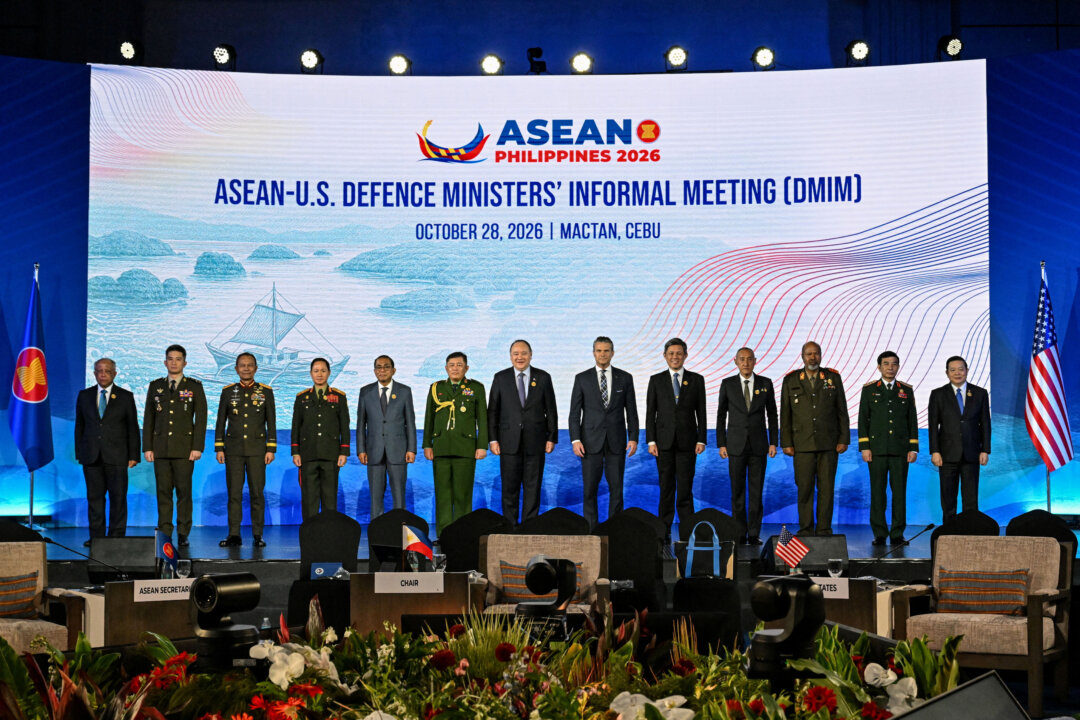
U.S. Defense Secretary Pete Hegseth has called for more ambitious cooperation with Southeast Asian nations, including stronger military ties, amid continuing disputes over the South China Sea.
Speaking to defense chiefs from the Association of Southeast Asian Nations (ASEAN) in Cebu, Philippines, on Wednesday, he proposed a new U.S.–ASEAN defense framework and pledged that Washington would defend its interests and those of its allies and partners.
Hegseth said the framework would coordinate joint efforts over the next several years, adding that Washington would continue pursuing practical cooperation with ASEAN partners to improve maritime awareness, strengthen military coordination, and expand cooperation between regional navies.
“These are not symbolic things. They are concrete demonstrations of what serious partners do,” Hegseth said. “Serious partners train together, learn together, plan together, and build the confidence and competence necessary to prevent conflict.”
Washington is ready to begin work on the proposed framework as Singapore prepares to assume the chairmanship of the ASEAN Defence Ministers’ Meeting-Plus (ADMM-Plus) next year, Hegseth said.
Hegseth’s latest proposal builds on remarks he made in 2025, when he called for the United States and ASEAN partners to develop a shared network capable of monitoring activity at sea and responding more quickly to security challenges.
“We need to develop our joint capabilities to respond,” Hegseth said at the time, adding that countries facing “aggression and provocation” should not have to respond alone.
The United States has increasingly emphasized maritime cooperation with Southeast Asian partners amid ongoing tensions in the South China Sea.
China continues to reject a 2016 Permanent Court of Arbitration ruling that found no legal basis for many of Beijing’s claims in the South China Sea.
Several ASEAN members, including the Philippines, Vietnam, Malaysia, and Brunei, claim parts of the disputed waters. The Philippines has faced repeated confrontations with Chinese vessels in recent years and has called for a stronger regional response.

On the sidelines of the meetings in Cebu, Hegseth met with counterparts from the Philippines, Japan, India, and South Korea, along with other defense chiefs.
After meeting Philippine Defense Secretary Gilberto Teodoro Jr., Hegseth said, “We are accelerating efforts to modernize the [Armed Forces of the Philippines] and enhance our interoperability along the First Island Chain.”
Hegseth and Japanese Defense Minister Shinjiro Koizumi agreed to strengthen military cooperation through realistic training and exercises across Japan, including live-fire exercises.
The Cebu meeting followed a coordinated anti-ship strike by U.S. and Japanese forces during the Keen Sword 27 military exercise, according to an Oct. 26 U.S. military statement provided to The Epoch Times.
The exercise involved more than 56,000 personnel from the United States, Japan, and partner nations. It tested the allies’ ability to detect approaching warships, share targeting information, and coordinate attacks from different locations.
Hegseth also praised ASEAN’s role in sustaining the ceasefire along the Thailand–Cambodia border, saying the organization had shown what it could achieve “when it acts with purpose and resolve.”
We had a problem loading this article. Please enable javascript or use a different browser. If the issue persists, please visit our help center.