
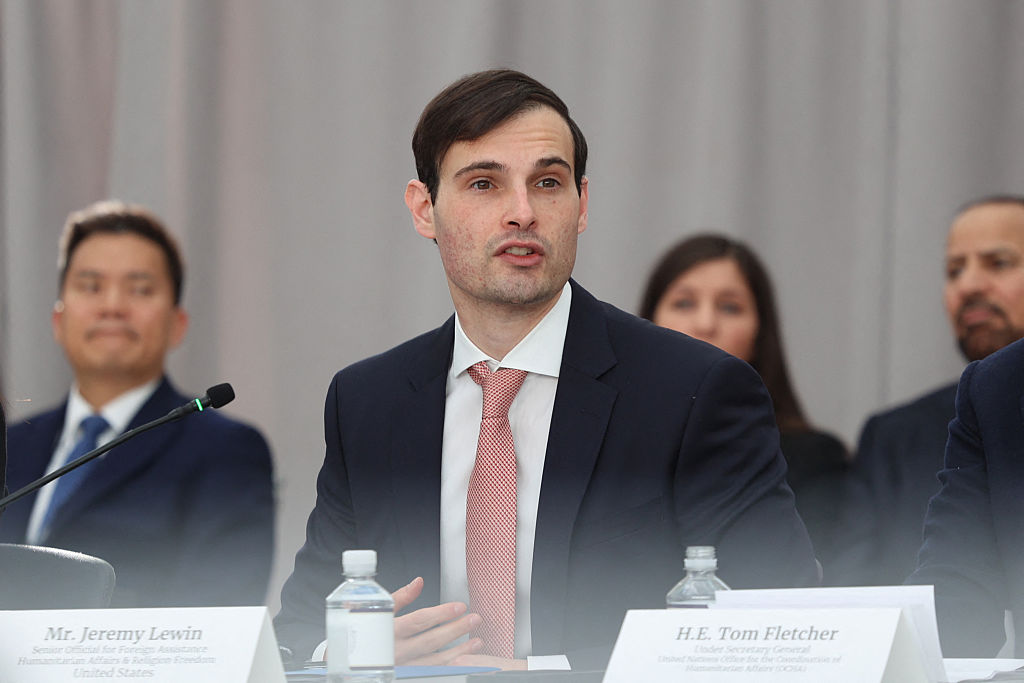
U.S. State Department policy planning chief Jeremy Lewin said on Oct. 27 that he was leaving after nearly two years in the role.
Lewin served as a top adviser to Secretary of State Marco Rubio and helped implement the Trump administration’s Western Hemisphere policies, according to his State Department biography.
The 29-year-old announced his departure on social media, saying he planned to return to the private sector.
“It has been the privilege of a lifetime to work for [President Donald Trump] and @SecRubio, and I’m eternally grateful for their trust in me to execute their foreign policy vision,” he wrote in a post on X.
“President Trump has put decades of post-Cold War malaise behind us—permanently transforming U.S. foreign policy to put Americans first, keep them safe, and drive peace and shared prosperity in key regions. I look forward to supporting the Administration as a private citizen.”
The State Department did not immediately respond to a request for comment.
Lewin joined the Trump administration as part of the Department of Government Efficiency (DOGE), led by SpaceX and Tesla CEO Elon Musk, who served as a presidential adviser. The temporary organization formally ceased operations in July after its 18-month limited term expired.
He helped dismantle the U.S. Agency for International Development, which Trump and Musk accused of waste, fraud, and abuse.
The State Department later restored or revamped some programs. Lewin oversaw that process as acting undersecretary of state for foreign assistance, humanitarian affairs, and religious freedom. In late August, he began his stint as the department’s director of policy planning.
Before joining the government, Lewin worked as an investment banker, investor, and lawyer specializing in banking regulation and constitutional law.
According to his State Department biography, Lewin was the only person under 30 to have served as either policy planning chief or acting undersecretary of state.
During his tenure at the department, he supported efforts to dismantle drug-smuggling networks in the region and implement the administration’s policies toward Venezuela and Cuba.
U.S. forces carried out airstrikes on Venezuela’s capital, Caracas, on Jan. 3 and captured then-Venezuelan leader Nicolás Maduro and his wife, Cilia Flores, from their residence to face drug and arms-related charges in the United States.
After Maduro’s ouster, interim Venezuelan leader Delcy Rodríguez redirected oil deliveries to the United States. Trump later said that communist-ruled Cuba would no longer live off Venezuelan oil. Cuba has relied on Venezuela’s oil supply for decades.
Trump signed an executive order in late January imposing tariffs on any country that “directly or indirectly provides oil to Cuba,” a move that exacerbated fuel shortages in the Caribbean island nation.
In his order, Trump accused the Cuban regime of aligning itself with “hostile countries, transnational terrorist groups, and malign actors,” including Russia, China, and Iran, as well as U.S.-designated foreign terrorist groups Hamas and Hezbollah.
Reuters contributed to this report.
We had a problem loading this article. Please enable javascript or use a different browser. If the issue persists, please visit our help center.