
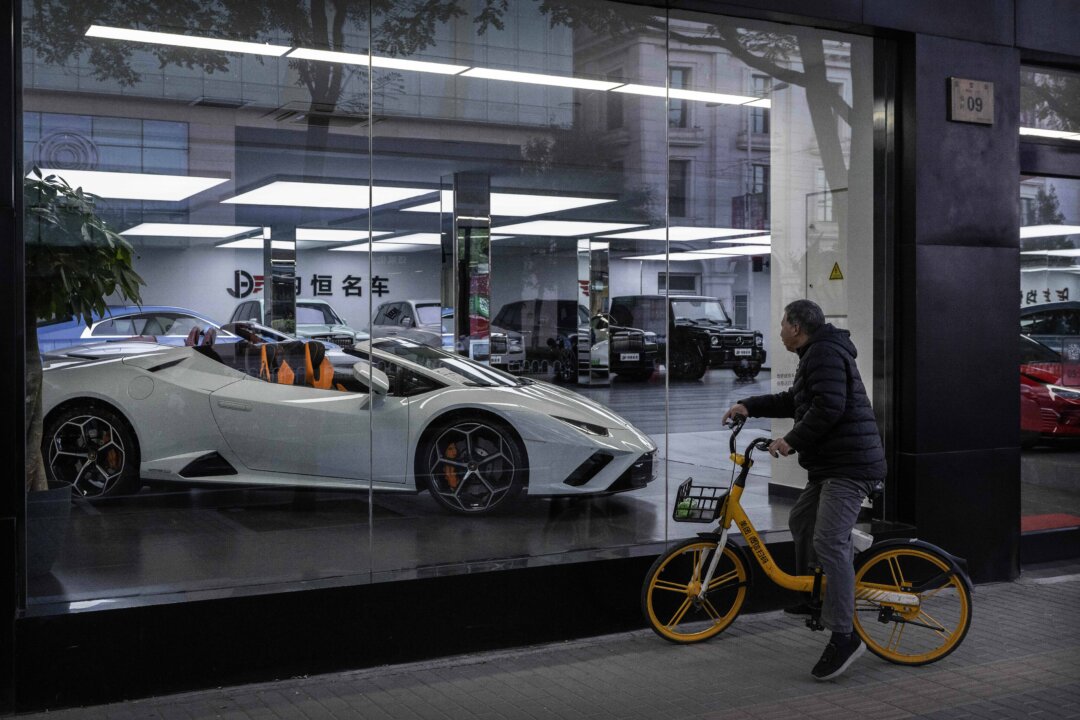
Chinese sales of imported vehicles, especially luxury cars, continued to plummet in September, according to the latest data, which analysts said is a manifestation of factors contributing to a sluggish economy.
Cui Dongshu, Secretary-General of the China Passenger Car Association (CPCA), released the September data on Oct. 25.
Imports totaled 21,000 units—a 49 percent year-on-year decrease and a 6 percent month-on-month decline.
For the first three quarters, total imports reached 290,000 units, down 20 percent year-on-year, while retail sales fell by 39 percent over the same period.
The decline in imported luxury vehicle sales was most pronounced in major cities and regional hubs in China.
Guangzhou saw the sharpest drop at 46 percent, while Chengdu, Hangzhou, Nanjing, and Zhengzhou all experienced declines exceeding 40 percent.
However, a few oil-producing cities in western China saw an increase in sales.
August imports totaled 23,000 units, representing a 51 percent year-on-year drop and a 48 percent month-on-month decline.
In the first nine months of 2026, China’s total vehicle imports reached 290,000 units, a year-on-year decrease of 20 percent.
The decline in sales for ultra-luxury brands has been particularly prominent.
According to a report by major Chinese financial media outlet Yicai on Oct.26, Maserati’s sales in September totaled 17 vehicles—a 79.5 percent year-on-year drop.
Lamborghini saw 21 sales, down 63.8 percent year-on-year; Ferrari recorded 22, down 48.8 percent; and Bentley reached 99, down 40 percent.
Furthermore, sales for Jaguar plummeted from 1,937 vehicles in the same period last year to just 6—a decline of 99.7 percent.
Analysts note that the cooling demand for imported luxury cars is linked to factors such as China’s slowing economic growth, a sluggish real estate market, and weak consumer confidence.
Most luxury car owners in China are rich businessmen, senior corporate officials, and the upper middle class, noted Xu Zhen, a senior professional in China’s finance sector.
“Their expectations for the future are getting worse and worse. Not only are their wallets thinner, but their confidence in the economy has also collapsed,” he told The Epoch Times.
Another factor is political, Xu said.
“It’s the fear of showing one’s wealth—in the political atmosphere of ‘common prosperity,’ driving a luxury car to show off one’s wealth may lead to audits, fines, and tax payments. This is a worry for many wealthy people in China.”
At least three overlapping factors are collectively reshaping the effective demand, relative prices, and competitive landscape of China’s automotive market, Davy J. Wong, a U.S.-based independent political economist, said of the sharp drop in sales of imported cars.
“China’s macroeconomy remains under sustained pressure, with weakness in consumer spending—initially concentrated among the general population—now spreading to higher-income groups,” Wong told The Epoch Times.
“Meanwhile, medium and small-sized enterprises are facing operational difficulties, a trend that is beginning to impact the high-end consumer market.”

The primary buyer demographic for imported luxury vehicles includes not only high-income professionals but also private enterprise owners, operators of small and medium-sized enterprises and corporate executives, Wong pointed out.
When businesses face challenges such as shrinking profit margins, a lack of orders, intense price competition, difficulties in collecting accounts receivable, or strained cash flow, business owners—even those with substantial personal assets—may cut back on non-essential, high-value expenditures, he said.
“Consequently, a decline in luxury car sales may reflect not just individual purchasing power, but also the operational pressures facing the private sector.”
Furthermore, the negative wealth effect resulting from a decline in real estate values further dampens the consumption propensity of middle- and high-income households, Wong pointed out.
“In first- and second-tier cities, household wealth is closely tied to the real estate market. A sustained correction in housing prices erodes household net worth, borrowing capacity (via mortgage financing), and expectations regarding future wealth,” he said.
Another factor is that imported cars have long been subject to a high comprehensive tax burden, according to Wong.
“Imported cars usually involve a 15 percent vehicle tariff, a 13 percent value-added tax, and a consumption tax based on engine displacement,” Wong noted.
“The consumption tax rate for large-displacement imported cars can reach up to 40 percent, and qualified ultra-luxury cars are also required to pay additional consumption tax.
“It is not uncommon for the sales prices of some imported luxury cars in China to be 50 percent to 150 percent higher than in overseas markets,” he said.
“The tax system changes the relative competitive conditions between imported and domestically produced cars.”
The third factor is that the Chinese regime influences the structure of automotive consumption through industrial policies, preferential market access, and the shaping of public opinion, Wong said.
“For a long time, the Chinese government has promoted electric vehicles (EVs) through fiscal subsidies, purchase tax exemptions, industrial investment, support from local governments, and specific license-plate policies,” he said.
In some cities, owners of traditional internal combustion engine (ICE) vehicles must participate in a lottery or an auction to obtain a license plate, whereas qualifying EVs benefit from more favorable licensing policies, Wong noted.
Some cities also impose driving restrictions on ICE vehicles, while EVs enjoy varying degrees of preferential access or exemptions from such restrictions, he added.
In major cities, in particular—which host a high concentration of affluent households and private enterprise owners—one also finds the most intense intersection of vehicle license plate restrictions, initiatives to promote new energy vehicles, and competition among high-end domestic electric vehicles, Wong said.
“The widening decline in sales of imported luxury cars in these cities is likely a direct manifestation of the combined impact of these various factors.”
In the past decade or so, foreign automakers, especially German ones, have set up factories to produce vehicles at a much lower cost than their production plants in Europe.
The performance of German automakers’ locally produced vehicles in China is also declining sharply.
Mercedes-Benz saw its second-quarter sales in China fall by 30 percent year-on-year, even as sales grew by 5 percent in Europe and 15 percent in North America during the same period.
Meanwhile, BMW’s deliveries in China plummeted by 24.8 percent year-on-year in the third quarter, whereas its sales in the United States and Europe rose by 2.5 percent and 2.7 percent, respectively, over the same timeframe.
According to data from the China Association of Automobile Manufacturers, from January to September this year, domestic automobile sales fell by 22.4 percent year-on-year, while vehicle exports surged by 65.8 percent, a stark contrast that highlights a “cold at home, hot abroad” scenario, Xu said.
In response to the surge of Chinese vehicle exports, the United States has set up high tariff barriers and imposed bans on connected vehicles, effectively blocking Chinese cars through measures targeting tariffs, technology, and security, Xu noted.
Meanwhile, the European Union—pursuing a strategy of “trading market access for technology”—has adopted an increasingly assertive approach, employing a three-pronged strategy involving tariffs, quotas, and localization requirements, he said.
Luo Ya and Xia Song contributed to this report.
We had a problem loading this article. Please enable javascript or use a different browser. If the issue persists, please visit our help center.