
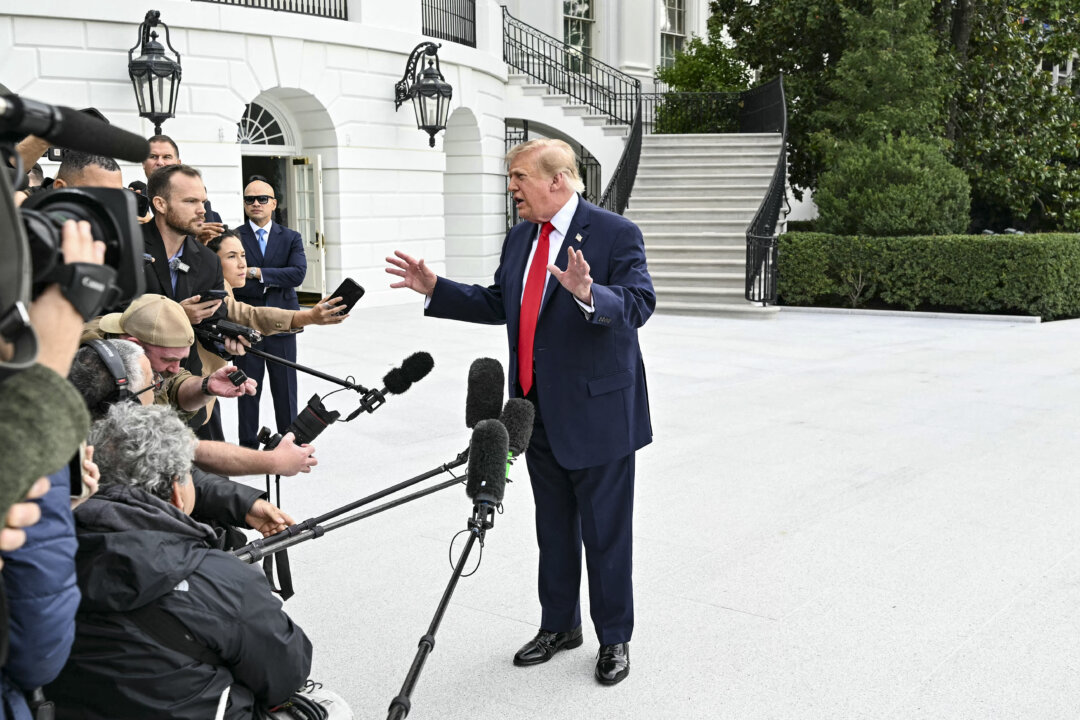
The White House policy of restricting access to journalists deprives the public of independent reporting and violates the First Amendment, a group of journalists and professors claimed in a federal lawsuit on Oct. 26.
The lawsuit, filed by Columbia University and Yale Law School organizations on behalf of six people, asks the court to find President Donald Trump’s policy unconstitutional and seeks a ban on future retaliatory restrictions for all White House reporters and news outlets.
The complaint alleges that the plaintiffs rely on White House reporting in their teaching, scholarship, journalism, and advocacy.
On Sept. 18, Trump banned three news outlets—CNN, MS NOW, and Politico—for what he said was constant reporting of “fake news” and unfavorable coverage. The president pointed to coverage of his deals with drugmakers that did not mention deals that had lowered prices.
The ban was met with criticism from the National Press Club and the White House Correspondents’ Association asking the president to reverse the decision. Several major television networks also temporarily suspended pooled coverage of the president in protest.
The banned news outlets filed a claim in court and were granted a restraining order from the ban on Sept. 24.
Katie Fallow of the Knight First Amendment Institute at Columbia University, one of the organizations leading the Oct. 26 lawsuit, said the restrictions harm the public interest.
“The First Amendment protects the public’s right to know what its government is doing. The White House cannot decide what information Americans receive by punishing critical reporting,” Fallow said.
In the complaint, the groups argue the White House has threatened to ban other journalists and news organizations if they fail to conform to the president’s preferences.
The lawsuit filed on Oct. 26 differs from the claim filed by banned news outlets seeking restoration of their access, because it seeks a broad injunction that would protect the entire White House press corps, the groups said.
The six plaintiffs are Kenneth Roth, a Yale Law School scholar; Daniel Froomkin, editor of Press Watch and former Washington Post columnist; Yale professor Beverly Gage; New York high school teacher Peter Schmidt-Nowara; Benjamin Wittes, editor-in-chief at Lawfare; and Ethan Young, editor-in-chief at The Daily Pennsylvanian at the University of Pennsylvania.
The White House declined to comment directly about the lawsuit on Oct. 26, but an official said that no one was allowed to demand access to the president’s private office.
“No person may demand access to the Oval Office,” the official told The Epoch Times in an email. “Media that [peddle] misinformation and defamation are completely capable of reporting their manufactured stories from directly outside.”
In February 2025, the president banned The Associated Press from the Oval Office and other executive spaces after the wire service declined to change the name of the Gulf of Mexico to the Gulf of America in its stylebook. A federal judge entered an injunction against the ban, finding that it violated the First Amendment because it discriminated based on The Associated Press’s viewpoint.

An appeals court ruling later that year partially stayed the injunction, allowing Trump to ban The Associated Press from the Oval Office, Air Force One, and other spaces, finding that the White House can retain discretion in those spaces and choose which outlets can be admitted.
The White House applauded the court’s decision at the time, saying The Associated Press’s lawsuit against Trump was “baseless.”
“AP’s outrageous, self-absorbed actions are an embarrassment to journalism,” a White House spokesman told The Epoch Times following the appeal court’s decision on July 22, 2025.
The spokesman also said that the Trump administration was “the most accessible and transparent in history” and that the access granted to the White House press corps represented “a complete reversal from the secretive and inaccessible Biden administration.”
In 2017, the Knight First Amendment Institute sued Trump over blocking users from his personal Twitter account. The Supreme Court dismissed the lawsuit as moot after Twitter banned his account in 2021.
We had a problem loading this article. Please enable javascript or use a different browser. If the issue persists, please visit our help center.