
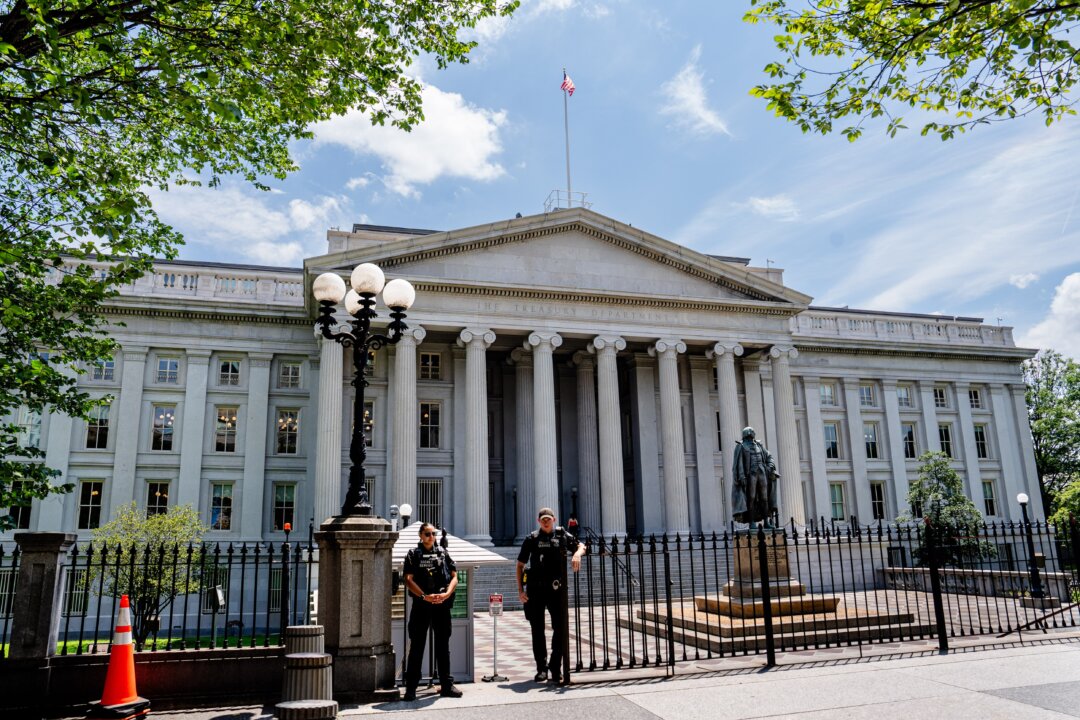
The Treasury Department has proposed adding biotechnology to restrictions on American investment in Chinese companies and widening an existing ban on investing in Chinese artificial intelligence businesses.
The proposal, announced Oct. 22, would also extend the China-focused program to Cuba, Iran, North Korea, and Russia.
Treasury says the restrictions are intended to prevent American money, business expertise, and connections from helping foreign adversaries develop technologies that could strengthen their military, intelligence, and surveillance capabilities.
Some investments would be banned outright. Others could proceed but would have to be reported to Treasury, generally within 30 days after completion. Ordinary purchases of publicly traded stocks and investment funds would generally remain exempt from this program, subject to conditions.
The proposal would implement legislation Congress passed in December 2025 to expand an existing U.S. investment-control program. The proposed changes have not taken effect, and Treasury is accepting public comments through Dec. 7.
Broader AI and Tech Investment Limits
The existing program began in January 2025 under a 2023 presidential executive order, initially targeting certain U.S. investments in Chinese artificial intelligence, semiconductor, and quantum technology companies.
Under the proposal, certain investments in companies in or linked to the targeted countries that develop AI systems would be prohibited, including investments that currently require only reporting to Treasury.
In an Oct. 23 email to The Epoch Times, Treasury said the proposed approach would no longer require investors to assess the “technical capabilities or thresholds” of AI systems.
Treasury explained in the proposed rule that improvements in algorithms and other techniques have made computing-power thresholds increasingly unreliable, while general-purpose AI systems may have national-security applications even when they were not designed for military use.
The proposal would also expand restrictions involving advanced computer chips and quantum technologies and broaden controls on high-performance computing and hypersonic systems.
It would further strengthen restrictions involving companies linked to the Chinese military. Certain investments that would otherwise require only reporting could become prohibited if the company involved, or an affiliate or subsidiary, appears on specified U.S. government lists.
These would include the Pentagon’s list of Chinese military companies and a federal list of biotechnology companies of concern.
200 Potential Transactions Annually
Treasury told The Epoch Times that the department estimates around 200 investment transactions annually could fall under the proposed regulations.
According to the proposed rule, Treasury examined data on approximately 300 investments by nearly 230 U.S.-based investors over three years, then doubled the annual average to account for potentially missing transactions.
The estimate does not mean all 200 transactions would be prohibited or require reporting.
American investors would have to determine whether their transactions fall within the rules. Treasury is considering a public database identifying some companies subject to the restrictions, but has not committed to establishing one.
Treasury announced its first civil enforcement penalty under the existing program on Oct. 7, a $200,000 penalty against Amidi LLC, the parent company of Plug and Play Tech Center.
Treasury said a Chinese investment fund controlled by Amidi invested about $92,500 in Shanghai-based AI and robotics company Noematrix in April 2025 without filing the required notification.
The violation concerned failure to report the investment, not a finding that the investment itself was prohibited.
Chinese Foreign Ministry spokesperson Mao Ning criticized the proposed expansion on Oct. 23, accusing Washington of using national security to justify discriminatory investment restrictions.
Congressional Support and Industry Concerns
Treasury proposes prohibiting certain American investments involving pharmaceutical compounds, genetic-sequencing equipment, brain-computer interfaces, and technologies used to automate laboratory research.
The proposal explicitly includes pharmaceutical compounds such as vaccines, cell and gene therapies, and other medicines. The restrictions would target specified investments involving covered companies, rather than prohibit pharmaceutical development or sales generally.
Treasury says advanced biotechnology could contribute to biological-weapons development, military capabilities, surveillance, and threats to American supply chains.
The National Security Commission on Emerging Biotechnology, a congressional advisory body, welcomed the proposal.
The commission said on Oct. 22 that Washington lacks a sufficiently clear picture of American investment in China’s biotechnology industry and needs to prevent U.S. capital from supporting technologies that could threaten national security.
The Biotechnology Innovation Organization, a U.S. industry group, cautioned against overly broad restrictions.
“We cannot restrict our way to success,” BIO President and CEO John F. Crowley said in an Oct. 22 statement.
Crowley warned that excessive restrictions could create uncertainty for biotechnology companies and investors, weakening American competitiveness as the United States competes with China.
In its response to The Epoch Times, the department recognizes that biotechnology investment restrictions could have “countervailing effects on national security” if they lead to significant public-health risks or harm U.S. businesses.
The spokesperson said Treasury is particularly interested in public comments addressing those concerns.
We had a problem loading this article. Please enable javascript or use a different browser. If the issue persists, please visit our help center.