
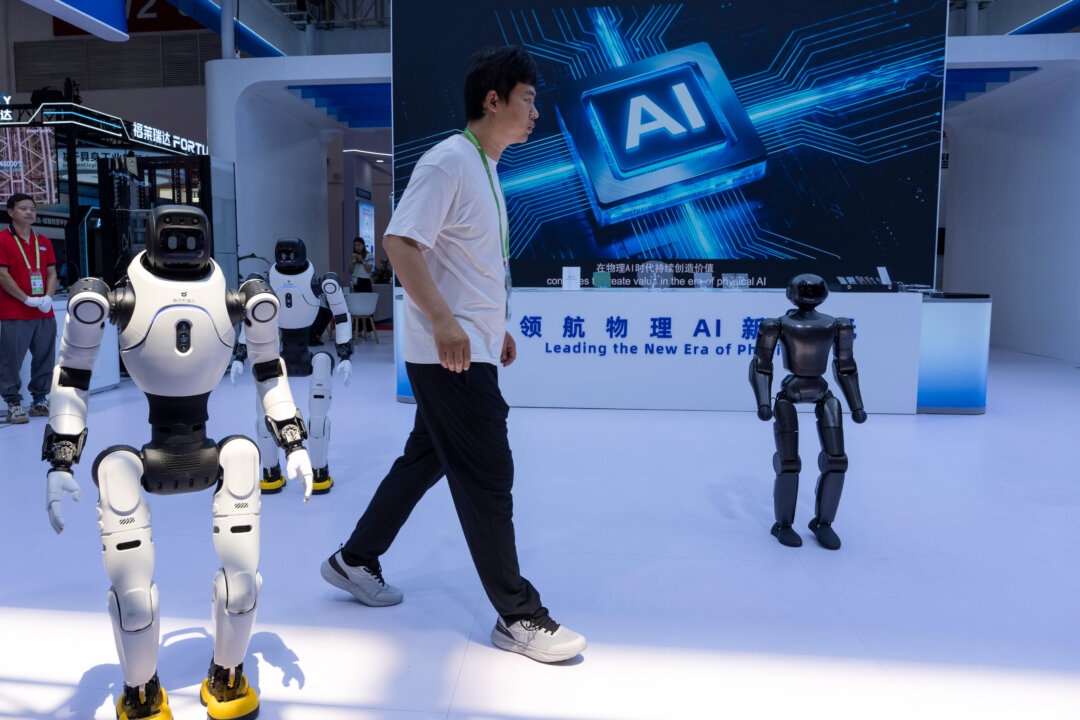
China’s proposal of new export controls on 40 technologies spanning AI, biotechnology, and solar technologies could give it leverage in trade negotiations but also encourage other countries to build alternative supply chains, analysts say.
China’s Ministry of Commerce announced the proposal on Oct. 16, citing national security as the reason. The ministry stated it was working with the Ministry of Science and Technology to expand the country’s list of technologies subject to export bans or restrictions.
The proposal covers 23 AI technologies, five biotechnology and pharmaceutical technologies, and 12 solar photovoltaic technologies. Of these, 14 would be prohibited from export, while 26 would face restrictions.
The ministry said the proposed AI technology controls would prevent them from being used to attack sensitive national infrastructure or bypass national security defenses. It described the proposed controls on pharmaceutical technologies as necessary to safeguard national security and biological security, and those on solar technologies as protecting national security interests.
Beijing Seeks Leverage
The announcement comes about three weeks after Chinese leader Xi Jinping visited the United States from Sept. 23 to 26.
Although Xi and U.S. President Donald Trump agreed to extend their trade-war truce through to January 2027, the agreement has not resolved deeper structural tensions between the two countries.
Su Tzu-yun, a research fellow at Taiwan’s Institute for National Defense and Security Research, told The Epoch Times that China’s proposed export controls on technology were primarily a political signal in response to U.S. restrictions on Chinese technology use in America.
“The matter remains undecided. [Beijing] is making a political statement,” Su said.
The proposal would also expand the impact of China’s new overseas travel regulations that took effect on Sept. 15. They bar Chinese citizens who have violated export control or tech import-export rules from leaving the country.
Su said that although China’s AI development faces hardware constraints due to U.S. export restrictions on advanced semiconductors to China, its software capabilities have advanced relatively quickly. The proposed controls could therefore help Beijing restrict the outflow of engineers, industry personnel, and software technologies, he said.
China also holds a significant position in global pharmaceutical manufacturing, giving Beijing an incentive to use its drug-related technologies as bargaining chips, Su said. In solar power, the regime is seeking to control exports of technologies related to higher-efficiency cells.
The measures are a combination of political signaling and exercising its control over strategically important technologies, Su said.
Sun Kuo-hsiang, a professor in international affairs and business at Nanhua University in Taiwan, told The Epoch Times that Beijing is seeking to retain control over core technologies, manufacturing advantages, and technology transfers, while slowing foreign competitors and preserving leverage in negotiations.

Rare Earth Controls a Warning
Su compared the proposed technology restrictions to China’s export controls on rare earths.
China dominates the global rare earth mining, refining, and manufacturing supply chain, with a market share reaching 90 percent. Beijing has used export controls and licensing reviews to turn that dominance into geopolitical leverage in tariff disputes and in fighting against U.S. tech export restrictions.
China’s rare earth dominance prompted the United States and its allies to rebuild domestic production, develop alternative supply chains, and invest in recycling and substitute materials.
Su said similar dynamics exist with AI, pharmaceuticals, and solar power. But while China holds important manufacturing and processing capabilities, Western countries retain leading positions in much of the underlying research and advanced technology.
“In the short term, it will certainly have an effect,” Su said. “But in the long run, it will not be too difficult for the leader”—referring to the United States—“to rebuild these manufacturing processes. It is only a matter of time.”
Sun similarly said uncertainty caused by Chinese export control will drive global companies to diversify their supply chain, and encourage investment outside China.
“Beijing may therefore extend its short-term technological advantage, but it will also stimulate the development of alternative capabilities overseas, gradually weakening China’s long-term market position,” Sun said.
Su said that using export controls to pressure other countries could ultimately undermine trust in Chinese businesses abroad and strengthen the case for government restrictions on Chinese products and technology.
“China’s approach is like shooting itself in the foot: It brings short-term benefits, but in the long run, it yields nothing,” he said.

Cheng Wen and Yi Ru contributed to this report.
We had a problem loading this article. Please enable javascript or use a different browser. If the issue persists, please visit our help center.