
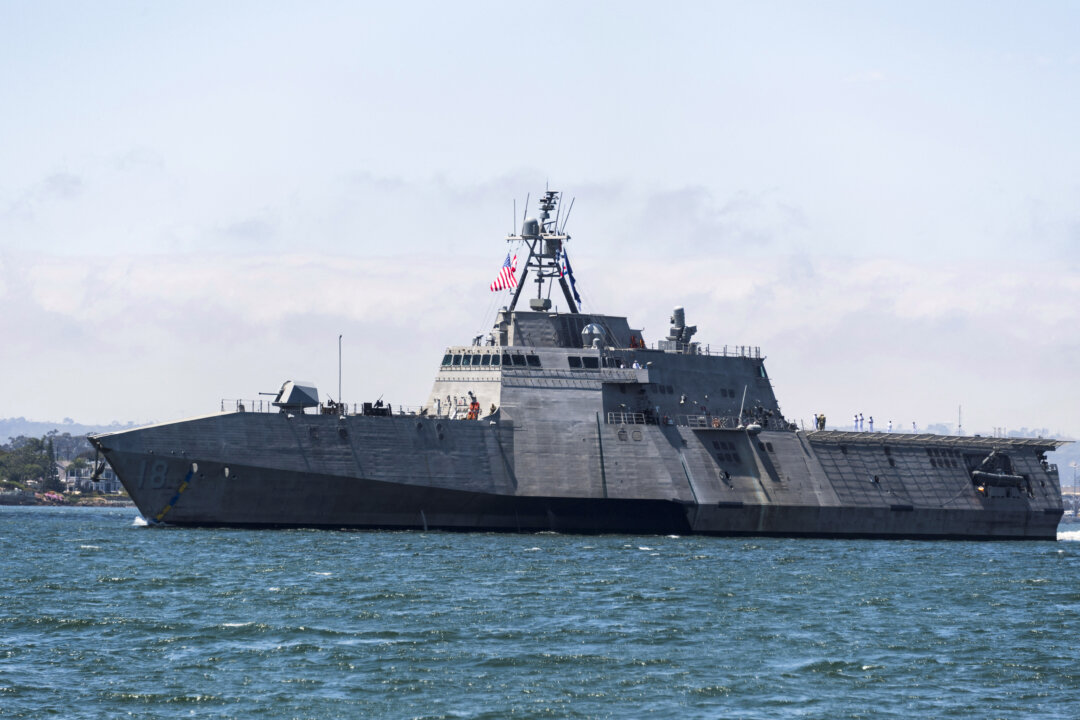
The U.S. Navy has rejected Beijing’s claim that a U.S. warship illegally entered the South China Sea, saying its ship was operating in international waters in accordance with international law.
A spokesman for the Chinese communist regime’s People’s Liberation Army (PLA) said the USS Charleston, a littoral combat ship, entered waters near Sabina Shoal—which the regime calls Xianbin Jiao—in the early hours of Tuesday, claiming that such entry requires the regime’s authorization.
The Chinese Communist Party (CCP) views almost all of the South China Sea as its own territory, despite claims by the Philippines, Malaysia, Vietnam, Taiwan, and Brunei.
A U.S. Navy 7th Fleet spokesperson told The Epoch Times in an email that the USS Charleston was conducting routine operations in international waters consistent with international law.
“All nations enjoy freedom of navigation and other lawful uses of the sea in this area,” the spokesperson said.
“The U.S. Navy has operated throughout the region for decades alongside our allies and partners. The United States will continue to fly, sail, and operate wherever international law allows in support of regional peace, stability, and security.”
A Chinese military spokesperson said in an Oct. 19 post on X that Beijing holds sovereignty over the Spratly Islands—which it refers to as Nansha Qundao—and its adjacent waters, and said the United States should “immediately cease” its activities there.
The spokesperson said the PLA Navy’s Southern Theater Command had “dispatched forces to track and monitor the U.S. vessel.”
A Philippine military spokesperson said USS Charleston “did not trespass into ‘Chinese territory’,” adding that it did not need permission for “lawful transit through international waters.”
Sabina Shoal, situated approximately 75 nautical miles west of Palawan, falls within the Philippines’ exclusive economic zone (EEZ) under international law.
In September 2024, Manila confirmed its commitment to maintaining a continuous presence at Sabina Shoal.
The Philippines is an ally of the United States, which has supported its legal position on the islands.
The CCP has repeatedly expressed dissatisfaction with the Philippines’ presence in the area, which it calls Xianbin Reef, or Xianbin Jiao.
In December 2025, a report by the Center for Strategic and International Studies’ Asia Maritime Transparency Initiative stated that the CCP has built several new facilities with intelligence and electronic warfare capabilities on its artificial islands—Fiery Cross, Mischief, and Subi reefs—in the Spratly Islands.
The Philippines summoned Chinese Ambassador Jing Quan on Monday to protest remarks suggesting Beijing could easily defeat the country militarily.
Philippine Foreign Secretary Maria Theresa Lazaro conveyed the Philippine government’s “serious concern and strong objection” to Jing’s remarks—made on Oct. 15—which the Philippine Department of Foreign Affairs said conveyed “a threat of the use of force.”
On March 16, the Philippines stated that it rejected Beijing’s claims to sovereignty over the entire South China Sea and denied the Chinese Embassy’s claim that a Filipino diplomat had conceded 36 years ago that the disputed Scarborough Shoal was not part of its territory.
“China must be reminded that maritime and territorial claims are subject to established international legal procedures and dispute settlement mechanisms, not through unilateral proclamations or social media posts,” Rogelio Villanueva, a spokesman for the Philippine Department of Foreign Affairs, said at the time.
In a separate incident on Tuesday, Taiwan’s coast guard said a Chinese coast guard ship had entered restricted waters near the Pratas Islands, which are claimed by Taipei.

A Taiwan coast guard vessel, the “Taichung,” was dispatched to warn away the Chinese ship.
The Taiwanese authorities said both ships exchanged political messages.
The Chinese ship broadcast messages deriding the “so-called Republic of China” and saying it does not exist, while the Taiwanese ship replied that “the Republic of China, Taiwan, is a sovereign and independent country.”
The Republic of China, founded in January 1912, was the name of the Kuomintang-ruled regime that was defeated on the Chinese mainland by the communists in 1949 and withdrew to Taiwan, and it remains the official name of the island.
Reuters contributed to this report.
We had a problem loading this article. Please enable javascript or use a different browser. If the issue persists, please visit our help center.