
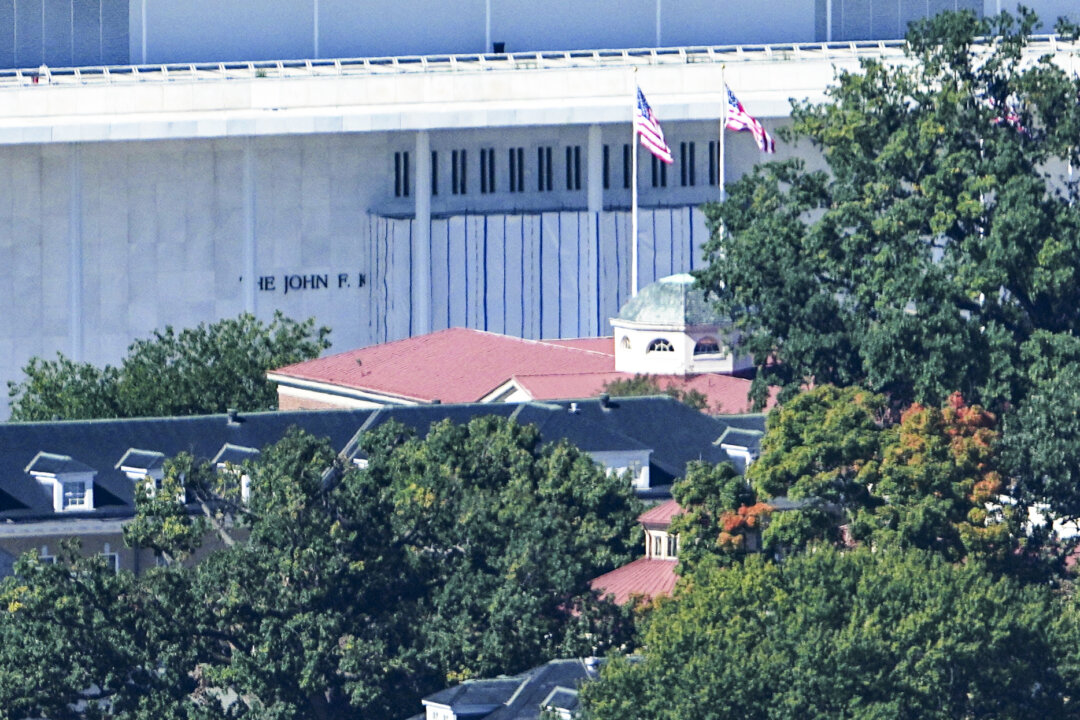
The White House is arguing it has executive privilege in preventing some of President Donald Trump’s communications from being published or used in a lawsuit targeting the Kennedy Center.
In court documents filed on Wednesday, deputy counsel to the president Joshua T. Hoyt wrote in a sworn declaration that “information, documents, and communications” from the president to his advisers as well as to the Kennedy Center’s staff about its operations should be barred from release amid the ongoing litigation.
“I submit this declaration formally invoking the presidential communications privilege with respect to” those materials that were requested for discovery in the case, Hoyt also wrote.
“The communications that Plaintiff seeks are those between the President, his advisors, and/or employees of the Kennedy Center who provided advice to the President and his staff concerning the President’s duties and the effective functioning of the Kennedy Center,” Hoyt wrote in a court filing in the U.S. District Court for the District of Columbia.
“These communications were intended to be confidential and have remained confidential.”
Hoyt further argued that executive privilege over the president’s communications is needed in this case because, without those safeguards, Trump’s staff and advisers “would be chilled” from carrying out their duties.
His filing was issued in response to Rep. Joyce Beatty (D-Ohio), a Kennedy Center board member challenging plans to shut down the Kennedy Center for renovations, and to add Trump’s name to the facility, as she seeks to obtain communications or documents related to Trump.
Earlier this month, Beatty submitted a motion to compel information from Trump because the president allegedly has refused to hand over “any documents” related to the Kennedy Center while seeking to block inquiry into those communications.
“The Department’s sweeping assertion of privilege, however, appears to be unprecedented,” her Oct. 5 filing states. “Donald Trump is the chair of a non-profit corporation’s board, and his decisions and directions lie at the heart of that board’s actions which, in turn, are the subject matter of this case.”
Also on Wednesday, the White House’s counsel wrote in a separate filing that Beatty’s demands are essentially a “fishing expedition” and argued that her attempts to produce Trump administration communications are unsubstantiated.
Beatty, they argued, could not “demonstrate that the information, documents, and communications she seeks are directly relevant to the Board’s votes to temporarily close the Center, the sole remaining issue in front of the Court,” it said.
Last month, the Kennedy Center’s board members voted to shut down the facility for two years, after a federal judge blocked a bid by Trump to return his name to the building.
Trump wrote in a Truth Social post at the time that the closure was required for safety-related repairs. The venue’s leaders have argued that the massive building, which began construction in 1965, was in dire need of renovations. A partial ceiling collapse in the building’s main hallway earlier this month intensified the calls for renovations.
U.S. District Judge Christopher Cooper wrote in September that the bid to add Trump’s name to the center’s facade was illegal.
“Simply put, Defendants cannot install memorials for President Trump or anyone or anything else at the Kennedy Center without Congress’s blessing. The board resolution bucks a federal court order and a statute Congress enacted,” Cooper stated.
The Associated Press contributed to this report.
We had a problem loading this article. Please enable javascript or use a different browser. If the issue persists, please visit our help center.