
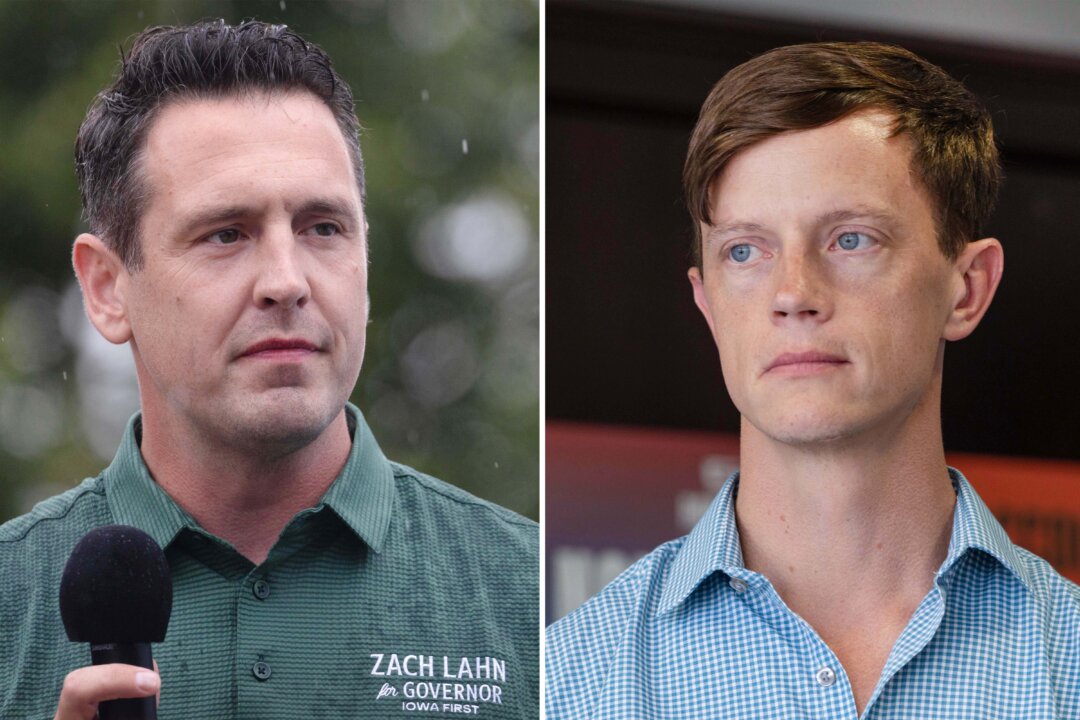
DES MOINES—Candidates for Iowa’s open governor’s seat faced off on Oct. 14 in an hour-long televised debate on KTIV in Sioux City.
Iowa’s state auditor Rob Sand sparred in a debate with no time limit restrictions against businessman and farmer Zach Lahn after election booths closed on the first day of early voting.
Sand, a Democrat, has a slight lead in the polls ahead of the general election battle and is trying to fend off Lahn, a Republican who beat the Trump-backed pick in the GOP primary.
Tax
During Wednesday night’s debate, Lahn suggested he wanted to make Iowa the first state to eliminate property taxes on primary-residence single-family homes.
Lahn said his proposal would be possible if Iowa eliminated tax breaks for data centers attempting to move in and also pitched the use of blockchain technology to detect fraud, making Iowa the first state to provide “radical transparency” about how taxpayer money is spent.
“We can root out waste and abuse, and we can start to add those funds back into a fund that would be set up for the purpose of lowering the property tax burden of the people of Iowa,” Lahn said.
Sand separately suggested a way to save tax dollars in the state would be to invoke an existing law that would make public servants pay for their wrongdoing—such as sexual harassment—as opposed to using taxpayer money for settlements.
Food
Debate moderators asked Lahn about his proposal to source 80 percent of lunches in Iowa public schools locally from farms and ranches in the state.
Lahn said it could work with a tiered system that would start by requiring schools to source 10 percent of their food locally and then slowly increase the percentage as the years go on and supply strengthens.

“Having healthy, nutritious food in our public schools is paramount,” Lahn said. “This could be the only healthy meal some of these kids in our state are having all day, and also it would provide a lot of vibrancy back into our rural communities. This is something that I think … would be a bipartisan initiative.”
Sand, an advocate for free breakfast and free lunch for kids in public schools, added that if funding was increased for the Cattle and Conservation Working Lands Program, cattle and livestock producers would be able to convert underperforming or highly erodible cropland into pasture or hay ground. The program aims to help ranchers grow their cattle supply, which could provide more local food to schools and hospitals.
“That helps more beginning farmers get out on the land because if they have a long-term contract with a school district, they can take that to a bank then and say, ‘Hey, here’s our income, a piece of our income over the next few years, so we can get a loan for that’ and that’s going to be really helpful for folks as well,” Sand said.
The program is also aimed at helping keep soil and nutrients out of Iowa’s waterways, which voters told The Epoch Times is a key concern after residents experienced water quality issues caused by runoff from fertilizer and manure from farmland.
Data Centers
Lahn suggested “no tax incentives whatsoever” should be given to data center companies, while saying that the businesses cannot raise energy rates.
He gave a nod to a data center plan proposed by Vivek Ramaswamy, who is running for governor of Ohio, which would make tech companies pay 100 percent of electricity bills for residents in the community where data centers are built.
“I think that we need to start thinking big about this,” Lahn said while discussing Ramaswamy’s multi-point plan.
Sand has called for a ban on public officials signing nondisclosure agreements relating to data center development.
“Local entities should not be allowed to have local elected officials—who are supposed to be representing the public—actually sign an NDA agreement, where they can’t tell the public that they represent who it is that’s coming in or what they’re going to build or anything like that,” Sand said. “That to me is just totally contrary to the spirit of public service. If somebody wants to build in the state of Iowa, great. Let us know. We can have a conversation.”
Polls
Sand’s lead in the polls has narrowed in October, but he still landed above his opponent.
Two and a half months after the primary election, the Cook Political Report changed the governor’s race from a toss-up to a seat it predicted will “Lean Democrat” this fall.
The winner of November’s election will succeed Republican Gov. Kim Reynolds, who said in 2025 that she wasn’t seeking reelection because she wants to spend more time with her family.
We had a problem loading this article. Please enable javascript or use a different browser. If the issue persists, please visit our help center.