
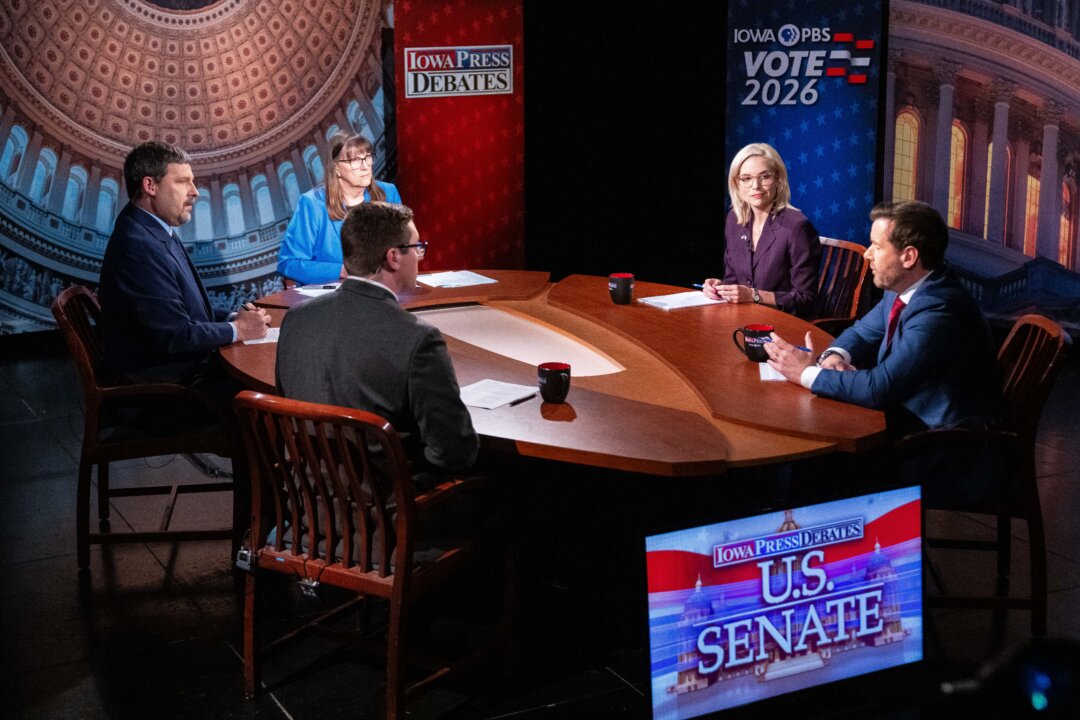
Democratic Senate candidates in Georgia, Iowa, and Maine made the Iran War and rising fuel costs their main case against their Republican opponents in debates on Oct. 13, three weeks before Election Day.
Sen. Jon Ossoff (D-Ga.), state Rep. Josh Turek of Iowa, and former Maine Senate President Troy Jackson each blamed the war for higher gas, diesel, and heating oil prices.
Each tied their opponent to President Donald Trump’s decision to go to war.
The Cook Political Report rates the Iowa and Maine races as toss-ups and Georgia as likely Democratic.
In Georgia, Ossoff pressed Rep. Mike Collins (R-Ga.) at the Atlanta Press Club debate to explain how the war had helped Georgians, citing 21 U.S. service members killed and what he called a global energy crisis.
“How is this war a success, Mike?” Ossoff asked.
Mike Collins said the United States is in Iran to keep the country from getting a nuclear weapon. He said diesel prices are too high but are coming down as supply increases.
He blamed Democrats’ energy policies for limiting domestic refining.
David Johnson, an Atlanta-based Republican strategist who has worked on campaigns for nearly 40 years, said Ossoff has been effective by tying a complicated foreign policy issue to what voters face every day at the pump.
Johnson, chief executive of Strategic Vision PR Group, said Ossoff is placing the blame for higher fuel prices on Trump and Republicans.
“While it has been smart, it is not a defining issue in the Georgia race,” Johnson told The Epoch Times in an email.
He said the message is part of a broader strategy to keep Mike Collins on the defensive.
Johnson said Mike Collins should argue that Republicans have the better long-term plan to lower energy prices and press Ossoff on how he would keep Iran from getting a nuclear weapon.
He said Mike Collins should refuse to let the race be framed as “war versus cheap gas.”
In Maine, the WABI and WAGM debate opened on heating costs. Jackson said Mainers are paying 80 percent more for heating oil than last year because Sen. Susan Collins (R-Maine) supported the war “because Donald Trump wanted it.”
Susan Collins said she voted nine times to end the war after the 60-day window under the War Powers Act. She said there were not enough votes to pass those measures.
“I agree that the president did not have a good plan,” she said, adding the administration should have anticipated disruptions due to the closure of the Strait of Hormuz—where she noted, “a part of the world’s oil travels.”
She also said Maine’s electricity rates, the fourth highest in the nation, are the result of state policies set while Jackson led the state Senate.
The National Republican Senatorial Committee made the same argument in a statement before the debate, saying Jackson voted as Senate president for energy legislation that added $234 million to Maine ratepayers’ bills in 2025.
After the debate, the committee said Susan Collins had laid out how she delivered $1.5 billion for all 16 Maine counties as senator.

In Iowa, Turek said at the WHO 13 debate that the war has driven gas prices up in Iowa more than in almost any other state and pushed diesel and fertilizer prices higher during harvest.
He said Rep. Ashley Hinson (R-Iowa) had voted seven times to continue the war.
Hinson voted six times against measures that would have required Trump to end the war in Iran, and once against a similar measure on U.S. fighting in Lebanon.
Hinson said in her response that the war needs to end as soon as possible.
She said Iran cannot be allowed to obtain a nuclear weapon and said she did not think another war powers resolution was needed, as the president and the military can bring the war to an end.
The Democrats also questioned their opponents’ ethics.
Ossoff read from an Office of Congressional Conduct report that found “substantial reason to believe” Mike Collins used congressional resources for unofficial purposes, and recommended that the House Ethics Committee subpoena him.
Ossoff repeatedly asked whether Mike Collins would testify.
Mike Collins called the inquiry “a nothing burger” and a political hit job, and said he had fully complied with the Ethics Committee.
He also hit back, questioning Ossoff’s ethics for taking campaign money from an alleged associate of convicted sex offender Jeffrey Epstein.
In the Midwest, Turek said Hinson’s financial disclosure lists $1 million to $5 million in private stock.
Hinson said the holdings stem from her husband’s business, which he sold in 2021, and that the couple does not trade stocks.
She hit Turek on reported absences as a state legislator, saying he showed up to work only 40 percent of the time.
Turek missed 261 of 445 floor votes in the Iowa House this year, according to Politifact, and said in the debate that he was campaigning across the state.
“Ashley Hinson has a proven record of showing up to work and delivering for Iowa’s families, farms, and businesses,” NRSC regional press secretary Samantha Cantrell said in a post-debate statement.
Jackson cited a ProPublica report that the FBI was looking into Susan Collins. The senator said he had lied about her and attacked her integrity.
“He lied when he said I was under investigation and found to have committed fraud by the FBI,” she responded. “And I just cannot continue to ignore these attacks on my integrity.”
Susan Collins noted that Jackson has not yet filed a federal campaign finance report, with Jackson responding that he would release one this week.
Maine’s candidates meet for a final debate on Oct. 15.
The Democratic and Republican Senate campaign arms did not respond to a request for comment from The Epoch Times before publication time.
We had a problem loading this article. Please enable javascript or use a different browser. If the issue persists, please visit our help center.