
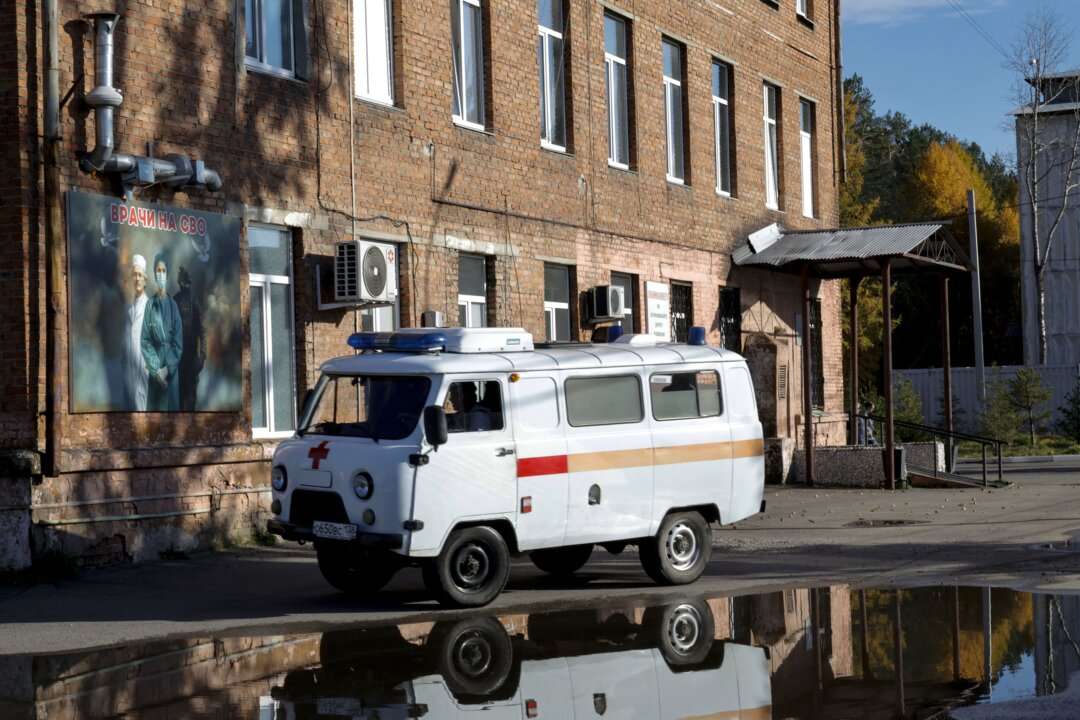
Hulunbuir city in Inner Mongolia near the Russian border issued a risk advisory on plague prevention and control, following the suspected case in Siberia.
Meanwhile, some Chinese have rushed back from Russia while others started stocking up on supplies, according to residents who spoke with The Epoch Times and social media posts.
Hulunbuir Center for Disease Control and Prevention issued a risk advisory regarding plague prevention and control on Oct. 10, urging “individuals arriving from plague-endemic areas in the Russian Far East to closely monitor their health.”
“Should any suspected symptoms appear, they should immediately seek medical attention at the nearest healthcare facility and truthfully disclose their travel history to the plague-endemic region,” the center stated.
The Hulunbuir CDC attributed the advisory to the recent death of a lab worker from pneumonia of unknown origin at the Irkutsk Anti-Plague Institute of Siberia and Far East in Russia that has drawn widespread international attention.
The center noted that while the specific cause of death has not yet been clear, the nature of the anti-plague institute and the region’s status as a unique natural focus for the disease have sparked discussions regarding potential public health risks.
Darya Shipilova, a 28-year-old laboratory worker at the Irkutsk Anti-Plague Research Institute for Siberia and the Far East, was hospitalized with severe pneumonia on Sept. 29 and died on Oct. 2, causing concerns of a possible plague outbreak.
Russian authorities told the World Health Organization (WHO) it had placed approximately 200 contacts under quarantine since Oct. 2.
The quarantine was lifted on Oct. 8 by Russian officials.
Irkutsk Governor Igor Kobzev stated that the cause of death was “pneumonia of unknown etiology (unknown origin).”
Russian authorities denied that Shipilova had died of pneumonic plague.
On Oct. 7, the Russian government denied reports of the death of a second employee at the research institute linked to the suspected pneumonic plague.
At a WHO press conference in Geneva on the same day, Director-General Tedros Adhanom Ghebreyesus said: “We don’t yet have the full picture of this event, and we’re not able to conduct a full risk assessment.”
One of the remaining questions is what difficulties arose during Shipilova’s treatment, according to Xiaoxu Sean Lin, a former U.S. Army microbiologist and associate professor of biomedical science at Fei Tian College Northern Campus in New York.
He told The Epoch Times that Russia needs to release the results of PCR and genetic testing.
“In this era of advanced molecular biology, the situation cannot simply be dismissed as ‘pneumonia of unknown etiology.’”
Dr. Jonathan Liu, a professor of Chinese Medicine at Georgian College in Canada, told The Epoch Times that Russia’s lack of transparency about the lab worker’s death and surrounding circumstances also demonstrates that it is an authoritarian regime.
“Because an outbreak of plague during the ongoing Russian-Ukrainian war would likely intensify the Russian public’s resentment toward the authorities, the government has tried to handle the matter as discreetly as possible.”
Soon after Shipilova’s death, Russia’s neighboring countries—including Uzbekistan, Kazakhstan, Kyrgyzstan, Tajikistan, and Mongolia—stepped up quarantine measures and testing to prevent a potential epidemic from spreading to their territories.
The Hulunbuir CDC’s advisory “serves as a warning regarding the ongoing risk of the plague epidemic,” Liu said.
“People travel between Inner Mongolia and Russia, including flight connections. So, there are concerns about the importation of cases.”
China and Russia have granted each other’s citizens visa-free entry since late 2025.
Public data show that the number of people who moved between China and Russia exceeded 3 million in 2025. That grew by 43 percent in the first half of 2026 and is expected to increase to 6 million by the end of 2027.
The Irkutsk region lies just 150 miles north of Mongolia. Although it doesn’t directly border China, the local capital is a major hub with frequent flights and rail links to Chinese cities.

Despite being far from the Russian border, disease control authorities in Hunan and Guangdong in the south also issued public health reminders regarding plague prevention on Oct. 9.
The term “pneumonia of unknown origin” that Russian authorities used to explain the lab worker’s death has sparked concern among the public in China.
When COVID-19 broke out in Wuhan in 2019, the Chinese authorities also used the same term to describe the early cases.
Having endured the pandemic and associated lockdowns, the Chinese public is on high alert regarding infectious diseases, and a rush to stockpile food and antibiotics has rapidly spread across social media and e-commerce platforms in recent days.
Out of fear of disease spread and a lockdown, Chinese internet users have been urging each other on social media to stockpile essential supplies and antibiotics in advance.
Dapeng, a resident of Hailar in Inner Mongolia who used a pseudonym out of fear of reprisal from the Chinese regime, told The Epoch Times that he bought 500 KN95 masks to keep on hand.
“If an outbreak really does occur, I’ll just need a supply of masks and rubbing alcohol for when I go out to buy groceries.
“Right now, only a very small number of people here are wearing masks, so it’s hard to tell if an outbreak has occurred. We’ll have to wait and see what happens in December.”
Social media posts show crowded security checks at Russian airports, as many Chinese expats rush back to China after the suspected plague case.
A Chinese man who requested anonymity told The Epoch Times that he returned to Beijing from Russia on Oct. 11 after hearing about the lab worker’s death.
“I’ve been in Russia for several years. I spent over 6,000 RMB ($897) on a connecting flight to get back to Beijing, arriving in the early hours of the 11th,” he said.
“I took a month of unpaid leave and chose to pay for the trip home myself to wait and see. I wanted to ensure absolute safety. I don’t trust the Russian government.
“The situation was just like this in the early stages of the Chernobyl disaster in the Soviet Union—back then, they also kept saying there was nothing to worry about.”
Everything in Moscow is completely normal right now; there are no alerts or preventive measures in place, he said.
“The flight was full, and no one was wearing a mask—there were quite a few Chinese people, but most passengers were Russians. I didn’t see any prevention measures when I got off the plane.”

Just over a month ago, China and Russia conducted a joint health emergency drill from Aug. 24 to Aug. 27, near the China–Russian border in Fuyuan City in Heilongjiang Province.
The drill simulated the response to infectious disease outbreaks, especially imported plague.
Sergey Balakhonov, director of the Irkutsk Anti-Plague Research Institute, also participated in the drill.
The Irkutsk Anti-Plague Research Institute has been working with various Chinese institutions on related research for many years.
Luo Ya and Gu Xiaohua contributed to this report.
We had a problem loading this article. Please enable javascript or use a different browser. If the issue persists, please visit our help center.