
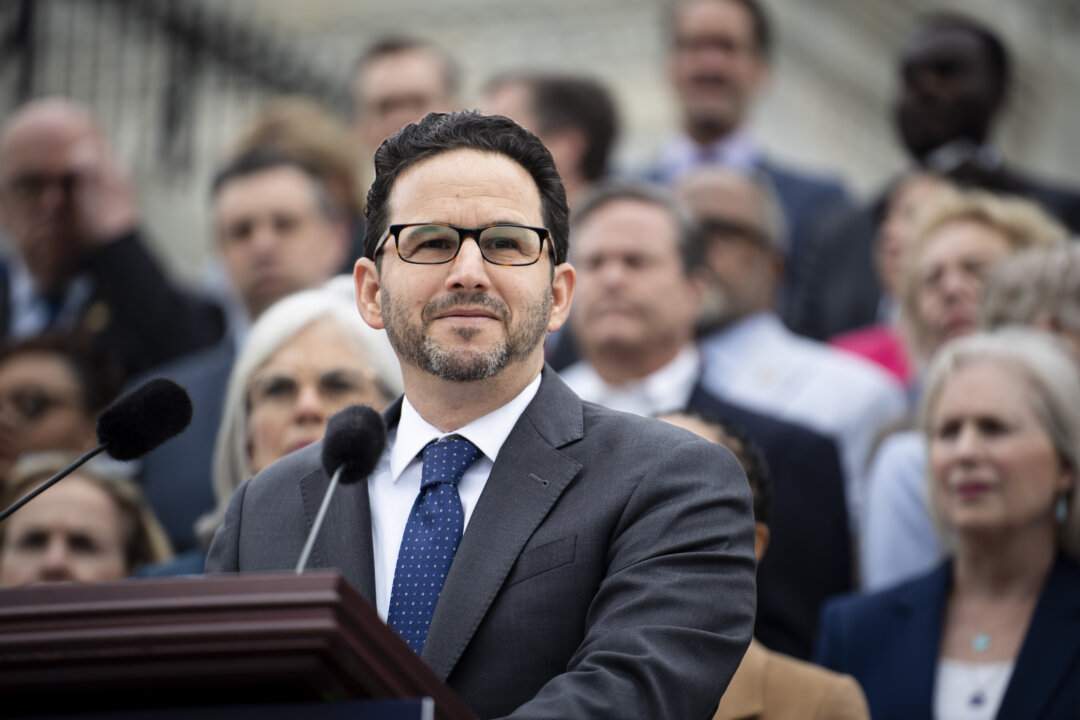
Sen. Brian Schatz (D-Hawaii) said Democrats will have to act as one half of a divided government even if they win both the House and Senate in November because they would still share power with President Donald Trump. He said Democrats would need to find areas of agreement with Republicans to pass legislation.
Schatz is in line to succeed Sen. Dick Durbin (D-Ill.) as Senate Democratic whip, the party’s No. 2 leadership post, when Durbin retires. He made the comments in an interview with The Bulwark published on Oct. 11.
“I don’t think we should promise the world while we’re talking about a divided government,” Schatz said. “People understand what a divided government means, and if they give it to us, we should behave as if the government is divided and not like we just won the whole thing.”
Schatz said he deliberately picked goals that were “realistic but meaningful.” Those include reversing Medicaid cuts in the 2025 Republicans’ tax and spending bill, the One Big Beautiful Bill Act, helping to end the war with Iran, and getting tariffs under control, which he said would likely be the hardest of the three.
He said a bipartisan coalition is already forming behind the scenes around delaying cuts to the Supplemental Nutrition Assistance Program (SNAP), otherwise known as food stamps, that were included in the same law.
He described Republican-led states and legislatures as raising concerns about the effect on grocery stores, farmers, and health care, and said that Republicans and Democrats are already having quiet conversations about pushing back the SNAP cuts.
In January, a coalition including the National Governors Association and the National Conference of State Legislatures asked congressional leaders in a letter to delay the law’s SNAP cost shifts for all states until fiscal 2030. The groups estimated the benefit cost share would cost states an average of $218 million a year and said the effects “cut across states of all sizes and political affiliations.”
Schatz said a poor midterm showing for Republicans could open more room for cooperation, particularly on the cost of living. He said he could see Republicans concluding that, if they lost on the issue of prices, they should do something different about prices.
On oversight of the Trump administration, Schatz said Democrats should reject what he called a false choice between accountability and moving forward. He said alleged corruption with foreign policy implications should be the priority, and that investigations should reach lower-level officials, not just well-known names.
He stressed that the goal is not to punish everyone who worked for the administration.
“If you committed an actual federal crime, that as long as the statute of limitations has not run, that you should probably get a lawyer,” Schatz said.
He said he did not expect a third impeachment because it was unlikely that a closely divided Senate would vote for the president’s removal from office, and that House Democrats should be “precise” and “cautious” if they pursue that path. He suggested that impeaching other officials accused of high crimes and misdemeanors could “put Republicans in a difficult position.”
Schatz also addressed Democratic Senate candidates, including Abdul El-Sayed in Michigan and Troy Jackson in Maine, who have said they would not back Senate Minority Leader Chuck Schumer (D-N.Y.) for leader.
Schatz said that senators can vote as they choose in the caucus election. He credited Schumer with recruiting candidates like former Sen. Sherrod Brown in Ohio, former Rep. Mary Peltola in Alaska, and former Gov. Roy Cooper in North Carolina, and said, “I think [Schumer’s] going to have the votes.”
He said he felt good about Democratic chances to take one or both houses of Congress in the midterms, saying he believed Democrats now have momentum in several Republican-leaning states, including Kansas, Texas, Iowa, Mississippi, and South Carolina. However, he added that this has created a “money crunch” for Democrats as the party tries to fund more competitive races.
We had a problem loading this article. Please enable javascript or use a different browser. If the issue persists, please visit our help center.