
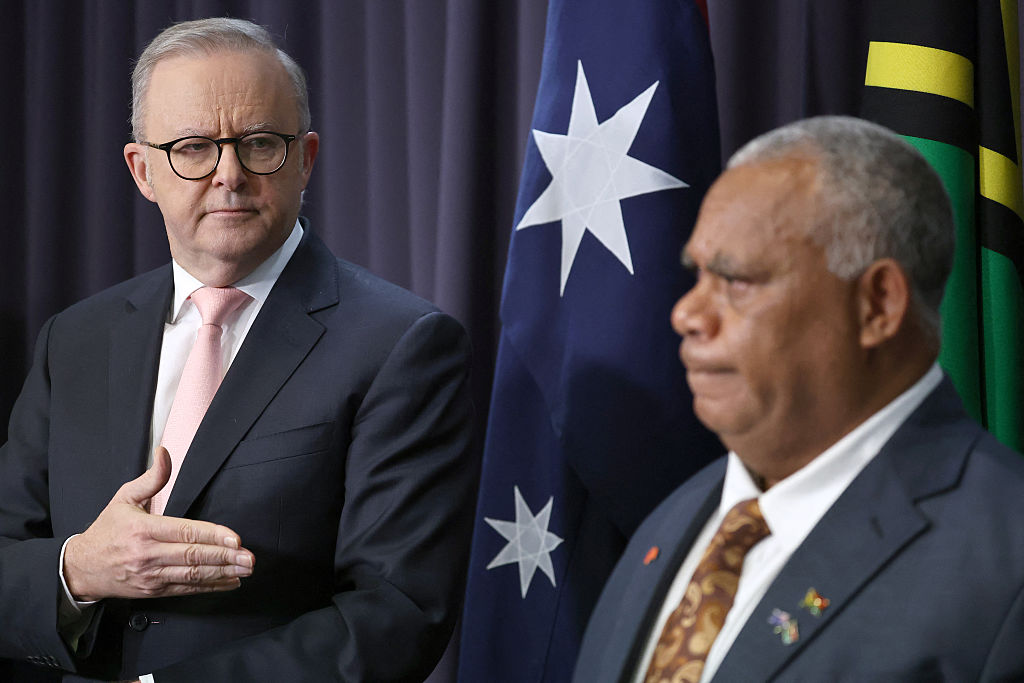
The number of Australian Federal Police (AFP) officers working in Vanuatu could almost double under a new treaty between the two countries, a parliamentary committee has heard.
AFP Assistant Commissioner David McLean told the Joint Standing Committee on Treaties that eight Australian federal officers are currently serving in the Pacific nation, and he expected that number “could nearly double in size” over the coming years.
The increase follows the Nakamal Agreement, signed by Prime Minister Anthony Albanese and his Vanuatuan counterpart Jotham Napat in Canberra on June 29.
Under the agreement, Vanuatu recognises Australia as its main policing partner and agrees to turn first to Pacific Islands Forum members when it needs police assistance.
McLean said the treaty builds on a policing partnership that has been running for about 25 years.
“That will be enhanced under the treaty. We’ll do more, and our rate of effort will increase,” he said.
McLean said Australian officers would assist with everything from investigations and forensics to designing Vanuatu’s police force and building a new police headquarters and station.
AFP officers were also assessing whether to help repair police training facilities damaged in Vanuatu’s December 2024 earthquake.
The next stage of the partnership will focus on getting reliable policing to Vanuatu’s remote outer islands, while a regional centre for specialist investigations being set up in Vanuatu will target online and cyber crime on behalf of the wider Pacific.
Similar Pacific Treaties Possible
Jan Hutton, a senior Department of Foreign Affairs and Trade (DFAT) official, said the Nakamal deal was tailored to Vanuatu but confirmed that Australia signed a statement of intent last year to negotiate a similar treaty with Tonga, with talks still under way.
She added that Albanese had agreed to a request from Solomon Islands Prime Minister Matthew Wale to negotiate a treaty with that country.
The treaties come as Australia competes with Beijing for influence in the Pacific. In 2022, Solomon Islands signed a secret deal with Beijing that would have allowed Chinese troops, weapons and naval ships on its territory.
An earlier version of the Vanuatu deal fell through in September last year after cabinet members raised sovereignty concerns and feared it would prevent China from funding infrastructure projects in the country.
While the final version of the Nakamal treaty requires Vanuatu to consult Australia about foreign involvement in its critical infrastructure, it does not give Australia veto power over such involvement.
The revised arrangement was negotiated against a backdrop of expanding Chinese policing cooperation in the Pacific and Australia’s efforts to strengthen its security partnerships with island nations.
Vanuatu is also negotiating its own agreement with China, called the Namele Agreement, which Napat said in June was awaiting “clearance from Beijing.”
Hutton told the committee that Vanuatu’s commitment not to allow any foreign military bases reflects an existing law and applies both now and in the future.
Net Zero Commitment Questioned
The treaty also commits both countries to transition their economies to net zero by 2050, meaning balancing the greenhouse gases they produce with the amount removed from the atmosphere.
Australia’s emission target is currently written into law, but the Coalition has vowed to scrap it.
Asked by Nationals MP Alison Penfold whether a future government that repealed the target would be in breach of the treaty, Hutton said that was “a hypothetical, not a question that I would answer,” but confirmed every commitment in the agreement is legally binding.
“My concern is that this is effectively a treaty binding domestic legislation,” Penfold said.
Naomi Mason, who advises DFAT on treaty law, said that if Australia chose to withdraw, it would take 24 months for the exit to take effect.
Hutton said no penalties apply if either country misses the target, “We don’t think of it in terms of penalties.”
She also did not specify how much Australia would spend under the treaty, saying the costs would be determined over time.
Australia’s original offer was $500 million (US$345 million) over 10 years, but Albanese said the government would confirm the final amount in its mid-year budget update in December.
We had a problem loading this article. Please enable javascript or use a different browser. If the issue persists, please visit our help center.