
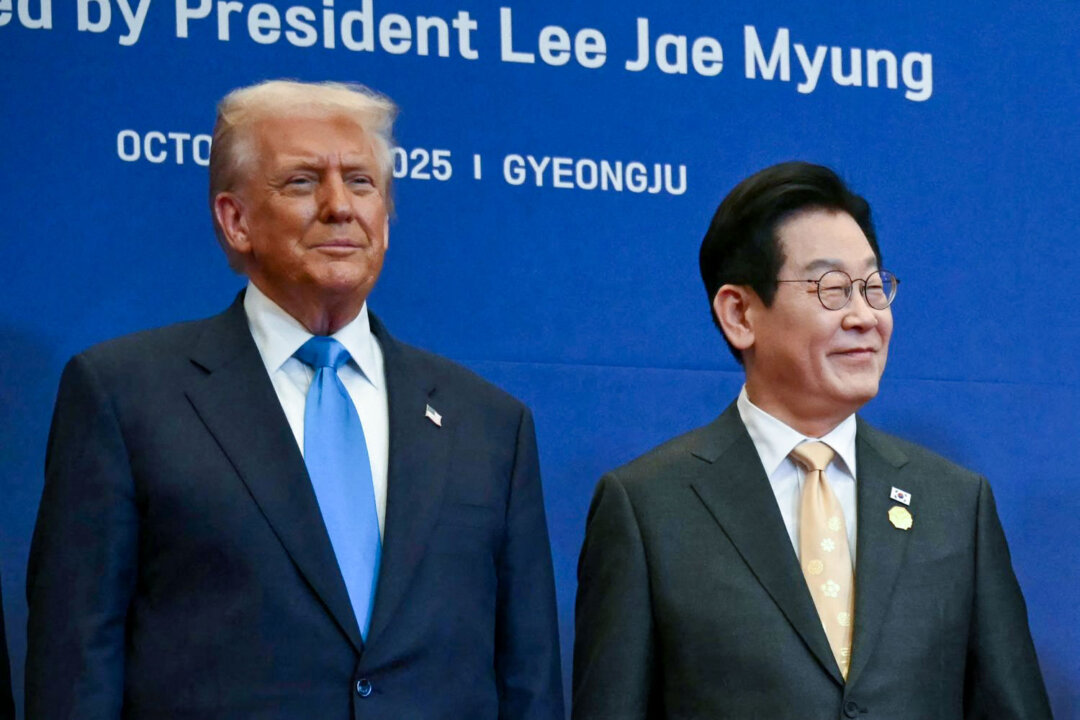
South Korean President Lee Jae Myung and U.S. President Donald Trump welcomed progress on strategic investment projects during a meeting on the sidelines of the U.N. General Assembly.
South Korea’s presidential office stated on Sept. 23 that the two leaders also agreed to deepen security cooperation and communicate more closely on North Korea. The meeting came as Seoul moves forward with implementing a 2025 U.S.–South Korea trade agreement.
Under the deal, South Korea agreed to invest $350 billion in the United States in exchange for a reduced 15 percent U.S. tariff on South Korean goods, including automobiles.
The package includes $200 billion in strategic investments in sectors including energy, semiconductors, pharmaceuticals, critical minerals, artificial intelligence, and quantum computing, as well as $150 billion for shipbuilding cooperation.
Cooperation Beyond Trade
The two leaders agreed to build on the framework established in their joint fact sheet issued after their November 2025 summit, Seoul’s presidential office stated. Areas of cooperation include nuclear submarine fuel, enrichment and reprocessing, shipbuilding cooperation, and the transfer of wartime operational control.
The South Korean Ministry of Trade, Industry, and Resources on Sept. 22 briefed lawmakers on plans to implement the $350 billion investment package.
South Korean National Security Adviser Wi Sung-lac said discussions have included a Texas gas-fired power project identified as a potential first investment under the agreement, possible investments in nuclear energy, and an Alaska liquefied natural gas project.
Korean Peninsula
The presidential office said Trump reaffirmed his willingness to engage in dialogue with North Korea.
“As peacemaker and pacemaker, [South Korea] and the United States will communicate even more closely to reopen the stalled channels of dialogue and help establish sustainable peace on the Korean Peninsula,” Lee wrote in a post on X after the meeting.
U.S. Secretary of State Marco Rubio addressed developments on the peninsula on Sept. 21 during his meeting with the foreign ministers of South Korea and Japan. Rubio wrote in a social media post that they looked forward to advancing a safe and prosperous Indo-Pacific.
A joint statement released by the U.S. State Department states that the United States had reaffirmed its commitment to defending Japan and South Korea, backed by U.S. military capabilities, including its nuclear deterrent.

The three countries also reaffirmed their commitment to North Korea’s denuclearization. The statement states that they continued to support efforts to block revenue generation for Pyongyang’s nuclear and ballistic missile programs in accordance with U.N. Security Council resolutions.
They said the opportunity for dialogue with North Korea remains open.
The diplomatic activity comes amid heightened tensions on the Korean Peninsula following annual military exercises conducted by South Korea and its allies, which North Korea denounced as provocative. Pyongyang responded with its own military drills and missile launches.

The United States, Japan, and South Korea recently concluded the five-day Freedom Edge 26 trilateral exercise. Earlier U.S.–South Korean Ulchi Freedom Shield exercises were scaled back on Trump’s orders after he said they sent the wrong message to North Korean leader Kim Jong Un and imposed unnecessary costs on U.S. taxpayers.
Seoul’s presidential office also said on Sept. 23 that Lee noted that the planned U.S.–China summit would be important for regional affairs, including relations between Seoul and Beijing.
He said in his social media post that Trump brought up their plans to play golf together, saying he looked forward to continuing their conversations at the G20 summit in Miami later this year.
Reuters contributed to this report.
We had a problem loading this article. Please enable javascript or use a different browser. If the issue persists, please visit our help center.