
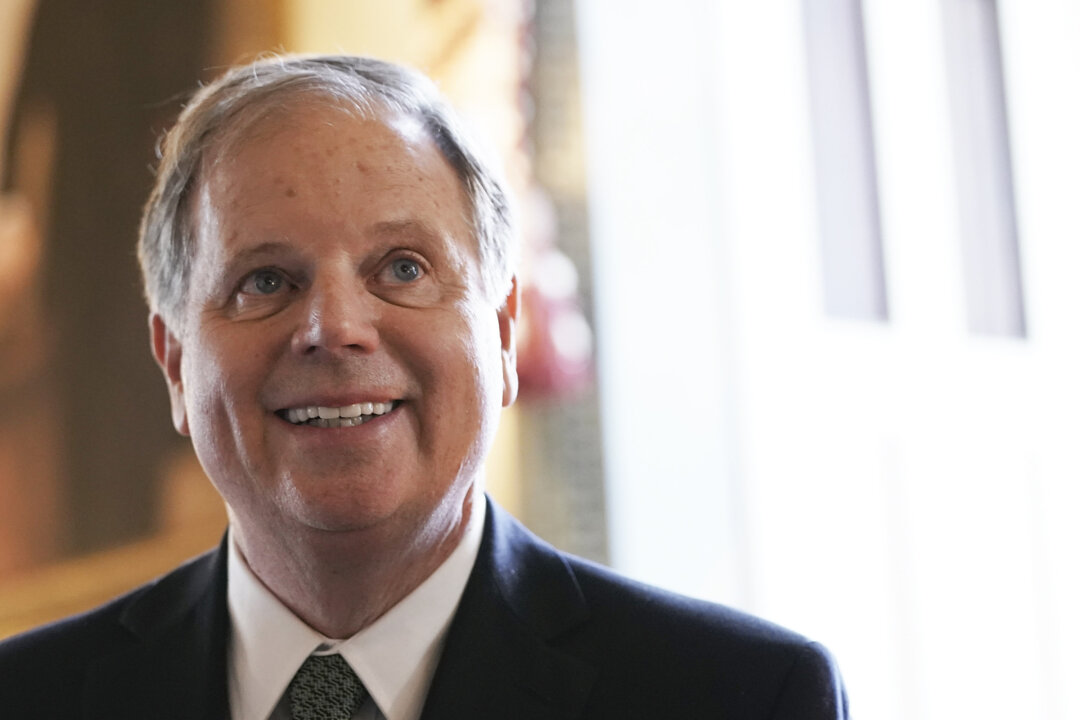
Gubernatorial candidate and former Sen. Doug Jones and state Rep. Phillip Ensler unveiled a plan Sept. 16 on the steps of the State Capitol in Montgomery, Alabama, to seek a constitutional amendment moving the lieutenant governor’s office into the executive branch and having future candidates for governor and lieutenant governor run together as a ticket, the way the president and vice president do.
“The main thing I want folks to take away from this is that we’re going to be a team,” Jones said in an accompanying press release. “What we’re going to be doing as governor and lieutenant governor will be to implement the new policies that bring change to Alabama’s government, that bring more transparency, more efficiency and more accountability.”
Alabama’s lieutenant governor serves as president of the state Senate and succeeds the governor if that office becomes vacant. The Senate has stripped away much of the office’s legislative authority over time, including additional powers during the 2026 legislative session, according to the campaign.
Jones said the current structure and legislative rules leave the office with a diminished role in state government, and that he wants the lieutenant governor to play a more strategic policy role in the executive branch.
Under the proposed amendment, future candidates for governor would select a running mate and the two would run together rather than being elected separately.
Just over half of states—27—will elect the two offices on the same ticket in November, Kellie Rittershausen, executive director of the National Lieutenant Governors Association (NLGA), told The Epoch Times in an email. In six of those states, candidates for lieutenant governor run in their own primary and are paired with the governor’s nominee only for the general election.
Rittershausen said the association takes no position on which method is better.
“NLGA does not take a position on the ‘best’ method of election, as there are benefits to both separate and joint methods of election for states, depending on the constitutional and statutory duties of the lieutenant governor,” she said. “Lieutenant governors are successors to governor, and each state assigns additional duties to the lieutenant governor via the state constitution, the legislature, assignment from the governor, or through personal initiative. Changing the method of election for a lieutenant governor may have an impact on the role and duties of the lieutenant governor in a given state.”
The campaign’s announcement did not include the text of a proposed amendment or name a lawmaker who would introduce it. Jones’s press office did not respond to a request for additional information by publication.
Getting such an amendment through would require Republican votes. Under Section 284 of the Alabama Constitution, an amendment must clear three-fifths of all members elected to the House and to the Senate before going to voters, where a majority decides it. That is 63 of 105 House members and 21 of 35 senators.
Republicans currently hold 76 House seats and 27 Senate seats, enough to pass or block an amendment without a single Democratic vote. Amendments also originate in the Legislature rather than with the governor, so Jones would need a Republican lawmaker willing to carry it.
Jones and Ensler said they would not wait for a constitutional amendment to begin working together. If elected, Ensler would serve as an adviser to Jones, taking on a policy portfolio and representing the administration across the state.
Ensler also said he would publicly post vacancies for the hundreds of appointments the lieutenant governor makes to state boards and commissions and base those appointments on qualifications and experience. He committed to visiting all 67 counties at least once each year.
“The lieutenant governor can and should, on day one, be ready to fight for the people of Alabama,” Ensler said. “The lieutenant governor really can get to work.”
Jones, who served in the U.S. Senate from 2018 to 2021 after winning a 2017 special election, won the Democratic nomination for governor in May with 76 percent of the primary vote.
He faces Sen. Tommy Tuberville, the Republican who defeated him in 2020. No Democrat has won an Alabama governor’s race since 1998. Ensler, a first-term representative from Montgomery, faces Republican John Wahl, a former chair of the state party.
The Tuberville campaign also did not respond to a request for comment.
A separate amendment already on the Nov. 3 ballot would require a special election to fill a vacancy in the lieutenant governor’s office.
We had a problem loading this article. Please enable javascript or use a different browser. If the issue persists, please visit our help center.