
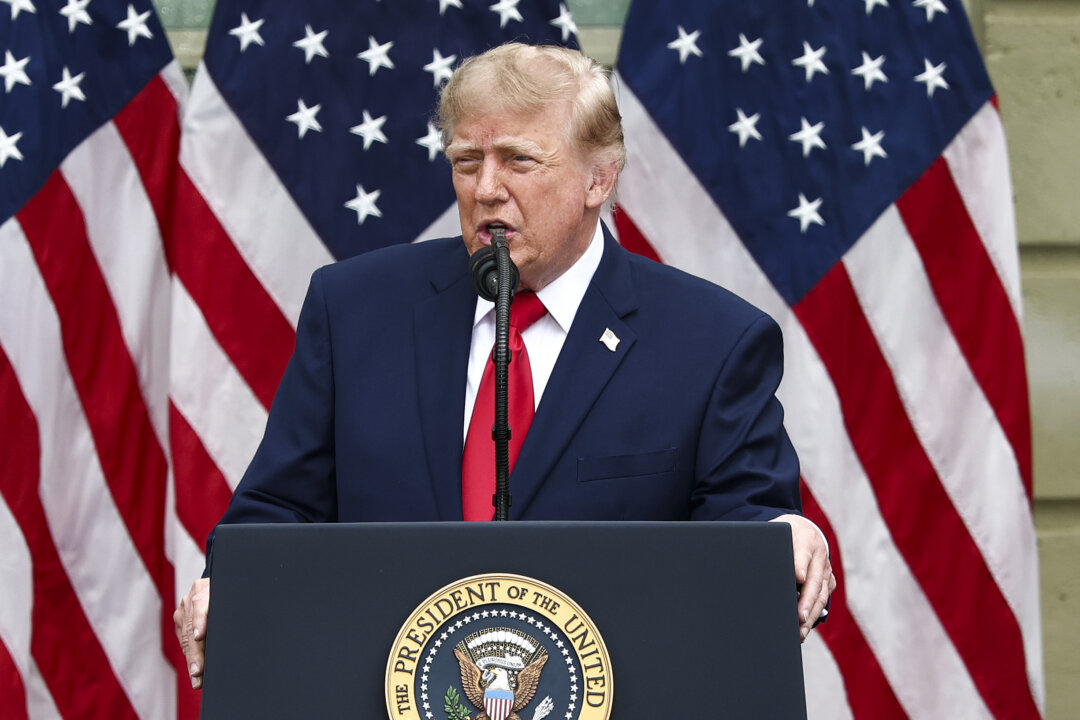
All 50 states plus the District of Columbia and Puerto Rico will participate in a program extending most-favored-nation drug prices to state Medicaid programs, President Donald Trump announced on Sept. 18.
“Every state will now have the ability to use those extra billions of dollars to invest in other healthcare improvements or something else,” Trump said from the Oval Office. “States are going to save tens of billions of dollars.”
The program, called the GENEROUS Model, will test whether manufacturer-paid supplemental rebates can align Medicaid drug prices with the most-favored-nation benchmark.
Most-favored-nation prescription drug pricing is Trump’s signature effort to reduce prescription drug prices, which have historically been the highest in the world.
Some 20 prescription drug manufacturers have signed agreements with the government, pledging to offer their lowest available price to the Medicaid program, to reinvest profits in domestic drug production, and to offer some drugs directly to consumers.
At the same time, Trump said other nations have agreed to raise the prices they pay for prescription drugs—in some cases by 300 percent or more.
Govs. Tate Reeves of Mississippi, Sarah Huckabee Sanders, and Larry Rhoden of South Dakota attended the announcement, praising Trump’s initiative.
Reeves noted that his state’s Medicaid drug payments are nearly $7 billion annually, about 10 percent of Mississippi’s state spending.
“This is a big deal,” Reeves said. “ When we combine the ability of the president to negotiate and give states the flexibility to operate, big things happen.”
The Council of Economic Advisers estimated more than $64 billion in taxpayer savings over the next decade because of lower Medicaid drug costs. That breaks down to nearly $36 billion in savings to the federal government and about $28 billion in state savings.
In addition, the manufacturers of Eliquis, a blood thinner commonly used to treat blood clots, have agreed to donate 1 million free doses of the medication to state Medicaid programs, Dr. Mehmet Oz, administrator of the Centers for Medicare and Medicaid Services, said.
Robert F. Kennedy Jr., secretary of the Department of Health and Human Services, said the initiative breaks a cycle that hindered states from promoting wellness among their citizens.
“We were locked in a negative feedback loop,” Kennedy said. “The states had to choose between medicine and nutrition, lifestyle, and prevention. Those areas were starved. And because of that, people were getting sicker and sicker and requiring more medication.”
Manufacturers that have entered most-favored-nation agreements are Pfizer, AstraZeneca, EMD Serono, Eli Lilly, Novo Nordisk, Amgen, Bristol Myers Squibb, Boehringer Ingelheim, Genentech, Gilead Sciences, GSK, Merck, Novartis, Sanofi, Johnson & Johnson, AbbVie, Regeneron, Alcon, Astellas Pharma, BeOne Medicines, BridgeBio, CSL, Kyowa Kirin, Sun Pharma, Teva Pharmaceuticals, and UCB.
Twenty-six pharmaceutical manufacturers currently hold most-favored-nation pricing agreements with the administration, and as of Sept. 18, the White House says all of them are extending those prices to every state Medicaid program. The mechanism CMS uses for that is the GENEROUS Model.
Those agreements include offering most-favored-nation pricing to all states. However, the agreements are not identical with participation in the GENEROUS Model, which is experimental.
Novartis has confirmed that it will participate in GENEROUS, though a full list of participants has not been published.
The administration launched TrumpRx.gov in February, a clearinghouse that connects consumers to manufacturers for discounts on direct-to-consumer sales of prescription drugs.
More than 1,000 medications are available through the site, according to the White House, including through partnerships with Amazon Pharmacy, Cost Plus Drugs, and GoodRx.
The White House stated that consumers have received more than $700 million in discounts through the site, including massive discounts on popular medications used to treat obesity and infertility.
A related initiative allows senior citizens to purchase GLP-1 medications, used to treat diabetes and obesity, for $50 per month.
We had a problem loading this article. Please enable javascript or use a different browser. If the issue persists, please visit our help center.