
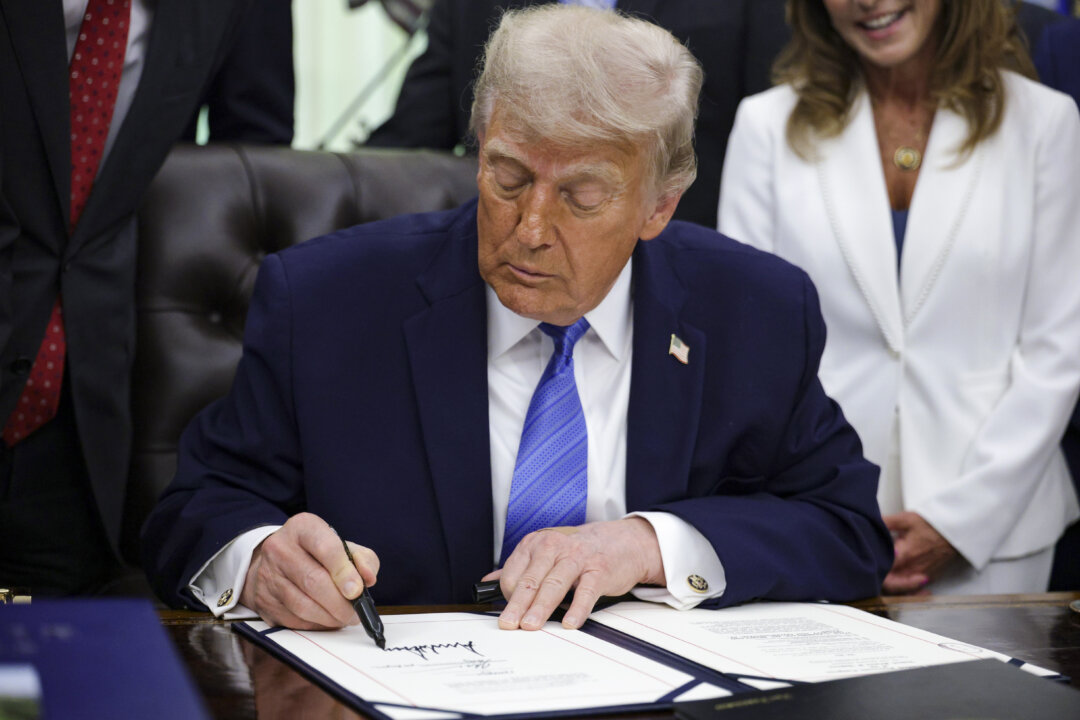
President Donald Trump is expected to sign a bill on Sept. 18 imposing new sanctions on Russia and extending sanctions on Iran.
The legislation includes additional sanctions intended to prevent Russia from continuing to fund its war against Ukraine with oil and gas sales to other countries. It also extends sanctions on Iran as the Trump administration has shifted to using economic strategies to force Tehran to make a deal.
A White House official told The Epoch Times that the Lindsey O. Graham Sanctioning Russia and Iran Act of 2026 is expected to be signed on Friday.
Trump is scheduled to sign the bill at the White House at 4:30 p.m. ET. The signing of the bill, which was revised this summer, comes more than a year after it was first introduced in the Senate.
The legislation imposes sanctions on Russian military and government officials, banks, oligarchs, and individuals linked to Russia’s arms and energy industries. It also sanctions Russia’s so-called shadow fleet—ships that attempt to bypass sanctions by concealing ownership or identity.
It also gives the president authority to impose tariffs of up to 500 percent on all Russian goods imported in the United States and up to 100 percent on goods from the top five countries that import Russian oil and gas products, such as China and India.
The U.S. House of Representatives voted 262–159 to pass the bill on Sept. 17, after the Senate approved it 86–11 on Aug. 7.
Ukrainian President Volodymyr Zelenskyy said the sanctions bill, combined with sanctions imposed by his country’s other allies, represents an “extremely powerful tool” that could force Russia to pursue peace.
“Sanctions must be strong so that all efforts for peace—including our joint diplomatic efforts with the United States, Europe, and our other friends—can succeed,” he wrote in a social media statement on Sept. 17. “Russia needs to end this war.”
However, Moscow warned on Sept. 17 that additional U.S. sanctions targeting Russia would make it more difficult to end the war in Ukraine.
“We are, of course, monitoring the progress of this document. It falls under the category of unfriendly actions, and of course the imposition of any additional sanctions by the U.S. would certainly complicate efforts to find a peace settlement in Ukraine,” Kremlin spokesman Dmitry Peskov told reporters.
The sanctions bill was originally introduced in the Senate by the late Sen. Lindsey Graham (R-S.C.) in April 2025 but remained stuck in committee. However, a revised version of the bill was introduced in Graham’s honor after his death on July 11.
The revised bill narrowed sanctions and gave Trump the ability to waive sanctions in the interest of national security.
The revisions also included sanctions on Iran, extending the Iran Sanctions Act of 1996, which restricts funding for Tehran’s weapons and energy sectors, through 2031.
While the legislation passed overwhelmingly in the Senate with bipartisan support, it faced significantly more opposition in the House. The bill divided House Democrats, with some expressing concerns that the bill would expand Trump’s tariff authorities.
Expressing opposition to the bill prior to the House’s vote on Sept. 16, Rep. Don Beyer (D-Va.) suggested that lawmakers supportive of Ukraine would regret voting for the legislation.
“Yes they will be able to say ‘we stood with Ukraine’ in the immediate aftermath,” Beyer said. “But when Donald Trump hits our allies with new tariffs and waives sanctions on Russia, the propaganda victory for Putin will be lasting, and the damage will be embedded in U.S. law.”
Meanwhile, Rep. Steny Hoyer (D-Md.) argued that if Congress failed to pass the bill, there would be “cheers in the Kremlin and tears in Kyiv.”
Reuters contributed to this report.
We had a problem loading this article. Please enable javascript or use a different browser. If the issue persists, please visit our help center.