
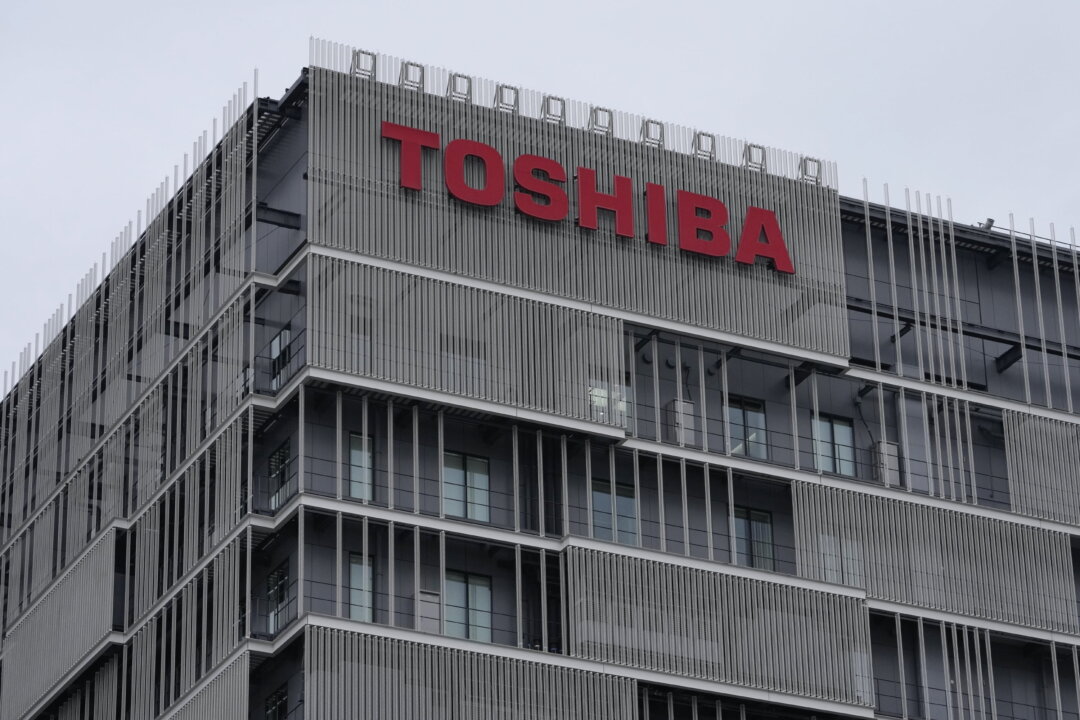
A Japanese semiconductor technology subsidiary has been deregistered in China after roughly 25 years of operations, adding to signs that some Japanese companies are reducing their presence in China amid weaker economic conditions and growing geopolitical and regulatory risks.
Established in Shanghai by Japan’s Toshiba Corporation in 2001, Zhongzhi Software System Engineering (Shanghai) Co. Ltd. was a wholly owned Japanese company that provided embedded semiconductor systems and tech services to Chinese appliance manufacturers and other industrial companies. Before its closure, it had 26 employees.
Toshiba underwent a major restructuring that involved delisting from the Tokyo stock exchange in December 2023 and began operating as a private entity.
Neither Toshiba’s headquarters in Japan nor its China operations, as well as Chinese market-regulation authorities, have publicly explained why the company was dissolved. Toshiba’s website has removed information about the subsidiary.
The Epoch Times reached out to Toshiba China for comment but did not receive a response as of the time of publication.
The closure of the subsidiary does not by itself imply a broader corporate withdrawal from China, as Toshiba still maintains more than a dozen subsidiaries in China.
Japanese companies operating in China face a combination of slowing economic growth, weak consumer demand, intensifying competition from Chinese companies, and heightened geopolitical tensions.
An economics scholar at China’s top Fudan University, who spoke to The Epoch Times on condition of anonymity out of fear of reprisal, said the company’s closure should not be viewed simply as an ordinary corporate restructuring.
“A Japanese tech company that has operated for 25 years, ending its legal corporate status, cannot be viewed simply as a general business adjustment,” the scholar said. “At the very least, it shows that foreign companies are reassessing the profits, operating costs, and political risks of the Chinese market.”
Semiconductor companies are particularly sensitive to data security, policy changes, and the tech competition between the United States and China, he said.
The semiconductor industry has been affected by Washington’s restrictions on the export of advanced semiconductor technology to China. Japanese companies with operations in China can consequently face regulatory and compliance requirements from both Chinese and U.S. authorities.
The scholar said the broader trend of companies de-risking their global supply chains by relocating to less politically sensitive countries has accelerated as geopolitical tensions have increased.
He cited the example of Nippon Steel, which ended its roughly 20-year joint venture with China’s Baosteel as it pursued the acquisition of U.S. Steel Corporation. The scholar said Nippon Steel’s case illustrates how Japanese companies are reconfiguring assets across China, the United States, and other markets.
The closure of the Toshiba subsidiary comes amid a series of adjustments by Japanese companies in China since 2025.
Panasonic Energy, a Tesla supplier, announced its plans to eliminate supply-chain dependence on China for EV batteries made in the United States. Canon closed its printer factory in China, according to Chinese state media China Daily, while Nissan stopped production at its Changzhou plant in China.
Data from the Japan External Trade Organization, released in January, showed that Japanese companies operating in China are expressing a broader shift in corporate sentiment.
Among 784 Japanese companies surveyed, only 21.3 percent said they planned to expand their operations in China over the following one to two years, the lowest level since the survey began in 2007.
Meanwhile, 14.4 percent said they planned to scale back their businesses, move operations to a third country, or withdraw from China, the highest proportion recorded in the survey.
The remaining 64.3 percent said they planned to maintain their current operations.
A Chinese economist currently based in Japan told The Epoch Times that China’s slowing economic growth, weak consumer spending, intense price competition from domestic companies, and expansion of national-security and counterespionage enforcement have prompted Japanese businesses to reassess their operations.
“Since the beginning of this year, even if some Japanese companies have not publicly announced their withdrawal, they have begun to gradually reduce the proportion of their China business by closing factories, selling subsidiaries, reducing employees, and stopping additional investment,” said the economist, who spoke to The Epoch Times on condition of anonymity out of fear of reprisal.
“At the same time, the Japanese government has promoted supply-chain diversification in recent years, and new corporate investment is gradually shifting toward countries such as India and Vietnam. This has already become a trend.”
The shift comes as Beijing continues to emphasize the need to attract foreign investment.
The Chinese regime’s data show that China attracted 747.69 billion yuan ($111.49 billion) in actual foreign direct investment in 2025, a decline of 9.5 percent from the previous year.
Ye Zilong contributed to this report.
We had a problem loading this article. Please enable javascript or use a different browser. If the issue persists, please visit our help center.