
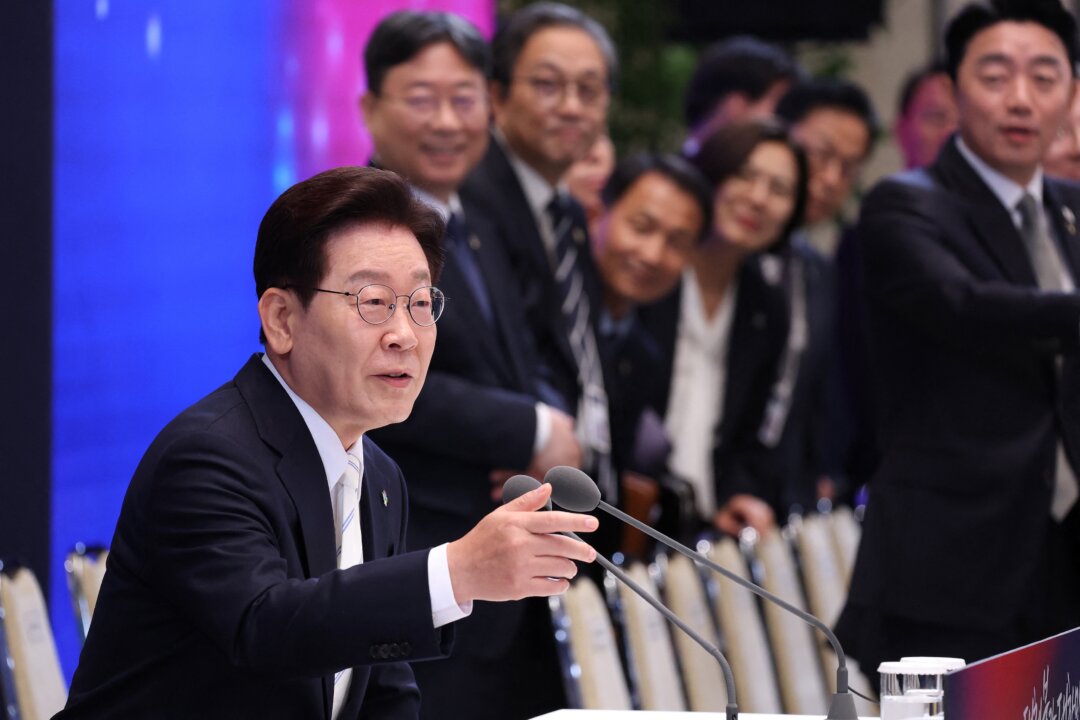
South Korea ruled out deploying military assets to the Middle East in any fashion that would draw the country into a conflict, South Korean President Lee Jae Myung said on Friday.
Lee, however, left the door open for the East Asian nation to send some forces to the region, but only to ensure that key waterways, such as the Strait of Hormuz, remain navigable.
“There won’t be deployment that would involve or enter war. I can tell you that very clearly. There will be no involvement or intervention in the war,” he said at a press conference in Seoul.
He further clarified that no “form of troop dispatch or deployment of military assets” of that nature would occur, saying this was a consistent principle of his government that would remain unchanged.
However, he added that South Korea “like other countries” must do “the minimum” to ensure the protection of its commercial shipping, crude oil shipments, and its people’s safety.
The country has had a naval presence off the coast of Somalia engaged in an anti-piracy mission since 2009, but has so far resisted American calls to play a more active role in the United States’ war on Iran.
South Korea’s reluctance in this regard has driven a wedge between Washington and Seoul, with President Donald Trump criticizing the country, one of the United States’ most important allies in the Asia–Pacific for decades.
Trump ordered the Pentagon to scale back joint military exercises with South Korea on Aug. 16, highlighting the expense of the exercises and suggesting they sent the wrong signal to North Korea.
In a Truth Social post announcing the decision, Trump also expressed frustration that Lee declined to lend a hand in the war.
“While somewhat unrelated (?), I recently asked the President of South Korea if they would like to join us in the Denuclearization of the Islamic Republic of Iran, and they said, ‘No thanks!’” Trump wrote.
Just over a week later, on Aug. 24, South Korea announced that another joint drill had been canceled by the U.S. Marine Corps in June, as their ability to deploy forces had been “constrained due to the situation in the Middle East.”
Lee’s comments about ensuring the navigability of the Middle East build on remarks he made last week in Paris, where he discussed cooperation on the issue with French President Emmanuel Macron during a state visit.
“South Korea and France agreed to continue close coordination so that freedom of navigation in the Strait of Hormuz and the stability of global supply chains can be restored swiftly,” he said on Sept. 9.
Lee, however, faces domestic opposition to any possible military deployment to the Strait of Hormuz, with the notion proving unpopular at home.
A Gallup Korea poll released on Sept. 11 found that 55 percent of respondents were against the deployment of military personnel and assets, with 32 percent in favor.
Among Lee’s own Democratic Party supporters, opposition was even stronger, with 69 percent objecting to deployment.
At the same press conference on Sept. 18, Lee also addressed the prospect of a meeting between Trump and North Korean leader Kim Jong Un.
The administration in Washington has expressed a desire for the two leaders to meet, in an effort to build on the pair of meetings the two held during Trump’s first term in the White House.
“I cannot say for certain whether a meeting between President Trump and Chairman Kim Jong Un will take place. However, what is clear is that President Trump wants dialogue, and I am also encouraging him to talk,” Lee said.
“While the situation remains difficult, it cannot be dismissed as impossible.”
He said Seoul would make “every effort to turn that possibility into reality.”
Lee further said that a meeting between Trump and Kim was far more likely than any meeting between the leaderships of Seoul and Pyongyang.
We had a problem loading this article. Please enable javascript or use a different browser. If the issue persists, please visit our help center.