
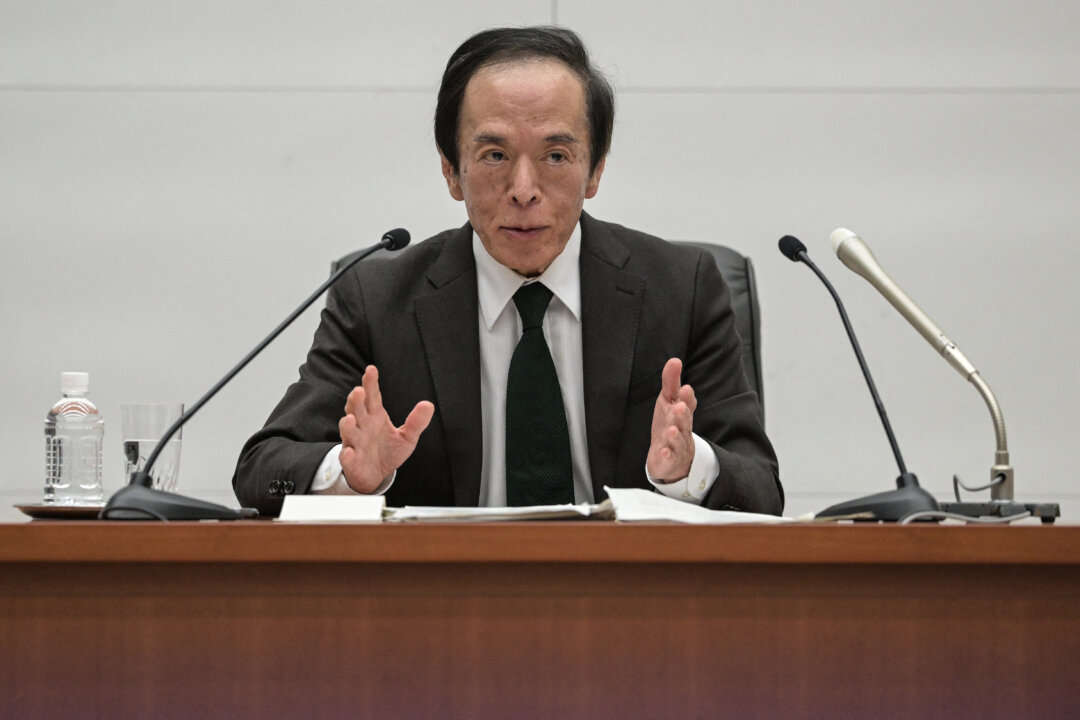
Japan’s central bank raised its benchmark short-term interest rate to 1.25 percent on Sept. 18, saying underlying inflation was approaching the bank’s 2 percent target and that further rate increases were likely if economic and price trends remained on track.
The Bank of Japan also raised the interest rate paid on excess reserves held by financial institutions to 1.25 percent and increased its basic loan rate to 1.5 percent.
The bank said Japan’s economy had continued to recover moderately, although some sectors remained weak because of the impact of the Middle East conflict. Underlying inflation has continued to move closer to the Bank’s 2 percent target.
“Up till now, our short-term policy focus was to push up underlying inflation from levels below 2 percent,” Bank of Japan Governor Kazuo Ueda told a news conference following the announcement. “If risks of underlying inflation overshooting 2 percent materialize, that could have a negative impact on Japan’s economy.”
The bank said it expects inflation to rise above the 2 percent target during the second half of fiscal 2026 before easing back towards it as the effects of higher oil prices fade.
Two members of the bank’s policy board, Toichiro Asada and Ayano Sato, both appointed by Japanese Prime Minister Sanae Takaichi, opposed the rate hike, saying economic conditions did not yet justify it.
Frantisek Taborsky, analyst at ING THINK, said the bank’s decision acknowledged persistent upside inflation risks but noted inflation eased slightly in August because of government subsidy effects.
He added that dissent from Asada and Sato could make it harder for policymakers to reach consensus on another rate increase this year.
Ueda left open the possibility of larger or consecutive rate increases if inflation risks intensify, adding that large or back-to-back hikes would be appropriate only if Japan faced significant inflation risks similar to those seen in the United States and Europe.
The Bank of Japan’s move follows similar decisions by other major central banks this month.

The U.S. Federal Reserve on Sept. 16 delivered its first interest rate increase in more than three years, raising its benchmark federal funds rate by a quarter of a percentage point to a target range of 3.75 to 4 percent.
The European Central Bank also raised its three key interest rates by a quarter point on Sept. 10, saying upside inflation risks and downside threats to economic growth shaped its decision.
The Bank of England kept interest rates unchanged at 3.75 percent on Sept. 17 but signaled it could tighten policy if persistently higher energy prices driven by the conflict in the Middle East fuel broader inflation pressures.
The yen weakened after the Bank of Japan’s decision. The bank’s central rate put the currency at 155.39 per U.S. dollar on Sept. 16, before the policy meeting, and 156.15 on Sept. 17.
It fell further to around 157.10 on Sept. 18 as investors reacted to the central bank’s cautious guidance on future rate increases.
Ueda said the Bank considers how exchange-rate volatility affects inflation but does not use monetary policy to target specific currency levels. He also said financial conditions were becoming less accommodative as rates rise.
“It’s important to avoid financial conditions from tightening too much, or to cause a big adjustment in asset prices, by raising rates too sharply,” Ueda said.
Looking ahead, the bank said it expects the economy to continue growing at a moderate pace, although the conflict in the Middle East and higher crude oil prices are likely to weigh on activity in the near term.
It said government support measures, accommodative financial conditions, and rising global demand for artificial intelligence-related products should help offset some of those pressures.
Reuters contributed to this report.
We had a problem loading this article. Please enable javascript or use a different browser. If the issue persists, please visit our help center.