
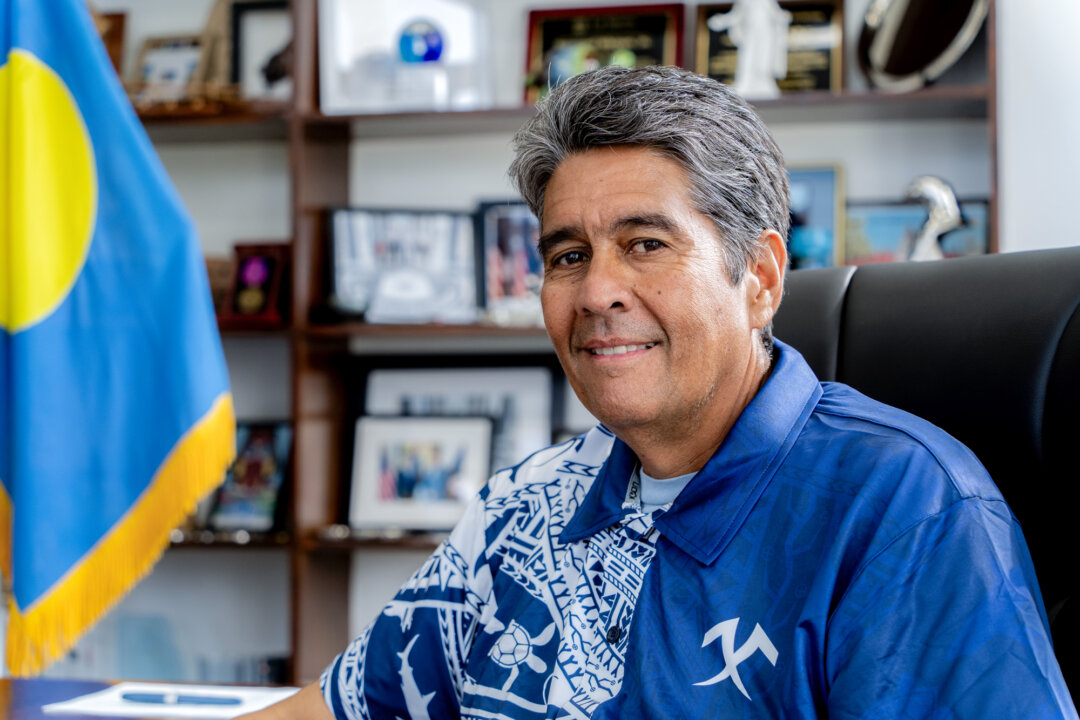
KOROR, Palau—When Surangel Whipps Jr. was pursuing an MBA at UCLA in the early 1990s, his classmates were chasing job interviews and lucrative careers. Whipps had something else in mind.
His classmates wondered why he wasn’t interviewing for jobs. Whipps had a simple answer: “I came here to go to school, but my plan was to go back home, help our family business, and then eventually serve the public.”
Whipps was born in Baltimore to an American mother and a Palauan father, so he held U.S. citizenship at the time. But the constitution of Palau bars elected officials from holding dual citizenship.
Even though “it felt at one point it was having to give up half of [himself],” Whipps renounced his claim to American citizenship.
“I talked to my mother about it, and the reality is, we’ve lived here basically all our lives. My mother said, ‘This is our home,’” he said.
“I feel blessed to be a Palauan, to live in this—we call it—pristine paradise.”
Whipps was first elected president in 2020 and reelected to another term in 2024.
Today, Whipps leads a country that he describes as a “bull’s-eye” because of its strategic location and growing geopolitical importance.

“I believe in the theory—that President Reagan said was, if you want peace, it comes through strength—and President Trump says the same thing,” Whipps told The Epoch Times’ “American Thought Leaders” during an interview at his presidential office.
That means finding the right partners to work with—countries that share the same values of freedom, democracy and the rule of law, Whipps said.

Whipps dismissed the notion that his country could simply sit out the current geopolitical competition. He warned against what he called a “false sense of security”: the belief that “we’re just out here in the Pacific and nobody’s going to be interested in us, and we can just live and be happy.”
Successive colonial powers—Spain, Germany, and Japan—ruled Palau before the archipelago came under U.S. administration as a United Nations trust territory in 1947.

Palau gained full independence from U.S. trusteeship in 1994 and entered into a compact of free association with the United States.
In March 2024, a renewed compact review agreement entered into force, committing $889 million in U.S. grants and trust-fund contributions to Palau over 20 years for education, health, the environment, administration of justice, public safety, and audits.

Pushing Back Against China
Another of Palau’s longstanding diplomatic partners is Taiwan. The two countries have maintained formal relations since 1999.
But the Chinese regime has been seeking to draw Palau away from Taiwan and establish its own diplomatic ties, Whipps said.

Whipps said Chinese officials have sought to win him over by talking up China, then warning him to play by their rules.
“They first tell me how wonderful they are, and then they turn around and say, ‘Well, if you don’t behave, we’ll beat you up,’” he said.
“I don’t know how that translates into trying to woo somebody, but usually that’s not the way you woo somebody.”
Tourism, Whipps said, is one way China has sought to exert leverage.
“They’ve told us, ‘Oh, we can build all the hotels you want, bring you a million tourists,’” he said.
But at the same time, the regime has threatened to cut off the flow of Chinese tourists if Palau doesn’t switch its diplomatic recognition from Taipei to Beijing. “This has been the narrative,” Whipps said.

Even if Whipps weren’t committed to supporting Taiwan, he said, the prospect of a million Chinese tourists a year is hardly enticing. An influx of that scale, he said, “would destroy the beautiful, pristine environment” of his country.
Palau has a population of about 17,600 people.
Tourism-related activity accounts for about 20 percent of Palau’s economy.
Other sources, including a 2025 U.S. State Department report, put the number at 40 percent.
The EconMAP review projects that tourism-related economic activity will grow by 28 percent in fiscal year 2026.
Illustrating the role of tourism in Palau’s economy, visitor spending relative to the island country’s GDP has stood as high as 50 percent, according to an IMF report.

China has repeatedly used outbound tourism as leverage, tightening approvals for group tours and issuing travel advisories to pressure countries that rely on Chinese visitors.
Taiwan, Japan, and South Korea have faced similar unofficial restrictions during political or security disputes, showing how the Chinese regime can weaponize tourism as a tool for coercion.

In 2017, Beijing barred Chinese travel operators from selling package tours to Palau, triggering a sharp drop in arrivals.
Palauan government data show Chinese visitor numbers fell to about 55,000 in 2017 and 28,000 in 2019, down from more than 91,000 in 2015.

The pressure resurfaced in mid-August, when Beijing warned its citizens against traveling to the island nation, citing concerns over theft and robbery, despite the archipelago’s international reputation as a safe place to travel with a low crime rate.
Beijing’s travel warning came just weeks before Palau was to host the 55th annual Pacific Islands Forum (PIF) Leaders Meeting, a gathering of 18 Pacific nations, including Australia and New Zealand. The forum ended on Sept. 4.
Taiwan’s foreign minister, Lin Chia-lung, attended the forum at the invitation of Whipps.
In an earlier exclusive interview with The Epoch Times, Whipps said he had dismissed a challenge from a Chinese diplomat who sought to exclude Taipei from the gathering.
The dispute underscored China’s effort to press its agenda on Palau.
Chinese officials have accused Palau of engaging in “illegal activities” under the “one China principle,” Whipps said.

He rejects that accusation. “Obviously, Palau recognizes Taiwan, so the ‘one China principle’ doesn’t apply in Palau, it only applies in countries that recognize China,” he said. “We believe that every country that has a right to self-determine should be allowed that right.”
Many countries, including the United States, have a “one China policy,” which asserts that there is only one sovereign state with the name “China.” That policy is distinct from the “one China principle” under which the Chinese regime asserts sovereignty over Taiwan.

Whipps said he was also struck by China’s attitude toward smaller countries. He recounted a conversation with a Chinese diplomat over Palau’s claim to an extended continental shelf.
When he suggested that there might be a misunderstanding at the governmental level over Palau’s claims to the shelf, the diplomat replied Palau was a “small country” that “shouldn’t have so much ocean.”
The incident, Whipps said, illustrated a lack of mutual respect and regard for international rules.
In recent years, Palau has repeatedly protested Chinese vessel incursions into its exclusive economic zone, including the Kyushu-Palau Ridge, an ocean floor feature in the Philippine Sea.

Drug Crisis
Palau, like countries across the Pacific, is grappling with an illicit drug crisis involving methamphetamine and cocaine, Whipps said, amid what he described as a lack of cooperation from Beijing.
“We know most of the [drugs] come on flights that come from Macau and Hong Kong,” Whipps said.
He added that he had raised the issue with Chinese authorities and urged them to prevent drugs from being loaded onto flights, but said they “haven’t helped us much in that area.”

According to data cited by Whipps in his state of the republic address this year, Palau had 15 meth-related convictions in 2024, resulting in $195,750 in fines. The number of convictions was three times the number recorded in fiscal year 2019. In 2025, convictions jumped to 21, while fines rose to $362,000.
Several Chinese nationals were found guilty of drug-related charges and sentenced in 2025, according to Palau’s Ministry of Justice. The rise in drug-related convictions is putting increasing pressure on Palau’s prisons. “They fill up our jails,” Whipps said. “It’s overrunning our systems.”

He noted that drug-related offenders now account for 15 percent of the country’s prison population—a share he said continues to grow.
Palau is working with the United States to tackle the drug crisis.
“I’ve brought this up with the United States continuously,” Whipps said. He has sought assistance from the Drug Enforcement Administration, the FBI, military intelligence agencies, and the Department of Homeland Security, he said, and has sought U.S. attorneys to prosecute cases.

The issue is at the top of the agenda at the biannual U.S.–Palau Joint Committee Meeting, Whipps said. At the March meeting in Koror, Palauan officials met with representatives from U.S. Indo-Pacific Command and other U.S. agencies to discuss illicit narcotics and broader security cooperation.
In February, Whipps signed an executive order that established a national working group to combat illicit drugs.
Whipps is asking the United States for more direct law enforcement support.
Under the compact between the two nations, “the United States should be taking an active role,” he said.
“We keep on talking, but sometimes [getting] boots on the ground is just not happening as fast as it needs to happen.”
We had a problem loading this article. Please enable javascript or use a different browser. If the issue persists, please visit our help center.