
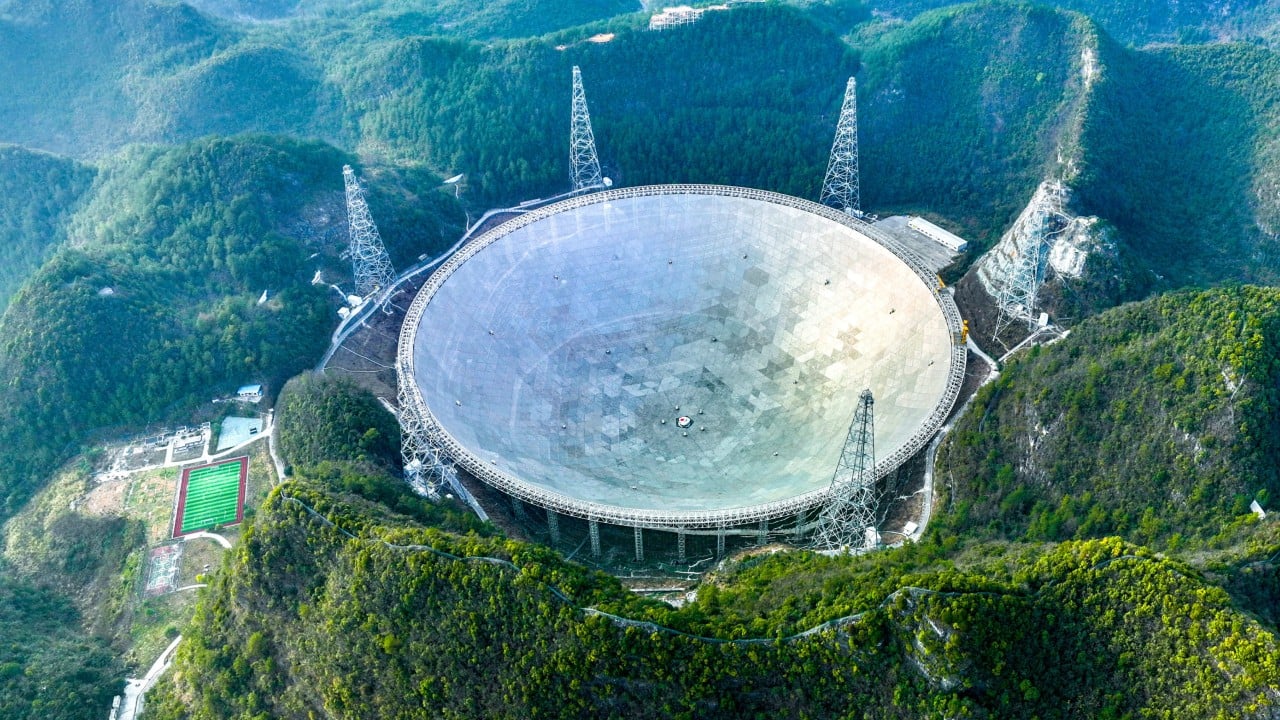
China’s FAST telescope has compiled the world’s largest catalogue of neutral hydrogen beyond the Milky Way, replacing a long-dominant US survey as the main reference for mapping the gas that fuels the formation of stars and galaxies.
The FAST All-Sky H I Survey (FASHI), conducted with the 500-metre (1,640-foot) radio dish in southwest China’s Guizhou province, released its second batch of data this week. It contains 156,411 extragalactic sources – nearly five times the number detected by the now-defunct Arecibo Telescope in Puerto Rico.
The publicly available data gives astronomers worldwide an unprecedented pool of galaxies to investigate some of the universe’s biggest questions – from how the vast cosmic web took shape, to why some galaxies thrive while others fade away.
Compared with ALFALFA – the landmark US survey carried out with Arecibo from 2005 to 2012 – FASHI covered about three times as much sky and detected galaxies that were much smaller, fainter and further away, a team led by researchers from the National Astronomical Observatories reported.
The work established “a legacy data set that bridges the gap” between earlier surveys and the coming Square Kilometre Array – a massive international radio telescope now being built in Australia and South Africa, they wrote in a study published in the peer-reviewed journal Science China Physics, Mechanics & Astronomy this month.
For more than half a century, Arecibo’s 305-metre dish was an icon of radio astronomy.
Completed in 1963, it remained the world’s largest single-aperture radio telescope until FAST overtook it in 2016, and was behind a string of major astronomical discoveries before its giant observing platform collapsed in 2020.