
When an assassin shot Turning Point USA founder and conservative commentator Charlie Kirk at Utah Valley University on Sept. 10, 2025, speculation immediately began to swirl.
The moment that graphic video footage showing Kirk’s shooting made the rounds online, it prompted a national outcry surrounding political violence.
His death marked the first assassination of a major American political figure since the advent of social media. Platforms repeatedly dissected and amplified every frame of the video. People across the political spectrum speculated about the reasons behind the slaying, and some made conjectures about it being an inside job or somehow tied to the Israeli government.
Other theories included a second shooter being present at the scene or that left-wing groups conspired to kill Kirk. The latter stemmed from the fact that accused killer Tyler Robinson’s romantic partner, Lance Twiggs, claimed to be “exploring gender transition.” Likewise, slogans used by Antifa, designated as a domestic terrorist group, were engraved on bullet cartridges found at the crime scene.
Evidence made public so far in Kirk’s murder case offered no corroboration for any of these theories. Instead, it focused on Robinson as the alleged lone gunman, with the prosecution’s case centering on him as the person driven to silence Kirk’s political views.
FBI Director Kash Patel acknowledged some of those theories in a Sept. 24, 2025, post on X. He said the agency was investigating possible accomplices, “hand gestures observed as potential ‘signals’ near Charlie at the time of his assassination, and visitors to the alleged shooter’s residence.”
Patel addressed a theory making the rounds that the killer escaped by plane, after an X post with almost 19 million views questioned why a private jet left Utah’s Provo Airport shortly after the shooting, went off radar, and then returned an hour later.
“After interviews with the pilot and consultation with the FAA, we determined the transponder was not turned off. Incomplete flight data in rural areas caused the apparent gap,” Patel said.

Prosecution’s Evidence
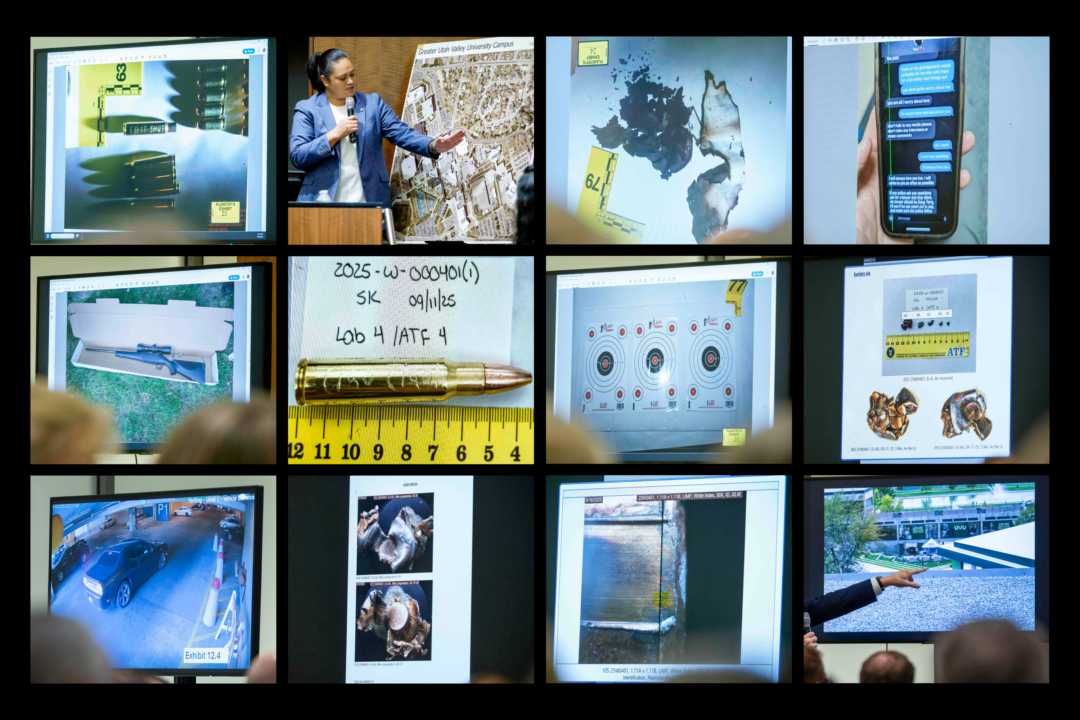
The probable cause hearing held this summer offered insight into the prosecution’s evidence in the murder case against Robinson to date.
The prosecution alleged during a Sept. 1 preliminary hearing that Robinson had the “motive, means, and opportunity” to kill Kirk.

Judge Tony Graf Jr. of the Fourth District Court of Utah ruled at the end of the hearing that the prosecution had demonstrated probable cause, and that Robinson would stand trial for aggravated murder and six other charges.
Robinson pleaded not guilty to all seven.
Zack Smith, a senior legal fellow at The Heritage Foundation who has followed the case, said that so far the prosecution hasn’t indicated that others might have conspired to help the shooter.
“It seems like the authorities believe they have the person who actually pulled the trigger,” he told The Epoch Times.

Jonathan Hullihan, president and general counsel at Remnant Law, which specializes in free speech and religious liberty cases, said the evidence presented so far points to a single shooter.

“According to evidence presented at the hearing, surveillance footage places Robinson on campus, forensic testimony tied his DNA to the rifle and every item recovered with it, and the medical examiner’s findings are consistent with a single gunshot wound. Nothing in the record points to an accomplice,” Hullihan told The Epoch Times.
“The theory that the murder was part of an organized conspiracy has no evidentiary support at this stage.”
The evidentiary hearing in July offered the public its first in-depth look at the state’s evidence against Robinson.
“What we know from the probable cause hearing, which again is a lower standard than the beyond a reasonable doubt standard, is that prosecutors have a very compelling case to make that Tyler Robinson is responsible,” Smith said.


‘Take Out Charlie Kirk’
The most dramatic testimony of the July evidentiary hearing came on July 9, when Robinson’s former roommate offered recorded testimony that Robinson cried and regretted his actions after Kirk’s fatal shooting.
Robinson’s text messages to Twiggs allegedly show he admitted responsibility, explained his motive, and described planning over a week in advance. The messages identified where the rifle was hidden and referenced engraved bullet cartridges.

According to testimony, Robinson told Twiggs to delete the messages and not cooperate with police.
Twiggs told police in a recorded interview that he spoke with Robinson in person when he returned to their residence after Kirk was shot.
He said he asked Robinson whether the information in their previous text thread after the shooting was true.
“He said he wishes he hadn’t done it,” Twiggs said, adding that Robinson was agitated and crying during the conversation.


A Utah state investigator who was present when Twiggs spoke with police also read text messages between the two.
“Twiggs asked, ‘You weren’t the one who did it, right?’“ the investigator said. ”And Tyler says: ‘I am. I’m sorry.’”
Smith said the alleged text messages demonstrate planning and speak to motive as well, which is why Robinson’s defense team is trying to exclude as many of them as possible.
He said the defense team will likely go after Twiggs’s credibility if he takes the stand.

“This is very problematic evidence for Tyler Robinson and his defense team,” Smith said.
Beyond the dramatic testimony, the prosecution’s charging document provided key details about a letter Robinson allegedly left on his desk for Twiggs, which was referenced during the evidentiary hearing.
Robinson allegedly texted Twiggs, “Drop what you are doing, look under my keyboard.” Twiggs then found a note reading, “I had the opportunity to take out Charlie Kirk, and I’m going to take it,” according to the document.

The Crime Scene
Evidence presented against Robinson included video allegedly placing him at the scene of the crime.
A man identified as Robinson was caught on campus surveillance video that day. Another video shows a vehicle identified as Robinson’s being stopped late at night by an officer stationed there. Robinson was allegedly returning to campus to recover his rifle.

Twiggs told investigators the man in the campus photos, which were released to the public during a manhunt for Kirk’s killer, looked like Robinson.
The prosecution entered evidence of bullet cartridges found at the crime scene that were engraved with references to homosexuality and anti-fascism. Robinson’s DNA was found on bullet cartridges, both fired and unfired, according to testimony.
One engraving read: “Hey fascist! Catch!” It was followed by a series of up arrow symbols that authorities noted may be code used in the video game “Helldivers 2.”
“If you read this, you are gay LMAO” appeared on another of the cartridges.


Robinson’s DNA was allegedly found on a towel wrapped around a rifle stashed in the nearby woods and a screwdriver found near a “sniper pad” on the roof of the Losee Center.
According to the prosecution’s testimony, the DNA found on the objects was at least 1 trillion times more likely to be linked to Robinson.
But during cross-examination of an FBI DNA analyst, the defense sought to poke holes in the process to cast doubt on its validity by suggesting that the technology was outdated.
Death Penalty
Throughout the case, the defense has repeatedly sought to take the death penalty off the table—a typical tactic for defendants facing a potential death sentence.
Smith pointed to the Idaho death penalty case against Bryan Kohberger, who was accused of brutally slaying four Idaho college students in 2022. In that case, a plea deal with prosecutors spared him the death penalty.
Such a deal is less likely in the Kirk case, he said.

“It wasn’t just done for sadistic purposes alone. It was clearly designed to send a message, to be essentially a political assassination,” Smith said. “So I suspect that that may also weigh into the prosecution’s decision as well.”
Motive, while not needed to bring a murder charge, could certainly play into the death penalty as an aggravating factor.

Hullihan added that the defense had recently attempted to throw out the aggravating factor that Robinson potentially put the crowd at risk of death or injury that day when he allegedly shot Kirk. The defense argued the shooter’s bullet struck true, therefore removing any threat to bystanders.
A death penalty hasn’t been handed down in Utah—which allows death by firing squad in certain situations—in nearly two decades.
“Eligibility and likelihood are different questions,” Hullihan said. “A death sentence requires a unanimous jury in a separate penalty phase, and no Utah jury has returned one since 2008.”

We had a problem loading this article. Please enable javascript or use a different browser. If the issue persists, please visit our help center.