
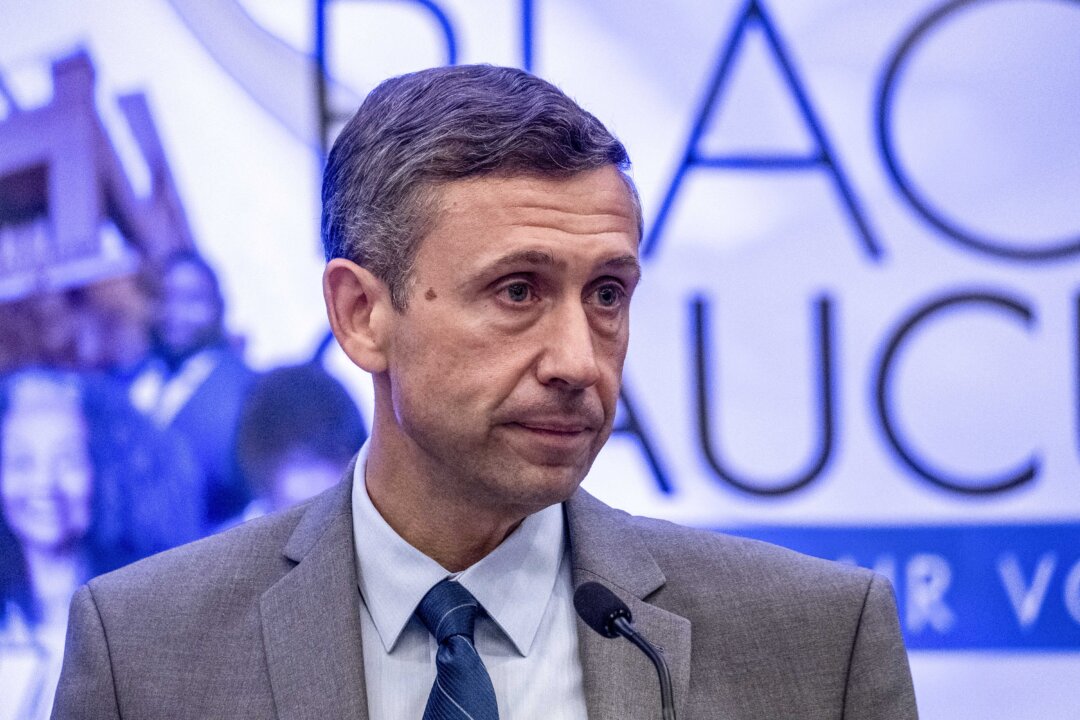
Democratic National Committee (DNC) Chair Ken Martin said “nothing’s gone wrong” with his committee’s finances, defending its cash position in a CNN interview on Sept. 9, hours before Republicans opened their first midterm convention in Dallas.
The committee’s most recent filing with the Federal Election Commission (FEC) shows it holding more debt than cash with less than two months until Election Day. Asked what had gone wrong, Martin said the position was intentional.
“Nothing’s gone wrong, just the opposite. We’ve made a bet,” Martin said.
The DNC reported $16,052,959 in cash on hand and $17,916,447 in debts and obligations at the close of July, according to its August monthly report, filed Aug. 20 and covering July 1–31. It raised $9,239,820 during the month and spent $9,519,794, leaving it about $280,000 further out of pocket than it took in. Its debts exceed its cash by roughly $1.86 million.
The Republican National Committee (RNC) reported $130,358,850 in cash and no debt over the same period, raising $19,405,952 and spending $17,585,983. The difference between the two committees’ cash positions is about $114.3 million, or roughly eight to one.
Martin described the debt as the product of a sequence of decisions dating to the last presidential cycle.
Martin said the campaign had inherited “a bunch of” debt from the previous presidential campaign followed by loans after paying that debt off.
“We decided to pay that money off. And of course, we did,” he told CNN’s Kasie Hunt on Wednesday. “And then we took out a loan so that we could make deep investments in the elections last year to win. And we did as a result.”
The DNC is the only one of the six national party committees reporting any debt, a position it has held all year. The other five ended July with none.
Republicans hold more cash at each of the three levels. The National Republican Senatorial Committee (NRSC) reported $56.2 million against the Democratic Senatorial Campaign Committee’s $39.9 million.
The National Republican Congressional Committee (NRCC) reported $92.4 million against the Democratic Congressional Campaign Committee’s $80.2 million.
The outside groups aligned with each party report a similar pattern, though their filings do not all cover the same period. Party committees file monthly while super PACs choose between a monthly or quarterly filing schedule.
Senate Leadership Fund, aligned with Senate Republicans, reported $238.6 million in cash as of June 30, its most recent report. Senate Majority PAC, its Democratic counterpart, reported $126.5 million over the identical period.
Congressional Leadership Fund, aligned with House Republicans, reported $141.8 million as of June 30. House Majority PAC, which files monthly, reported $114.8 million a month later, at the close of July.
Make America Great Again Inc., the super PAC aligned with President Donald Trump, reported $403,450,027 in cash at the close of July, and no debt. It began the year with $304.4 million and has taken in $111.6 million since, spending $12.5 million.
The RNC has made the same comparison as Martin. In a Sept. 6 newsletter, the committee said Republicans have “a massive fundraising advantage this cycle with nearly $1 billion in the bank,” pointing to recent Supreme Court rulings on coordinated party spending and on the lowest unit charge for television ads.
The pattern reverses at the candidate level. Democratic candidates lead Republican candidates in reported fundraising in both chambers, according to FEC summary figures covering everyone running in 2026.
House candidates have raised $1.84 billion over the two-year window beginning Jan. 1, 2025. Democratic candidates account for $1.01 billion of that, Republican candidates $816.7 million, and others $11.8 million.
Senate figures cover a six-year window matching the length of a Senate term, from Jan. 1, 2021 through the end of 2026, and total $940.9 million. Democratic candidates account for $585.2 million, Republican candidates $336.8 million, and others $18.9 million. Senators who have served a full term appear in that total alongside candidates who entered their races last year.
Sen. Jon Ossoff (D-Ga.) leads all Senate candidates at $98 million. Texas state Rep. James Talarico, the Democratic nominee for the seat Republicans are defending in Texas, is second at $68.6 million. Sen. Susan Collins (R-Maine) is the highest-raising Republican still on the ballot at $18.9 million.
The FEC totals include candidates who are no longer running. Sen. Lindsey Graham (R-S.C.), who raised $21.5 million and ranks eighth among all Senate candidates, died July 11. Graham Platner, who raised $21.1 million and ranks ninth, withdrew from the Maine Democratic primary in July, with state Sen. Troy Jackson becoming the Democratic nominee against Collins.
Rep. Alexandria Ocasio-Cortez (D-N.Y.) leads House candidates at $32.6 million. House Speaker Mike Johnson (R-La.) is the highest-raising Republican at $21 million.
Martin said the DNC has directed money outward rather than holding it.
“But the difference here is that we’re spending the money. We’re actually pushing it out to have conversations with voters, to have year-round organizing throughout the country, to support our state parties in a 50-state party strategy, to invest deeply in elections up and down the ballot, not just federal elections, but state and local elections as well,” he said.
A party chair should be judged on two questions—whether the chair is raising money and whether the party is winning—he said, and Democrats have won about 90 percent of the elections on the ballot over the past 19 months.
Martin also said the committee has raised more than $216 million to date through July 31, which he said is $100 million more than former DNC Chair Tom Perez raised at a comparable point after a presidential loss. That figure covers the 18 months beginning in January 2025 when he took over as chair.
Asked whether opposition to Trump is enough to carry the party, Martin said Democratic candidates have been running on affordability, health care access, and what he described as a system rigged for the wealthy.
He said the party will find out shortly whether the approach worked.
“We’ll see in 55 days what ends up happening. I’m confident we’re going to win,” Martin said. “I’m not complacent, but I can tell you what, we’ve been raising the resources we need to actually invest in the things that will help us win.”
We had a problem loading this article. Please enable javascript or use a different browser. If the issue persists, please visit our help center.