
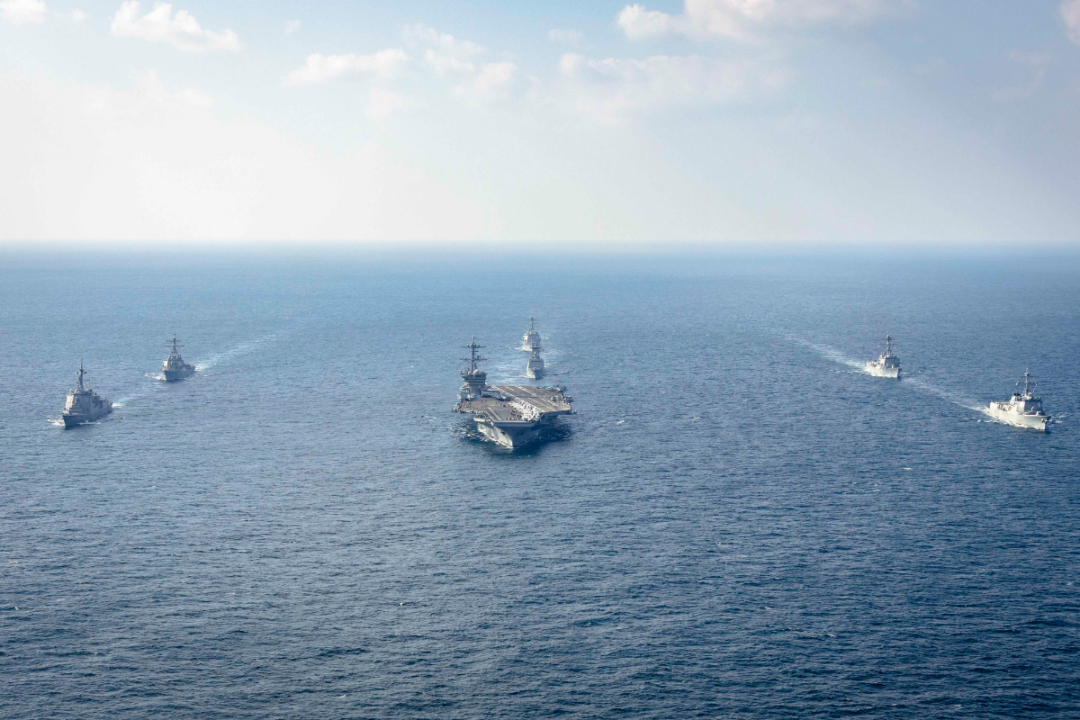
North Korea commissioned its second naval destroyer on Sept. 6 as the United States, South Korea, and Japan prepared to launch trilateral military drills.
The commissioning of the Choe Hyon-class guided-missile destroyer came after U.S. President Donald Trump ordered the Pentagon to shorten a joint military exercise with South Korea last month.
The new destroyer also comes as the regime has been modernizing its navy.
North Korea’s second naval destroyer, the Kang Kon, was commissioned on Sunday at a ceremony in the eastern port city of Wonsan.
The ceremony was attended by North Korean leader Kim Jong-Un and his teenage daughter, believed to be named Kim Ju-Ae.
The Choe Hyon, North Korea’s first guided-missile destroyer, was commissioned in June.
The two 5,000-ton naval destroyers are capable of carrying conventional and nuclear weapons, according to North Korean state media.
North Korea previously announced the firing of nuclear-capable cruise missiles from the Kang Kon in July.
“The enemies’ concerns will surely be deepened,” Kim said in a speech at the commissioning ceremony.
“We must establish more clearly a powerful and reliable nuclear war deterrent, to put into practice the diverse and effective operation of our nuclear combat systems and further strengthen our military activities for maritime defense and war deterrence.”
The United States, South Korea, and Japan held the opening ceremony for Freedom Edge 2026 at Yokota Air Base in Japan on Sept. 7.
The trilateral military exercise is scheduled to end on Sept. 11.
U.S. Pacific Command described the trilateral exercise as “defensive in nature” and said the drill was intended to improve information sharing, coordination, and combined readiness for the United States, South Korea, and Japan.
This year’s exercise is taking place in South Korea’s airspace, international waters, and military installations in Japan.
Freedom Edge 2026 is the fourth iteration of the trilateral military drill since the United States, South Korea, and Japan first began the joint exercise in June 2024.
U.S. Pacific Command said the exercise strengthens trilateral readiness, trust, and interoperability across air, cyber, maritime, and integrated air and missile defense capabilities.
“The message of this exercise is simple and clear,” Lt. Gen. Stephen Jost, commander of U.S. Forces Japan, said in a statement. “The Republic of Korea, Japan, and the United States stand together on common interests, ready to preserve the peace and security we have built and defended for more than eight decades.”
North Korean Defense Minister Kim Song-gi criticized the trilateral military exercise as an attempt to provoke North Korea, according to North Korea’s state-run Korean Central News Agency.
He warned that North Korea could take “strong and reflective countermeasures” if the United States and its allies tried to provoke a new military confrontation.
Ulchi Freedom Shield, a joint military exercise between the United States and South Korea, was shortened last month after Trump directed Secretary of War Pete Hegseth to reduce it.
Trump said the drills sent a signal that was “totally inappropriate and hostile.”
Kim Yo-jong, the North Korean leader’s sister, warned last month that the “provocative” and “aggressive nature” of the joint U.S. and South Korean military drills would not be changed by a reduction in the duration and size of the exercise.
North Korea appeared to dismiss Trump’s gesture of shortening the exercises, firing 10 short-range ballistic missiles toward the Sea of Japan last month.
Reuters and The Associated Press contributed to this report.
We had a problem loading this article. Please enable javascript or use a different browser. If the issue persists, please visit our help center.