
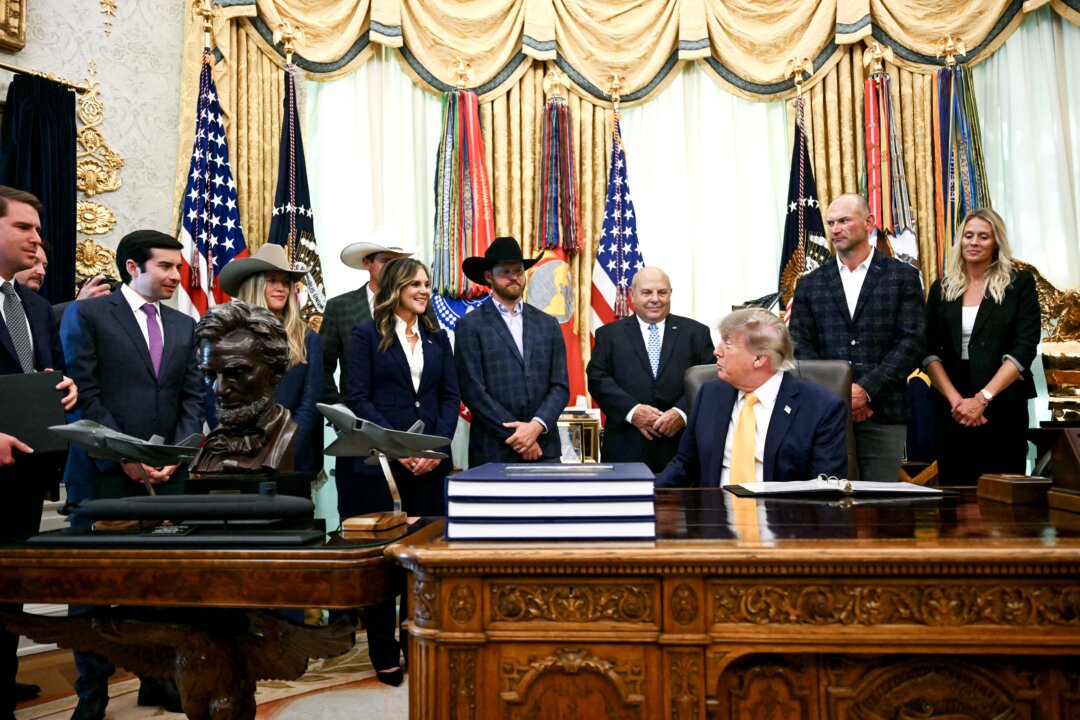
President Donald Trump signed two executive orders on Friday that aim to help ranchers recover from the effects of Biden administration policies that he said depressed the beef industry.
Trump told reporters the executive orders are “very earthshaking from the standpoint of positivity for our ranchers and for our farmers, who I love.”
The orders, which Trump announced from the Oval Office, direct the Interior secretary, U.S. Trade Representative, commissioner of the Food and Drug Administration, and the head of the Small Business Administration to assess policies affecting ranchers and “promote ranchers’ financial viability and market access.”
One of the key provisions is an order for “more vigorous enforcement of the Packers and Stockyards Act, 1921.”
That law was enacted to promote fair competition in the livestock, meat, and poultry markets. It was a response to allegations that the large companies—Swift & Company, Armour & Company, Cudahy Packing Company, Wilson & Company, and Morris & Company, then known as the “Big Five”—had engaged in unfair trade practices at the expense of producers and consumers.
Trump has called for allowing producers to sell their meat and poultry to local customers and processors. Currently four corporations dominate the meatpacking industry: Tyson, Cargill, JBS, and National Beef. They control 80 percent to 85 percent of the U.S. beef market, according to watchdog group Farm Action.
“For years I’ve heard they have problems with the big processors,” Trump said. “They say the four are a ‘nasty group.’”
The president pulled no punches in labeling the four big processors, two of which he noted are based in Brazil, a monopoly. He accused the companies of working to keep prices high.
“They cost our farmers a lot of money, and they cost our ranchers a lot of money, and they cost our people a lot of money,” he said.
Trump’s order calls for the Agriculture secretary to work with the Justice Department’s Antitrust Division to investigate and refer possible violations of the law for enforcement.
He is also ordering the USDA to review existing laws to look for ways to allow state-inspected small processors to expand their markets. This includes getting more of them involved in federal meat and poultry inspection programs and streamlining the inspection process.
He is also ordering the secretary to create a resource and coordinator position within USDA to help with implementing the new inspection process.
The president is ordering a report on the progress of this work within 60 days.
“People have been asking for this change for decades, and we’re getting it done,” Trump said.

The president also ordered USDA to review country-of-origin labeling for beef products and propose new rules and legislation. Beef producers have been calling for such labeling, saying that Americans have a right to know where their food comes from.
This includes voluntary “Product of USA” labeling, the executive order states.
Trump has also ordered a determination from the secretary of the Interior on whether the gray wolf and the Mexican gray wolf still meet the criteria for delisting or down-listing under the Endangered Species Act. The order includes directions to encourage states to remove the wolves from any state-specific lists.
Among ranchers present for the signing, one from Washington told the president that the predator has been delisted from the federal endangered list, but the state still protects it. The ranchers said the predators attack livestock and pets. The Washington rancher said the state was using federal tax dollars to grow the wolf population in the Pacific Northwest while livestock producers struggle to get by.
“We are funding our own demise,” the rancher said.
The administration accused the Biden White House of pursuing “radical climate activists’ misguided policies” that increased ranchers’ input costs. This, it said, combined with drought and wildfires that reduced feed and forage, depressed the herd numbers to a 75-year low.
Fact sheets released by the White House highlighted several actions taken by the Trump administration to promote agricultural interests, including tax policies allowing the depreciation of farm equipment and other deductions for farmers and ranchers, the expansion of grazing on federal lands, and wildfire mitigation.
We had a problem loading this article. Please enable javascript or use a different browser. If the issue persists, please visit our help center.