
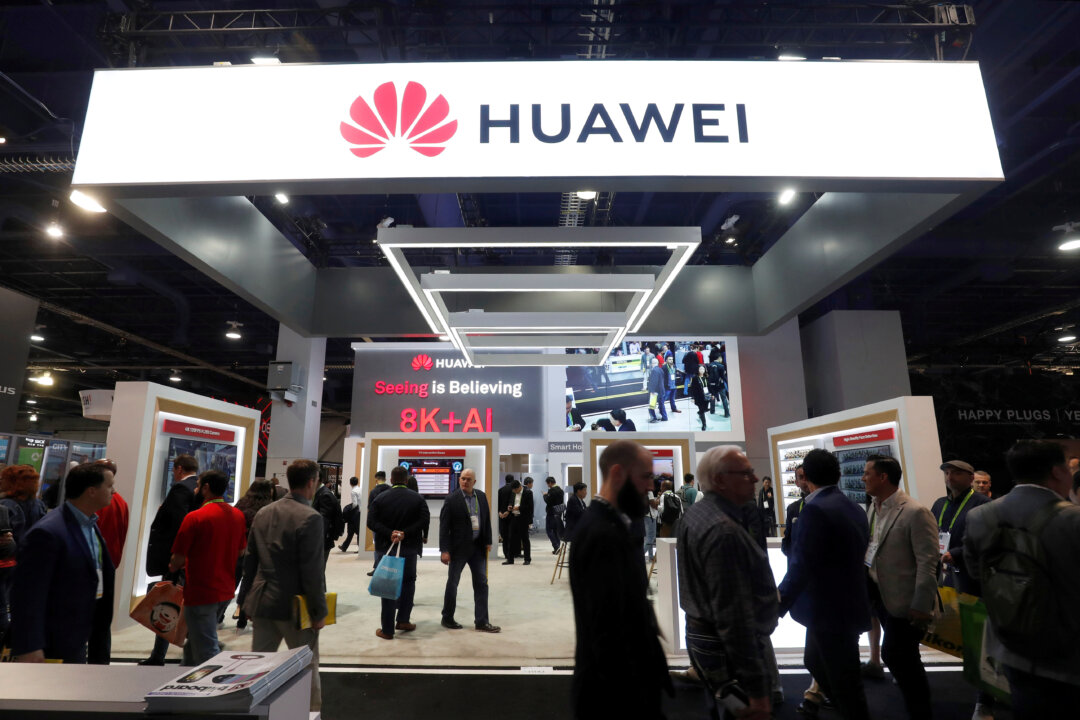
After Huawei announced plans to expand its artificial intelligence collaboration with Chinese pharmaceutical companies into the drug discovery market, analysts who spoke to The Epoch Times warned of the risks these moves by the Chinese communist regime-linked technology conglomerate could bring to the Chinese public and nations around the world.
“As we further deepen our research into AI in the medical field, we’ll have more collaboration and results emerging with pharmaceutical companies from drug manufacturing to clinical to final implementation,” William Zhang, president of Huawei’s healthcare business unit, told Reuters on Aug. 26.
Zhang said that the company’s current projects are mainly with domestic drugmakers, and Huawei also had some existing collaborations in the area of clinical practice in hospitals and was exploring more opportunities. However, Zhang didn’t reveal further details of the plan.
Davy J. Wong, a U.S.-based independent political economist, told The Epoch Times that this was first and foremost a declaration of strategic direction, as the company didn’t reveal any budget or specifics of its ambition.
Huawei is transforming from an “equipment supplier” into an “industry operating system,” Wong said.
Su Tzu-yun, researcher and director of Division of Defense Strategy and Resources at Taiwan’s Institute for National Defense and Security Research, told The Epoch Times, “The application of AI in bioengineering or pharmaceuticals is indeed a global trend in the biotechnology industry.”
Huawei offers AI tools for screening potentially viable drug compounds, alongside its Ascend and Kunpeng chips.
AI-driven drug discovery does not require the use of the world’s most cutting-edge chips for every task, Wong said, adding, “Huawei’s Ascend platform is already fully capable of handling molecular feature learning, initial compound screening, protein-binding prediction, and model inference.”
In May 2026, Huawei and major Chinese state-owned company Guangzhou Pharmaceutical Holdings Limited signed an AI pharmaceutical ecosystem cooperation agreement with Huawei to deepen collaboration on digital and intelligent pharmaceutical R&D and develop AI models for drug research.
Huawei said at the time that one project involving Guangzhou Pharmaceutical was the industry’s first production validation of independently developed AI drug research models that were adapted to its Ascend and Kunpeng technologies.
Such cooperation between Huawei and Guangzhou Pharmaceutical has a significant impact, Su said, “because China is now the world’s new drug supply center, including the United States, which purchases a large amount of new drugs from mainland China.”
When Western countries develop new drugs, they are required by law to follow extensive procedures and conduct numerous experiments, Su said. “In contrast, regulations in China tend to be more lenient in this regard. Consequently, Chinese pharmaceutical companies can develop new drugs much faster than their Western counterparts, and at a significantly lower cost,” Su added.
“Introducing this AI now would align with global trends, and it would also significantly boost China’s influence in the pharmaceutical sector.”
Guangzhou Pharmaceutical Group’s domestically developed drug research and development project using computing power, in collaboration with Huawei, was listed as a high-value AI application case by the Chinese regime’s Ministry of Industry and Information Technology in July.
This listing indicates that it is not merely an ordinary commercial partnership but also serves as a demonstration project for industrial policy, Wong said.
“If a single company simultaneously provides chips, cloud services, models, clinical document generation, manufacturing quality management, and clinical AI, it could transform from a technology vendor into a ‘gatekeeper’ of the pharmaceutical industry,” Wong said.

Risks to Chinese Public
He warned of four primary risks posed by Huawei having such power for the general public in China:
“First, data regarding medical history, genetics, medication use, and familial diseases can serve as permanent personal identifiers; while passwords can be changed, genetic information cannot.
“Second, if a ‘black-box’ model fails, its widespread adoption across multiple hospitals and pharmaceutical companies could transform an isolated error into a systemic, correlated failure.
“Third, patients often lack awareness of the specific models utilizing their data, as well as the ability to effectively opt out, request data deletion, or hold parties accountable.
“Fourth, high levels of platform concentration create risks associated with vendor lock-in and single points of failure regarding cybersecurity.”
Article 7 of the Chinese regime’s National Intelligence Law requires organizations and citizens to support, assist, and cooperate with intelligence work in accordance with the law.
Risks for International Community
Huawei’s links to the Chinese military and state are well known.

“Huawei is a company controlled by the Chinese Communist Party (CCP), and the CCP itself represents the greatest risk,” Su said. “If AI is used to develop new drugs, it creates dependency among other nations. Then, should political disputes arise, the supply of those drugs could be cut off.”
Huawei poses civil-military dual-use risks, Wong said. “AI tools designed for vaccines, viral vectors, and therapeutic proteins could equally be used to enhance the capabilities of harmful biological systems. The U.S. National Institute of Standards and Technology has warned that the combination of AI and synthetic nucleic acid technologies could generate novel sequences that are difficult for existing screening tools to detect.”
If Huawei exports its platform to hospitals, pharmaceutical companies, and public health systems in other countries, issues regarding genomic data sovereignty, reliance on vaccine supplies, cybersecurity, and the independent verification of epidemic data will inevitably arise, he said.
“As long as raw data, failed trials, and adverse reactions remain beyond the scope of external scrutiny, any technological achievement risks turning into a source of global public health friction due to a lack of trust,” he said.
Wong said that deciding whether it is a medical advance or an expansion of power depends on five questions: “who owns the data, who can audit the model, whether patients can refuse, who is responsible for errors, and whether the results of failures must be made public.”
The biggest risk of Huawei AI entering medical care is not just the risk that a certain model is miscalculated, but that computing power, data, pharmaceutical companies, hospitals, and public decision-making are strung together into a closed loop, Wong said.
Luo Ya and Reuters contributed to this report.
We had a problem loading this article. Please enable javascript or use a different browser. If the issue persists, please visit our help center.