
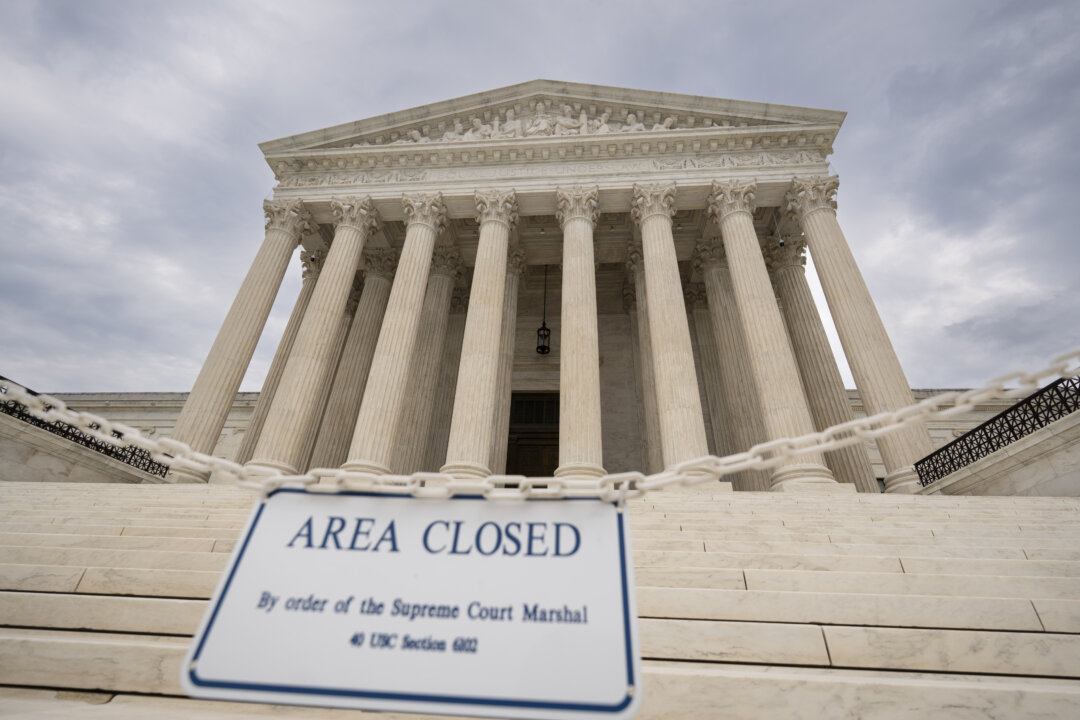
Republican committees have asked the U.S. Supreme Court to allow them access to lowest-rate television ads before the November midterms after a federal appeals court ruled that only candidates are entitled to the special campaign rate required by law.
The emergency application by the National Republican Congressional Committee (NRCC) and the National Republican Senatorial Committee (NRSC), which was docketed on Aug. 31, has been presented to Chief Justice John Roberts. Roberts may act on it by himself, or he may refer it to the full court.
Roberts has directed the respondents—former Sen. Sherrod Brown (D-Ohio); Sen. Jon Ossoff (D-Ga.); former North Carolina Gov. Roy Cooper, a Democrat; and Rep. Kristen McDonald Rivet (D-Mich.)—to file a response to the application by midday on Sept. 3. Brown, Ossoff, and Cooper are currently running for the Senate; Rivet is seeking reelection to the House.
The NRCC and NRSC view the matter as urgent because Sept. 4 is the first day of the 60-day period before the Nov. 3 midterm elections, when federal law requires broadcasters to sell candidates airtime at their cheapest rate. They are asking the Supreme Court to put the appeals court ruling on hold before that window opens. If the high court does not do so, they say they will have to pay full freight for the rest of the campaign cycle, and that stations have already begun to cancel the cheaper reservations they previously made.
The federal Communications Act provides that in the 45 days before a primary election and 60 days before a general election, broadcasters must charge legally qualified candidates no more than the lowest rate offered to their most favored customers. This is known as the Lowest Unit Rate rule. The rule does not apply to streaming and social media ads.
In March of this year, the staff of the Federal Communications Commission’s (FCC’s) Media Bureau issued an interpretive guidance reminding both television and radio broadcasters about the rule. The public notice reiterated that favorable rates must be provided to “authorized committees that engage in joint fundraising with legally qualified candidates” and to “advertisements that qualify as coordinated expenditures.”
The respondents appealed the notice to the full FCC, and when it failed to rule, they argued that it amounted to constructive denial of the appeal and took the matter to the U.S. Court of Appeals for the Fourth Circuit.
They argued that the Communications Act requires the cheap airtime rate be given to candidates, not political parties. They also said that when a party buys an ad that a candidate approves, it is the party spending its own money—not the candidate, and if the candidate rate still applied, it would constitute an illegal gift to the candidate’s campaign.
A panel of the appeals court agreed with the respondents, voting 2–1 to vacate the notice.
The panel held that the lowest unit charge applies only to a legally qualified candidate, not to party-coordinated ads and joint fundraising committee ads with non-candidate members. The panel also determined it had jurisdiction, or authority, to hear the case even though the full FCC had not yet completed reviewing the notice.
A dissenting judge said the court should not have reviewed the guidance while it was pending at the FCC and that barring parties from the discount rate restricted political speech on the eve of an election.
The NRCC and NRSC said in the application that the Fourth Circuit erred and that its decision is hurting the two committees.
“In the midst of election season, a divided Fourth Circuit panel just rewrote longstanding rules about preferential broadcast rates for political ads,” at the behest of Democratic candidates “who said those rules favor their electoral opponents,” the Republican committees said.
The panel’s decision violates two jurisdictional principles and splits with multiple federal courts of appeals, while it “restrict[s] political speech in the sensitive period leading up to an election,” they said.
The Fourth Circuit ruling also ignores the Supreme Court’s recent instruction that courts should not treat incomplete agency work as final for purposes of filing an appeal, they added.
The two committees have budgeted tens of millions of dollars for ad purchases based on the rules that were in effect before the panel ruled, “but because of the Fourth Circuit’s decision, broadcast stations are already rescinding those rates,” they said.
The circuit court denied a request to pause its order on Aug. 27 and allowed its ruling to take effect the same day.
The NRCC and NRSC asked the Supreme Court justices to act before Sept. 4. The Trump administration weighed in to support the application.
Justice Department Solicitor General D. John Sauer is arguing that the respondents are appealing prematurely, lack standing to challenge the FCC notice, and have mischaracterized it, according to his brief.
The notice “does not grant favored treatment to one side or the other; instead, the notice’s interpretation offers the same benefit to all sides, including the challengers themselves,” he said.
We had a problem loading this article. Please enable javascript or use a different browser. If the issue persists, please visit our help center.